NUTRITIONAL DISORDERS
The mouth is a sensitive indicator of nutritional status because of the assorted hard and soft tissues of the oral cavity and the specific nutritional needs of each. Frequently, oral manifestations of nutritional disorders reflect the initial sign of a deficiency. The severity of oral involvement is generally not proportional to the nutritional shortage, nor are there oral clinical characteristic specific to any one nutritional disorder. Rather, the oral features are variable in their appearance and a careful physical examination, history, laboratory studies, and a high degree of suspicion are recquired to diagnose specific disorders.
Vitamin C Deficiency
Scurvy, or vitamin C deficiency, develops predominantly in individuals who do not consume fruits and vegetables. More than 50% of patients with scurvy develop a hemorrhagic gingivitis. The interdental papillae are the initial sites of involvement and become reddened and edematous. Tiny hemorrhages appear on the tips of the papillae. The disease proceeds to the marginal and attached gingiva with the development of erythema, desquamation, and ulcerations. scorbutic gingivitis is painful and causes profuse bleeding asa a result of impaired collagen formation and defects in capillary walls attributed to vitamin C defficiency. In adults, with low plasms ascorbic acid levels, oral mucosal changes include petechiae, lichenoid lesions, and most frequently, leuplakia.
CONNECTIVE TISSUE DISORDERS
A number of connective tissue diseases display oral manifestations that may aid in establishing a diagnosis. For example, linear scleroderma causes characterisctic oral changes as well as cutaneous changes.
Sjogren's Syndrome
Sjogren's syndrome is an autoimmune disease that affects as many as 3% of women older than 55 years. Apart from dryness of the eyes and mucous membranes, which are the most common clinical findings, systematic involvement frequently results in significant morbidity. This includes myositis, central, peripheral nervous system involvement, interstitial lung disease, hypergammaglobulinemic purpura, renal tubula acidosis, and vasculitis.
Symptoms associated with keratoconjuctivitis sicca(dry eyes) include photophobia, burning, itching, and an inability to produce tears. An abnormal Schirmer's test is the most sensitive method of determining ocular involvement in patients with Sjogren's syndrome.
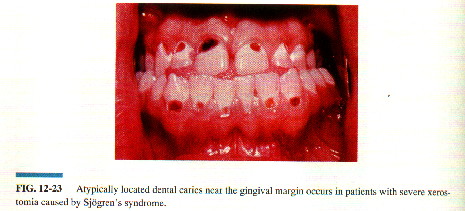
The oral manifestations of Sjogren's syndrome are not specific to disease entity beause they occur in other conditions in which salivary funtion is diminished. Xerostomia results in pronounced syptoms including oral dryness, burning mucous membranes(especially of the tongue), and difficulty in swallowing and speaking. An increased teeth correlates directly with a prolonged oral sugar clearance time in patients.
The damage of the salivary gland parenchyma is progressive ad irreversible. In the eary stages, symptomatic treatment of xerostomia includes stimulating salivary secretion with physiologic sialogogues or pharmacologic agents such as pilocarpine. In the advanced stages when the saliva cannot be stimulated, saliva substiues may be tired, although many patients do not find them satisfactory. Rampantcaries can be prevented by optimal oral hygeine, frequent applications of topical flouride, and avoidance of sweets between meals. Oral candidiasis is a frequent complication in patients, and predisposing factors such as poor oral hygeine and ill-fitting dentures should be corrected.