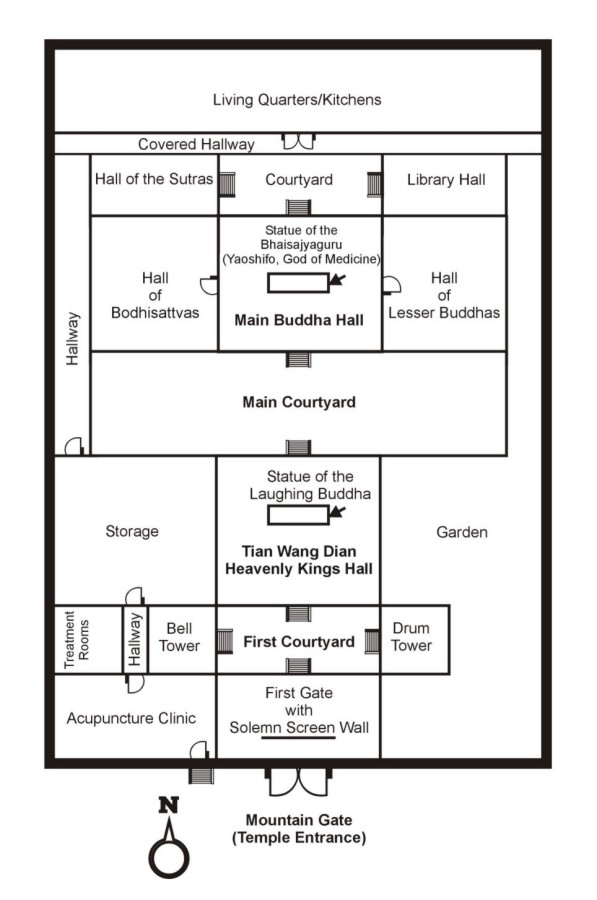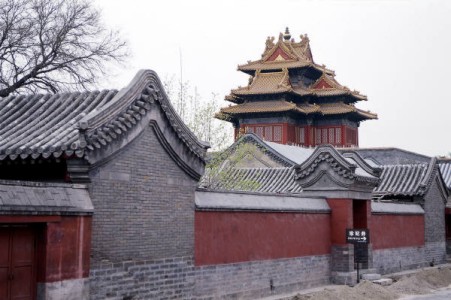
At the south, the main entrance is called the Shan Men (Mountain Gate). Directly following the gate is small wall/divider to prevent people from seeing directly into the temple. After entering this hall, there is a courtyard, called the forecourt. The Bell Tower and Drum Towers are two-storied structures set symmetrically on either side.
The next structure, Tian Wang Dian (Heavenly Kings Hall) is the first main hall on the axis. In this hall, a smiling Maitreya (known in the West as "Laughing Buddha") is set on the middle alter. Four fierce-looking Heavenly Kings (warrior guardians) stand in two groups on either side.
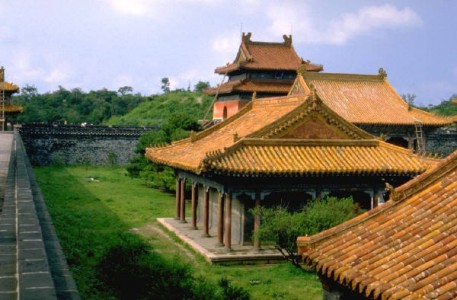
Leaving the Heavenly Kings Hall, you enter a second courtyard. This is now the principle part of the temple which includes the Main Buddha hall, and several flanking rooms. The Main Hall stands on a high terrace or foundation with marble balustrades. This hall is called the Hall of the Bhaisajyaguru Buddha. This means that the Golden Temple is dedicated to a Buddha of healing, and that according to the rules of the temple, no creature may be harmed within the walls -- not even an insect. A huge bronze incense burner or "Ding" is inside the Main Hall, in front of the statue of Bhaisajyaguru, for people burn incense in prayer.
Behind the Main Buddha Hall is another courtyard. On either side is a libary hall and a two story tower in which the Buddhist sutras, scriptures, and books are kept. It is called the Cang Jing Ge, or Sutra Keeping Tower.
Finally the rooms to the back are doormitories and kithens. On the western side of the temple, ther is an acpuncture clinic, open to the public, with a separte door that leads into the clinical section only. On the eastern side, there is a well, cultivated garden, with beautiful trees and flowering plants.
For a rough idea of the temple's layout, see below: