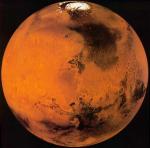
The Viking and Global Surveyor probes analyzed gases in the Martian atmosphere and determined atmospheric pressure and temperature. They found that Mar�s atmosphere is much thinner than Earth�s. It is composed mostly of carbon dioxide, with some nitrogen and argon. Surface temperatures range from -125�C to 35�C. The temperature difference between day and night results in strong winds on the planet, which can cause global dust storms during certain seasons.
Mars is tilted on its axis by 25�C, which is close to Earth�s tilt of 23.5�C. Because of this, Mars goes through season as it orbits the Sun, just like Earth does. The polar ice caps get larger during the Martian winter as ice collects on their surface. The ice caps shrink during the summer. As one ice cap shrinks, the other expands, and both their surfaces change color during different seasons. Wind causes this seasonal change in the coloration of the Martian surface. When the seasons change, winds blow the dust around on the planet�s surface. As dust blows off one area, it might look darker.
Mars has two small, irregularly shaped moons that are heavily cratered. Phobos, shown in Figure 3, is about 25 km in length, and Deimos is about 13 km in length. Deimos orbits Mars once every 31 h, while Phobos speeds around Mars once every 7 h.
Phobos has grooves on its surface that seem to radiate out in all directions from the giant Stickney Crater. Some of the grooves are 700 m across and 90 m deep. Phobos�s orbit is spiraling slowly inward toward Mars. It is expected to crash into the Martian surface in about 50 million years.
Mars's Atmosphere
Martian Moons
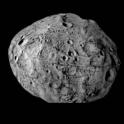 |
Figure 3: Phobos |
Deimos is the outer of Mars�s two moons. It is among the smallest known moons in the solar system. Its surface is smoother in appearance than that of Phobos because some of its craters have partially filled with soil and rock.
As you toured the inner planets through the eyes of the space probes, you saw how each planet is unique.