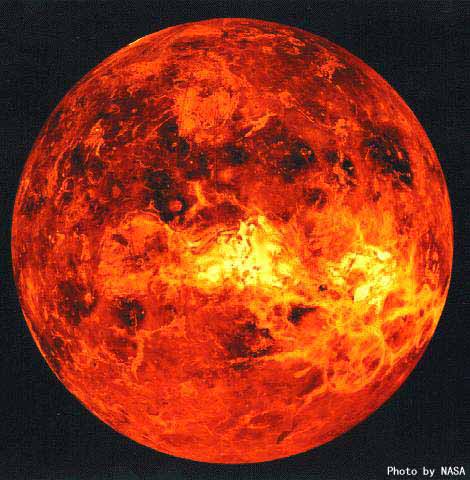
The second planet from the Sun is Venus. Venus is sometimes called Earth�s twin because its size and mass are similar to Earth�s. In 1962, Mariner 2 flew within 34,400 km of Venus and sent back information about Venus�s atmosphere and rotation. The former Soviet Union landed the first probe on the surface of Venus in 1970. Venera 7 , however, stopped working in less than an hour because of the high temperature and pressure. Additional Venera probes photographed and mapped the surface of Venus using cameras and radar. Between 1990 and 1994, the U.S. Magellan probe used its radar to make the most detailed maps yet of Venus�s surface. It collected radar images of 98% of Venus�s surface.
Clouds on Venus are so dense that only a small percentage of the sunlight that strikes the top of the clouds reaches the planet�s surface. Much of the solar energy that does reach the surface is trapped by carbon dioxide gas in Venus�s atmosphere. This causes a greenhouse effect similar to, but more intense than, Earth�s greenhouse effect. Due to this intense greenhouse effect, the temperature on the surface of Venus is between 450�C and 475�C.