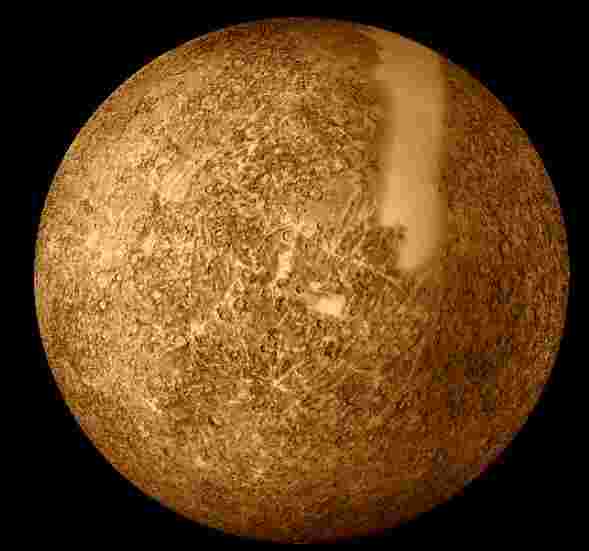
The closest planet to the Sun is Mercury. It is also the second-smallest p1anet.The first American spacecraft mission to Mercury was in 1974-1975 by Mariner 10. The spacecraft flew by the planet and sent pictures back to Earth. Mariner 10 photographed only 45% of Mercury�s surface, so scientists don�t know what the other 55% looks like. What they do know is the surface of Mercury has many crates and looks much like Earth�s Moon. It also has cliffs as high as 3km on its surface. These cliffs may have formed at a time when Mercury apparently shrank in diameter.
Mariner 10 detected a weak magnetic field around Mercury. This indicates that the planet has an iron core. Some scientists hypothesize that the crust of Mercury solidified while the iron core was still hot and molten.
As the core cooled and solidified, it contracted. The cliffs might have resulted from breaks in the crust caused by this contraction.
Because of Mercury� small size and low gravitational pull, most gases that could form an atmosphere escape into space. Mariner 10 found traces of gases that were first thought to be an atmosphere. However, these gases are now known to be temporarily trapped hydrogen and helium from the solar wind. Mercury traps these gases and holds them for just a few weeks.
Earth-based observations have also found traces of sodium and potassium around Mercury. Scientists think that these atoms come from rocks in the planet�s crust. Therefore, Mercury has no true atmosphere. This lack of atmosphere and the nearness of Mercury to the Sun cause this planet to have great extremes in temperature. Mercury�s surface temperature can reach 425�C during the day and it drop to -170� at night.
Why would Mercury have shrunk?
Does Mercury have an atmosphere?