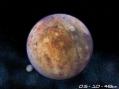
The smallest planet in the solar system, and the one scientist know the least about, is Pluto. For 20 years of its 249-year orbit, Pluto is closer to the Sun than Neptune. However, because Pluto is farther from the Sun than Neptune during most of its orbit, it is considered to be the ninth planet from the Sun. From Pluto�s surface, the Sun would appear as only a bright star. Pluto is vastly different from the outer planets. It�s surrounded by only a thin atmosphere, and it�s the only outer planet with a solid, cry-rock surface.
Pluto�s single moon, Charon, has a diameter about half the size of Pluto�s. It was discovered in 1978 when a bulge was noticed on a photograph of the planet. Later photographs, taken with improved telescope, showed that the bulge was a moon. Because of their close size and orbit, some scientists consider them to be double planet.
Data from the Hubble Space Telescope indicate the presence of a vast disk of icy comets called the Kuiper Belt near Neptune�s orbit. Some of the comets are hundreds of kilometers in diameter. Are Pluto and Charon members of this belt? Or did they simply from at the distance where they are? Scientists might mot find out until a probe is sent to Pluto.
Pluto�s Moon
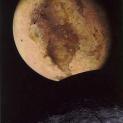 |
Figure 4: Charon |