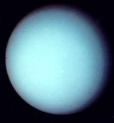
Beyond Saturn, Voyager 2 flew by Uranus in 1986. Uranus (YOOR uh nus) is the seventh planet from the Sun and was discovered in 1781. It is a large, gaseous planet with 21 satellites and a system of thin, dark rings. Three of its satellites were identified in 1999 from Earth-based observations. Most of the rings of Uranus are less than 10 km across. Two of Uranus�s moons, Cordelia and Ophelia, keep the outer ring from dispersing into space.
The atmosphere of Uranus is composed of hydrogen, helium, and some methane. Methane gives the planet the bluish-green color. Methane absorbs the red and yellow light, and the clouds reflect the green and blue. Few cloud bands and storm systems can be seen on Uranus. Evidence suggests that under its atmosphere, Uranus has a mantle of liquid and solid water, methane, and ammonia surrounding a rocky core.
Uranus�s Characteristics