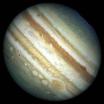
In 1979, Voyager 1 and Voyager 2 flew past Jupiter, the largest planet and the fifth planet from the Sun. Galileo reached Jupiter in 1995. The spacecrafts gathered new information about Jupiter�s atmosphere and discovered three new moons. Voyager probes also revealed that Jupiter has faint dust ring around it and that one of its moons has volcanoes on it.
Jupiter is composed mostly of hydrogen and helium, with some ammonia, methane, and water vapor. Scientists hypothesize that the atmosphere of hydrogen and helium gradually changes to a planet wide ocean of liquid hydrogen and helium toward the middle of the planet. Below this liquid layer might be a solid rocky core. The extreme pressure and temperature, however, would make the core different from any rock on Earth.
Jupiter�s Atmosphere
At least 28 moons orbit Jupiter. In 1610, the astronomer Galileo Galilei was the first person to see Jupiter�s four largest moons, shown in Table 2.
Moons of Jupiter
Table 2: LARGE MOONS OF JUPITER
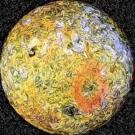
Io
The most volcanically active object in the solar system; sulfurous compounds give it its distinctive reddish and orange colors; has a thin oxygen, sulfur, and sulfur dioxide atmosphere.
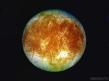
Europa
Rocky interior is covered by a 100-km-thick crust of ice, which has a network of cracks, indicating tectonic activity; an ocean might exist under the ice crust; has a thin oxygen atmosphere.
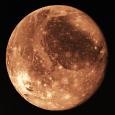
Ganymede
Has a crust of ice about 100 km thick, covered with grooves; crust might surround an ocean of water or slushy ice; has a rocky core and a thin oxygen atmosphere.
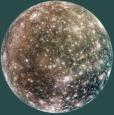
Callisto
Has a heavily cratered crust of ice and rock several hundred kilometers thick; crust might surround a salty ocean around a rock core; has a thin atmosphere of carbon dioxide.