Candlepin Bowling Basics
Candlepin bowling was invented in the late 19th century in Worcester, Massachusetts, as an alternative to Ten Pin bowling that some felt was too easy to get a perfect score (300). The highest score in candlepin bowling is 245 and scores over 200 are only achieved by the very best bowlers once in a blue moon. Most league bowlers hold an average between 80 and 100.
Candlepin bowling is very similar to the more widely known ten pin bowling game. There are 10 pins, set up in rows, 1 in the first row, 2 in the second, 3 in the third, and 4 in the fourth. Each pin is about 15 inches tall and 2* inches in diameter. The pins are 2-15/16" in diameter in the center and taper to 1-3/4" at the ends and are set 12 inches apart from each other on the lane.
The balls used are 4* inches in diameter and weigh between 2 lbs. 4 oz. and 2 lbs. 7 oz. The lanes are 45 inches wide and 60 feet long from the foul line to the head pin (the pin closest to the bowler). On each side there are gutters that catch balls that fall off the edge of the lane.
Scoring is fairly simple, as long as the bowler isn't that good. A game, or "string", of bowling is broken into 10 frames, or "box", and in each frame the bowler gets 3 chances to knock down as many pins as possible. The score for that frame is the number of pins knocked down. If the ball goes into the gutter before hitting anything, all the pins that fall with that ball do not count, so the most the frame can be worth is 10 minus the pins that fell. Now comes the difficult part... If the bowler gets all the pins down on the first ball, that's a strike, or if it takes only two balls, it's a spare. On a strike, whatever the bowler gets with the first two balls of the next frame is added to the ten from the strike for the previous frame. On a spare, just the first ball from the next frame is added. So if the bowler gets a strike and hits 8 pins with the first two balls on the second frame, he gets an 18 for the first frame and he has one last ball to get a 10 on the second frame.
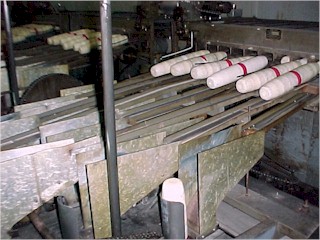
The pin-setting machines, now you know they don't make new pins every time
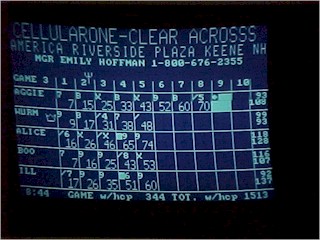
Computer scoring can make this problem all but disappear, and many bowling alleys are going to a semi-automatic or fully automatic scoring system. Semi-automatic scoring just requires someone to push in the numbers on a keypad and the computer adds everything, including spares and strikes. Automatic scoring means you throw the ball and the score appears on the screen, you don't even have to push a button to reset the lanes, that's automatic too.