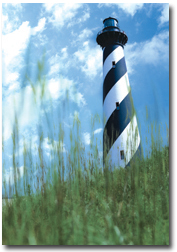
The beautiful Cape Hatteras National Seashore stretches across over 75 miles of beautiful beaches and small fishing towns and covers 30,000 acres. It reaches from South Nags Head to Ocracoke Inlet, which includes all of Hatteras Island. It was the very first national seashore in the nation. It includes both natural and historic attractions, like lighthouses and lifesaving stations, picnic places, and camping grounds. The shoreline is completely untouched, except for 8 small fishing towns that are located on the wider areas of Hatteras Island. The National Park Service controls the beaches and dunes, and tries to keep the many storms from washing away the island.
I myself have been to the Outer Banks several times. My most recent trip was last summer, in 2005. I also went in the eighth grade (2002) with my class and a few times before when I was younger. If you continue to my next page, you will find pictures of my Outer Banks experience. These pictures are not just limited to Hatteras Island, since we visited many sites along the Outer Banks.
Or you can click here to return to my home page about Hatteras Island.
Click here to return to my main menu page.
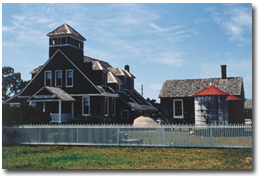 The Chicamacomico Life Saving Station, which is made up of seven buildings on both the National and State Historic Registeries, is located on Highway 12 in Rodanthe. It is the most complete life saving station remaining in America. It was one of the first of its kind to appear on the shores of the United States. The oldest building was built in 1874, and is currently being restored to its original condition. The main station, which was built in 1911 and modified in 1928, is used as a museum. Some of the other buildings are open to the public, but not all of them. The buildings that are open hold displays of the Livesaving Service, which eventually led to the formation of the Coast Guard, and also houses recovered artifacts from shipwrecks. You do have to pay: $5 general admission or $4 for senior citizens and AAA members.
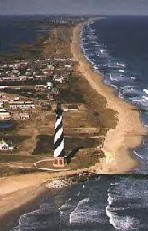
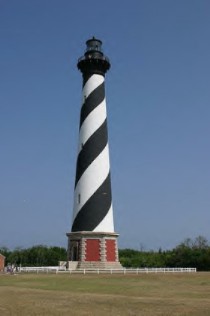 At 208 feet, the Cape Hatteras Lighthouse is the tallest in the nation. It's unique black and white candy cane paint scheme is unforgettable. Its beacon is too, since it can be seen 20 miles out at sea, warning sailors of the treacherous sand bars. The lighthouse that is so "unforgettable" is the second structure of three that have stood on the cape. The first tower was completed in 1804, but its light was damaged by Union shells in 1861. The retreating Confederate soldiers took the lamp from the lighthouse, and it was not found until recently. Today's well-known tower was erected in 1870 by the US Lighthouse Board, and a first order Fresnel lens magnified the small flame at the top for the first time on December 16, 1870. In 1935, the lens was vandalized after the federal government abandoned the lighthouse. A temporary steel structure was placed not far from the present tower. The present tower was put back into operation on July 23, 1950 when the light from the temporary tower was moved. The lamp was replaced with a rotating dual beacons with 1000 watt lamps, which allows for 20 mile visibility. Some reports have claimed that they have seen the light 51 miles at sea and 115 miles in air. In March of 1999, the beacon was extinguished in preparation for its big move. The lighthouse was moved in 1999, a half-mile from its original position, in order to keep it safe from hurricanes and the ocean's eroding waves. The move was accomplished in just 23 days, and the lighthouse now sits securely, away from the treacherous waves. A relighting ceremony was held in November of 1999 and the lighthouse itself reopened in May of 2000. There is a fee to climb the lighthouse: $6 for adults, $3 for children 12 and under, and $3 for seniors 62 and older. The lighthouse is open from Good Friday to Columbus Day, weather permitting.
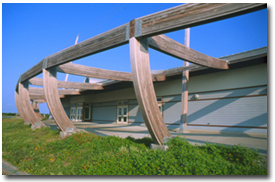 The one-of-a-kind Graveyard of the Atlantic Museum is dedicated to preserving and understanding all of the maritime history of the Outer Banks, along with the 1500+ shipwrecks off the coast that claimed the lives of so many people. This museum lies at the end of Highway 12 in the village of Hatteras; just next to the Ferry Landing for Ocracoke Island. There is some construction being finished up, but a section of the museum is open to the public. There, you can find collections on display that include the "Lost Lens" from the first Cape Hatteras Lighthouse and a part of the Enigma machine from the German u-boat that crashed off the shores of the Outer Banks. Also on display are Billy Mitchell's historic bombing tests off the Cape Hatteras coast, the Huron and the Ghostship Carroll A. Deering. These aren't the only exhibits to be seen. There are several ship models, and other exhibits on display as well.
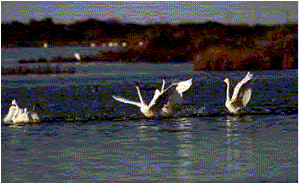 You will find Pea Island National Wildlife Refuge as soon as you cross the Oregon Inlet Bridge, coming from Nags Head. This 6,000-acre refuge stretches from Oregon Inlet to Rodanthe, and is home to over 360 types of birds. From the beginning of spring through the fall, you will find several types of wading, shore, and upland birds. There are observation platforms where you can stand and watch them all, or you can watch from an observation tower. The refuge is open during daylight hours every day. There is no cost to view the animals, and for a fee, you can take a guided canoe tour.
 At this museum, you will find a collection of nationally recognized Native American artifacts, natural history displays, and exhibits. There are several galleries that hold native art and information on Native Americans from all across the United States. There are also artifacts from the first inhabitants on Hatteras island. The museum has been designated as a North Carolina Environmental Education Center. Along with the museum itself, the site also has several acres of nature trails that wind through the thick woods. Along the trails are exhibits and accomodations for those who are visually impaired. The museum is located in the village of Frisco, on Highway 12 and is open from 11:00 AM to 5:00 PM on Tuesdays through Saturdays. There is an admission: $2 for an individual, $5 for a family, and $1.50 for senior citizens.
Last Updated: February 21, 2006