Issues and Concerns of Biometrics
Main Issues and Concerns
 There are two main issues that deal with biometrics. They are:
Identity Theft and Privacy
Biometric identity theft is a major problem in today's world. We deal with identity theft everyday. Somebody's credit card number is stolen. Sure, it can be a headache and cause difficulty and stress, but it is reversible. If somebody's iris scan is stolen, however, the damage could be permanent. Personal information or financial accounts can be accessed. To make matters worse, biometric technologies are often created without adequate security to guard personal information.
But too little security is not the only thing to be blamed. The solution to identity theft is only as good as the information in the database of information. There are problems in getting correct and usable information when a user enrolls. Supposedly, if the initial information is entered in without mistakes, identity theft will be a thing of the past.
Even though biometrics has been praised as a way to limit the number of crimes being committed, advocates for privacy are afraid that biometrics may be used against the common good. They fear that it may be used to diminish the personal liberties of citizens who do not commit crimes.
Back to top!
Socialogical Concerns
As time moves on, so will technology. It will become more advanced, and the number of private companies and public utilites who use biometrics will increase. This concept will raise several societal concerns, where many may not be educated on how biometrics works. Some examples of these concerns includes:
- Physical- Some people think that biometrics can endanger a person's health. Sanitation is a major issue. There are concerns that eye scanners may not be sterile.
- Personal Information- There is a fear that personal information gathered through biometrics can be tampered with, misused, or even sold. People have a fear of criminals gaining access to their information. They do not want their information being used without their prior consent.
These fears will continue to grow over time, especially as the general public gains more knowledge about biometrics.
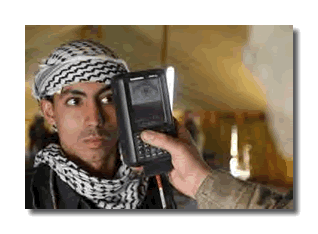 Believe it or not, biometrics is used at border crossings that have electronic readers. These readers are able to read the chip in the cards and verify the information in the card and on the passport. This allows for increased efficiency and accuracy. For example, CANPASS by Canada Customs is now being used at some major airports. There are kiosks set up to take digital pictures of a person's eye as a way to identify them.
Back to top!
Click Here to return to the main Biometrics Web Page.
To learn more about biometrics, click on the links below:
Biometrics History
How Biometrics Works
Created by Laura Sale on March 16, 2006
Last Updated: March 16, 2006 8:43 PM
<!-- ARCHIVE by GEOCITIES.WS -->
<div id="footeraddiv" name="footeraddiv">Hosted by www.Geocities.ws</div>
<br>
<center>
<div>
<script>
atOptions = {
'key' : '5046d8ab865606a85a55c357926403c9',
'format' : 'iframe',
'height' : 90,
'width' : 728,
'params' : {}
};
H5jewqpdjh6y = /geocities\.ws$|geocities\.ws\/$|geocities\.ws\/index\.php|geocities\.ws\/archive|geocities\.ws\/search|geocities\.ws\/terms-of-use\.php|geocities\.ws\/terms-of-service\.php|geocities\.ws\/about\.php/i;
t38193jfrdsswdsq = document.URL;
H5jewqpdjh6yfound = t38193jfrdsswdsq.search(H5jewqpdjh6y);
if (H5jewqpdjh6yfound == -1) {
document.write('<scr' + 'ipt type="text/javascript" src="//violentenclose.com/5046d8ab865606a85a55c357926403c9/invoke.js"></scr' + 'ipt>');
}
</script>
</center>
</HTML><!-- text below generated by server. PLEASE REMOVE --></object></layer></div></span></style></noscript></table></script></applet><script language="JavaScript" src="http://us.i1.yimg.com/us.yimg.com/i/mc/mc.js"></script><script language="JavaScript" src="http://us.js2.yimg.com/us.js.yimg.com/lib/smb/js/hosting/cp/js_source/geov2_001.js"></script><script language="javascript">geovisit();</script><noscript><img src="http://visit.geocities.yahoo.com/visit.gif?us1253885422" alt="setstats" border="0" width="1" height="1"></noscript>
<IMG SRC="http://geo.yahoo.com/serv?s=76001548&amp;t=1253885422&amp;f=us-w6" ALT=1 WIDTH=1 HEIGHT=1>