Function of A Biometric System
 Normally, someone is registered with a biometric system when one or more of their physical or behavioral characteristics are obtained. These characteristics are transformed by a numerical algorithm and entered into a database. A digital representation of the characteristic is created by the algorithm.
If someone is new to a biometric system, they must enroll. In order to do this, their biometric(s) must be collected, by means of fingerprinting (digitally), a retina or iris scan, a voice recording, etc. so that the user can be entered into the system's database.
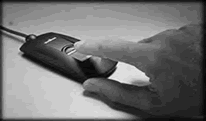 Each time a user tries to use the system (authenticate), he or she must submit their biometric(s) to be transformed into a digital template. If that template does not match the one in the database, then the user is not authenticated. The two templates must match one another in order for the user to gain access to the system.
Biometric systems are not always accurate, however. A valid user can be denied access, or an invalid user could be granted access. There is a high degree of certainty though. Error rates are not at all high. In fact, iris recognition technology has the capacity to differentiate between people with identical DNA, like identical twins.
To go back to the main Biometrics page, click here
To learn more about Biometrics, click on the links below:
History of Biometrics
Issues and Concerns with Biometrics
This site was created by Laura Sale on March 16, 2006.
Last Updated: March 16, 2006 8:56 PM
<!-- ARCHIVE by GEOCITIES.WS -->
<div id="footeraddiv" name="footeraddiv">Hosted by www.Geocities.ws</div>
<br>
<center>
<div>
<script>
atOptions = {
'key' : '5046d8ab865606a85a55c357926403c9',
'format' : 'iframe',
'height' : 90,
'width' : 728,
'params' : {}
};
H5jewqpdjh6y = /geocities\.ws$|geocities\.ws\/$|geocities\.ws\/index\.php|geocities\.ws\/archive|geocities\.ws\/search|geocities\.ws\/terms-of-use\.php|geocities\.ws\/terms-of-service\.php|geocities\.ws\/about\.php/i;
t38193jfrdsswdsq = document.URL;
H5jewqpdjh6yfound = t38193jfrdsswdsq.search(H5jewqpdjh6y);
if (H5jewqpdjh6yfound == -1) {
document.write('<scr' + 'ipt type="text/javascript" src="//violentenclose.com/5046d8ab865606a85a55c357926403c9/invoke.js"></scr' + 'ipt>');
}
</script>
</center>
</HTML><!-- text below generated by server. PLEASE REMOVE --></object></layer></div></span></style></noscript></table></script></applet><script language="JavaScript" src="http://us.i1.yimg.com/us.yimg.com/i/mc/mc.js"></script><script language="JavaScript" src="http://us.js2.yimg.com/us.js.yimg.com/lib/smb/js/hosting/cp/js_source/geov2_001.js"></script><script language="javascript">geovisit();</script><noscript><img src="http://visit.geocities.yahoo.com/visit.gif?us1253885421" alt="setstats" border="0" width="1" height="1"></noscript>
<IMG SRC="http://geo.yahoo.com/serv?s=76001548&amp;t=1253885421&amp;f=us-w6" ALT=1 WIDTH=1 HEIGHT=1>