1. Measurements of necessary constants
| Object |
Weight, Unit : ( ) |
Diameter, Unit: ( ) |
|
Small ball |
|
|
|
Big ball |
|
|
2. Measurements of gravity, g, for the small ball, referring to Page 17:
| (y-y0), Unit: ( ) |
Five elapsed time, Unit:( ) |
t average ( ) |
D tRMS( ) |
||||
|
t1 |
t2 |
t3 |
t4 |
t5 |
|||
|
|
|
|
|
|
|
||
|
|
|
|
|
|
|
||
|
|
|
|
|
|
|
||
|
|
|
|
|
|
|
||
|
|
|
|
|
|
|
||
Calculate t average (1 point) and D tRMS (1 point) with only one sample calculation.
3. Results of Analysis, for the small ball:
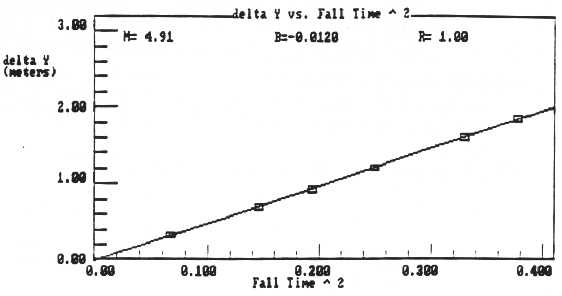
Plot "y-y0 vs. t" graph on screen. Modify “t average” to get Graph "d versus t average 2." (0.5 point)
Print out the modified graph with “statistics” for modified data and find out "g fitted".
Calculate %error: g true = 9.795 m/s2 , σg = standard deviation of slope
(0.5 point) [(g fitted - g true) / g true] ´ 100%=
(0.5 point) (2σg / g fitted ) ´ 100%=
4. Do "2" and "3" again for the big ball. For your "(y-y0) vs. taverage2", Accuracy, and Precision, each, 0.5 point is.
5. This additional part regarding "air resistance" is for the questions and the remarks on page 15.
|
|
g average, Unit:( ) |
A/m, Unit:( ) |
|
Small ball |
|
|
|
Big ball |
|
|
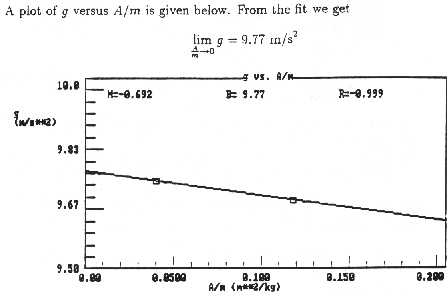
Plot and print "gaverage vs. A/m."
"A" is the shadow area of the body projected on a horizontal plane. For a ball, A=p R2.
This is a Sample Graph for your practice only.
"m" is the mass of the ball.
You have only two data points for this graph, which are associated with two balls.
Additional Question 1, Comparison, 1 point
Consider that the magnitude of air resistance is proportional to "A/m". Based on "gaverage vs. A/m", we have an empirical relation between g average and A/m. Please write it down as Y= [M]X + [B] and plug in the values of [M] and [B] you have.
Additional Question 2, Errors, 1 point
Here is a follow-up. Define that [%error]g = |[( g average - g true) / g true] ´ 100%|. Now, let's say that the reasonable percentage error of g average is [%error]g <1%, or -1%< [(g average - g true) / g true] ´ 100%] <1%. What are the upper and lower bound of “A/m” to get the reasonable percentage error of g average ?
In other words, if “A1/m1”<“A/m”<“A2/m2”, what are your numerical values of “A1/m1” (0.5 point) and “A2/m2” (0.5 point) when [%error]g <1%?
Question 3, Application of Graph “g average versus A/m”, 1 point
It is on Page 12. “From g values measured with two different size balls, can the measured g be extrapolated to A/m=0?” It will be easier, at first, to figure out the physical situation of a ball as “A/m” goes to 0.
Answer all three additional questions.
