|
|||||||||||||||||||||||||||||||||||||||||||||||||||||||||||||||||||||||||||||||||||||||||||||||||||||||||||||||||||||||
 Nowhere Man will argue that mankind was a special creation. The first man was a distinct species, created perfect, about 6,000 years ago. The Biblical Adam & Eve were the first human couple and have since propagated the entire human race. The current imperfections in mankind (including ageing and death) are a direct result of God withdrawing his holy spirit, or active force from mankind after Adam's original sin. Nowhere Man will argue that the evidence is most consistent with this view.
 Lilith will argue that mankind has descended, by way of the current scientific view of evolution, from a common ancestor with modern primate species. The most recent common ancestor of all mankind is substantially older than 6,000 years. Mankind was not a special creation and is another branch on the tree of life. The current imperfections in mankind (including ageing and death) are due to imperfect blind evolutionary processes. Lilith will argue that the evidence is most consistent with this view.
| Round 1 | Round 2 | Judgement Call | End of Debate | |||||
|---|---|---|---|---|---|---|---|---|
| Nowhere Man 2003-05-08 20:03:26 PST |
Lilith 2003-05-11 20:15:17 PST |
Nowhere Man 2003-05-18 19:21:27 PST |
Lilith 2003-05-24 05:25:21 PST |
Nowhere Man 2003-06-05 02:54:17 PST |
Judgement Call 2003-06-19 07:45:19 PST |
Lilith 2003-06-20 08:20:30 PST |
Judges 2003-08-25 05:30:40 PST |
|
 |
|
|
|
|
|
|
|
|
|
Before this debate is over I will have demonstrated how the most plausible explanation for human origins is creation. Before I can do that we need to review all the general data. I hope that we can end this debate before having to go into the details. Terms Introduced in this Post Human: A member of the genus Homo and especially of the species H. sapiens. [Dictionary.com] A healthy human can learn language and read the Bible. A species that cannot learn languages after birth and learn to read the Bible is not human for this debate. Ape: Any of various large, tailless Old World primates of the family Pongidae, including the chimpanzee, gorilla, gibbon, and orangutan. [Dictionary.com] Not a human. |
On my part, I hope we can spend as much time on the details as necessary. Terms used in this post (additional non-applicable definitions from [ref 1] elided): Human: A member of the genus Homo and especially of the species H. sapiens. Empirical: 1a. Relying on or derived from observation or experiment: empirical results that supported the hypothesis. 1b. Verifiable or provable by means of observation or experiment: empirical laws. 2. Guided by practical experience and not theory, especially in medicine. [ref 1] Parameter: (2). One of a set of measurable factors, such as temperature and pressure, that define a system and determine its behavior and are varied in an experiment. [ref 1] Induction: a. The process of deriving general principles from particular facts or instances. 2. A conclusion reached by this process. [ref 1] Hypothesis: A tentative explanation for an observation, phenomenon, or scientific problem that can be tested by further investigation. [ref 1] Scientific method: The principles and empirical processes of discovery and demonstration considered characteristic of or necessary for scientific investigation, generally involving the observation of phenomena, the formulation of a hypothesis concerning the phenomena, experimentation to demonstrate the truth or falseness of the hypothesis, and a conclusion that validates or modifies the hypothesis. [ref 1] Scientific Theory: I paraphrase and add to the definition of the single word "theory" in [ref 1], "A set of statements or principles devised to explain an empirically-observed group of facts or phenomena, especially one that has been repeatedly and successfully tested with the scientific method, widely accepted after many empirical observations and tests of the body of the theory, and can be used to make further predictions about natural phenomena." Species: A taxonomic category subordinate to a genus (or subgenus) and superior to a subspecies or variety, composed of individuals possessing common characters distinguishing them from other categories of individuals of the same taxonomic level. In taxonomic nomenclature, species are designated by the genus name followed by a Latin or Latinised adjective or noun. [ref 2] [cancerweb] (Note: Using absolute reproductive isolation to define species is not adequate). Evolution: Change in the genetic composition (allele frequency) of a population during successive generations, as a result of natural selection acting on the genetic variation among individuals, sometimes resulting in the appearence of a new species. [modified from ref 2] [cancerweb] Evolutionary Theory: The scientific theory that all species originated through the process of evolution. Taxonomy: 1. The classification of organisms in an ordered system that indicates natural relationships. 2. The science, laws, or principles of classification; systematics. [ref 1] For an example of the glorious classification structure of taxonomy, see here. Technology: (Anthropology) The body of knowledge available to a society that is of use in fashioning implements, practicing manual arts and skills, and extracting or collecting materials. [ref 1] |
New Definitions species: A fundamental category of taxonomic classification, ranking below a genus or subgenus and consisting of related organisms capable of interbreeding. [Dictionary.com] My definition means they are genetically capable of interbreeding. So if humans breed them to where they physically can't breed but their DNA is still compatible they are still one species. macroevolution: Large-scale evolution occurring over geologic time that results in the formation of new taxonomic groups. [Dictionary.com] Especially at the genus level but also at the species level. |
Definitions: phenotype: The total characteristics displayed by an organism under a particular set of environmental and internal factors. The phenotype arises both from the expression of the alleles within an individual's genotype and the interaction of the expressed alleles with the environment. As populations have distributions of alleles, the allele types can determine the phenotypes of individuals. genotype: The genetic constitution of an organism or cell, as distinct from its expressed features or phenotype. haplotype: The set, made up of one allele of each gene, comprising the genotype, representative of an individual within a population. There are a finite number of haplotypes within any species. See for instance. SNP (single nucleotide polymorphism): Single-base differences within a genotype. SNPs are one source of variation that gives rise to haplotypes within a population as they are one source of allelic variation. See for instance. dbSNP: A database that catalogs SNPs within gene loci in the human genome. There are currently 518467 known allelic variation SNPs estimated through studies of a limited number of individuals (NCBI, build 114).This number will likely increase as more individuals are studied See for instance. Just some points to consider...wolves and dogs are by his definition one species? Donkeys and horses can interbreed with sterile progeny -- are they by his definition one species? Various conure parrot species can still interbreed even though they, in the wild, would not normally select for a mate with plumage outside their species. These conures have radically different plumage, average body size, behaviors, and natural ranges -- are they one species? Outside of these examples, he may believe that he's just talking about physical reproductive barriers between two members of the SAME species that have been human-bred to differing physical proportions, and not genetic reproductive barriers. For instance, a chihuahua and a great dane are unlikely to breed, yet are still considered canis familiaris. [Definition moved forward from subsequent discussion:] Complex System: Any system which involves a number of elements, arranged in structure(s) which can exist on many scales. These go through processes of change that are not describable by a single rule nor are reducible to only one level of explanation, these levels often include features whose emergence cannot be predicted from their current specifications. Complex Systems Theory also includes the study of the interactions of the many parts of the system. See for example. |
Ok I'm going to have to ask for Lilith to correct a number of errors and fix some things before I can reply. The judges can evaluate my requests and if they seem reasonable then Lilith should fix them before I reply. |
Responce to NM's judgement requests on 6/5/03: (Claims have been paraphrased for clarity) |
[Definition moved forward from subsequent discussion:] Creationism: n. A belief in the supernaturally-directed creation of the universe including all living things, often based on belief in the literal interpretation of religious texts. |
The judges have decided unanimously to close the "Human Origins" debate between Lilith and "Nowhere Man". This decision was made after spending much time and effort attempting to gain Nowhere Man's cooperation through email. Nowhere Man is apparently too pressed for time to complete a reply to Lilith's last post. He has been given time extension after time extension. This decision was made solely on the part of the judges -- Lilith has never requested for the debate to end. Us judges simply got tired of waiting around. We're all busy people and this had been taking our time. As an indication of how long this debate has been going on, during the time of this debate I've been swayed far enough towards the mainstream evolutionary position that I'm not so sure I qualify as a "neutral judge" anymore. Actually, to be more straightforward, I'm not so sure there *is* such a thing as a neutral judge. We will probably not consider reopening the debate in the future unless Nowhere Man is able to demonstrate he can finish it in a timely fashion. Thank you all who have contributed to this debate. Despite all that's happened, I think it's still been an educational experience for everyone. Lilith provided a lot of good information in a short period of time. [link] |
|
|
(Remeber that I use my opponents definitions when replying to her and she should use mine when replying to me) |
Except I see in no place where you used my definitions. I'll point those places out where you go against my definitions. |
|||||||
|
What Is the Most Plausible Explanation? In simple terms the most plausible explanation is the one that explains all the facts, makes the most accurate uses predictions, but the least amount of unexplained things. For example if I say that God causes apples to fall and my opponent says gravity causes apples to fall then both theories make the same predictions and explain the same facts. But my opponent's theory would be better because it does not add the extra intelligent supernatural God. This does not mean the God does not cause apples to fall. He may be the Causer of Gravity but science is not concerned with such untestable things. |
Plausible Explanations and the Scientific Method First, let me say my opponent's use of the word "theory" is correct in colloquial use, but incorrect in a scientific context. [ed: link] I believe my opponent means "hypothesis" here. That said, I would point out, just as an additional pedantic point, that it is not the actual inclusion of the "extra intelligent supernatural God" in the supernatural hypothesis which makes the opposing hypothesis "better". Each scientific hypothesis must be judged on how well it survives the scientific method as defined above, especially "...generally involving the observation of phenomena, the formulation of a hypothesis concerning the phenomena, experimentation to demonstrate the truth or falseness of the hypothesis, and a conclusion that validates or modifies the hypothesis." Therefore, hypotheses are judged as to their success as a predictive mechanism. The hypothesis of "God causes apples to fall" is unable to be applied to any kind of predictive framework for testing. Therefore, on its own, the supernatural hypothesis will not test well as it cannot be verified as true or false, so fails on its own inability to provide predictive empirical power. The comparison of one hypothesis to another is not what determines the fitness of a hypothesis; it is rather the fitness of the individual hypothesis. That said, any supernatural hypothesis must be able to generate "experimentation to demonstrate the truth or falseness of the hypothesis" in order to be tested with the scientific method or it fails before it even reaches the conclusion stage. |
You suggest that my theory is really just a hypothosis. I should clear this up right now. I accept your definition of a scientific theory and creation theory fits the definition. There has been hundreds of years worth of experiments and research confirming creation theory. Not only does the evidence match creation theory but creation theory makes predictions about the future. This is impressive for a theory that talks about an event in the past. Creation theory surpasses evolution theory in it's ability to explain and predict. That is why it is a better theory or a better explanation. |
It is up to the judges to make the decision on which explanation better explains the evidence. However, I have not seen my opponent provide any predictive, testable hypothesis using his creation hypothesis. I request that my opponent outline the "hundreds of years worth of experiments and research confirming creation theory" because I have seen no such experiments and research. The purpose of the debate, from the rules, is "The debate will not be over which view actually happened. The debate will be over which view is the most consistent with the evidence and therefore is the best explanation." To get back to the purpose of the debate -- which is to examine which explanation is most consistent with the evidence -- let us return to the actual definition of scientific theory, which my opponent accepts and claims that creation theory fits. The evidence in favor of evolutionary theory I presented to my opponent has not been addressed directly in terms of how Creationism addresses this evidence, nor has he presented evidence of his own. My opponent says, ""I accept your definition of a scientific theory and creation theory fits the definition." The definition of a scientific theory was defined as: "Scientific Theory: I paraphrase and add to the definition of the single word "theory" in [ref 1], "A set of statements or principles devised to explain an empirically- observed group of facts or phenomena, especially one that has been repeatedly and successfully tested with the scientific method, widely accepted after many empirical observations and tests of the body of the theory, and can be used to make further predictions about natural phenomena." Let me break this up stepwise and show that, if he accepts my definition of theory, and if he claims that creationism fits the definition of a scientific theory, and with both of these, simultaneously by definition accepts the purpose of the debate as outlined in the Rules post, then all complaints aside, he must show within this debate how creationism is truly a scientific theory as he must support his assertion by addressing the evidence. I will show this within the definition of scientific theory that my opponent has agreed on. |
1. Ok it's not up to the judges to decide whos explanation is the best. That's the whole reason for this debate is that you can't team up with you friends to win. You have to win by using logic and reason. The rules explain this very straitforwardly. When a person runs out of arguements to support their position then that is when they loose. |
Claim 1. Lilith misunderstands the rules. Steve: Claim is rejected. There is not sufficient grounds to warrant a ruling on this claim. It's not apparent that any specific rule is being violated. This matter should be resolved in debate. Mike: At worst, this is a mistake, and mistakes are not rule violations. The claim is rejected. Tim: No comment. Claim Rejected (2/3) |
|||
|
1) "A set of statements or principles devised to explain an empirically-observed group of facts or phenomena..." The purpose of this debate is to show which explanation best fits the evidence. Such evidence is empirically observed. Evolution provides a set of statements or principles to explain this empirically- observed group of facts or phenomena. Creationism must respond in kind due to the agreed-on purpose of this debate. My opponent can begin by outlining the simple principles that Creationism offers which are in themselves devised to explain the group of facts on human origins. My opponent must realize that Creationism must address real data and not resort to hand-waving arguments. If the Creation explanation is a scientific theory, and a valid explanation for human origins, then it should have no problems accounting for at least the observed phenomena -- the evidence -- I have already presented here. 2) "...especially one that has been repeatedly and successfully tested with the scientific method,..." As the best explanation of the data will be the most rigorously tested, and the scientific method provides experimental tests of scientific theories, my opponent must show how creationism -- if it is truly the best explanation -- has been repeatedly and successfully tested with the scientific method. My opponent claims "There has been hundreds of years worth of experiments and research confirming creation theory" yet he has not furnished one. He must provide evidence with references to where creationism has been repeatedly and successfully tested with the scientific method and provide the source references, as he has already claimed in his response above. 3) "...widely accepted after many empirical observations and tests of the body of the theory,..." Creationism has not been widely accepted after many empirical observations. Many Steves say so. In this respect, creationism is not a scientific theory and again, has no evidence of being either observed or tested. Again, if my opponent wishes to give evidence of the tests of the body of the Creation theory, he is welcome to. 4) "...and can be used to make further predictions about natural phenomena." My opponent claims, "Not only does the evidence match creation theory but creation theory makes predictions about the future." Granted, he has not yet shown evidence outside of assertions in his previous posts, yet beyond that, he must be able to show, after he outlines the principles of Creation theory, how it can be used to make predictions, along the same lines that evolutionary theory can be used to make predictions. It is my opponent's job to show how Creationism can not only provide explanations but also provide predictive power. Can my opponent predict what the closest genetic non-bird relatives are to to chickens are based on Creationism? Evolutionary theory will predict, for source such as the fossil record, that outside of other Aves,reptiles are the closest genetic members to chickens. For instance, it is most likely that birds are genetically closer to lizards, crocodiles, alligators, and other reptiles than to mammals. Evolutionary theory would make this prediction strictly from the fossil record. What would Creation theory say, and why? |
2. This is going to be complicated. This is not what it sounds like. I have to retract my statement that I agree with her definition. I didn't notice the statement she slipped in about "widely accepted". Everything else is true about creation theory. You can tell she is using dishonest tactics because everybody knows creation theory is not widely accepted by scientists as a the scientific theory of life or human origins. But everybody knows that. So what is she trying to do? She is trying to win automatically by defining a scientific theory in such a way that only evolution can be discussed. Please acknoloedge that this is unfair and request that Lilith does not use this tactic. |
Claim 2. Lilith is using unfair tactics. She is forcing her opponent to accept her definition while rules out the possibility of his explanation being acceptable. Steve: Claim is rejected. It is both valid and required for debaters put forth definitions for terms intoduced (Rule 1e). Each debater should accept their opponents definitions or attempt to resolve disputes involving definitions within the debate. Mike: The definition given by Lilith is in general use, and was not created for this purpose. Further, at one time a creation model did in fact meet that standard, so it is not impossible for creation to meet that definition, and the definition is not innately unfair. The claim is rejected. Tim: Both NW and Lilith need to both understand each other theories. Lilith needs to show NW respect if she has *appeared* to 'down-grade' his theory. And so she must treat it has a theory and not some 'fairy tale', so just to warn her not to appear to be 'funny' against it. Technically she hasnt broken any rules, it appears NW seemed to be slightly offended because she may of given the wrong impression. So just a word of caution to her, thats all. Claim Rejected (3/3) |
||||||
|
3. I have shown in plain terms that creation theory is a scientific theory (except for the obvious part that it's not widely accepted by scientists). In all real practical ways it is a theory. I have shown what it states and what it predicts. I have also shown the data that supports it. Based on this I would like to ask the judges acknowledge this also and ask that Lilith corrects her statements about it not being a theory. |
Claim 3. "Creation theory" is a valid scientific theory according to Lilith's definition with the singular exception of widespread acceptance. Lilith should acknowledge this and retract her claim that "creation theory" is not a valid scientific theory. Steve: Claim is rejected. There is not sufficient grounds to warrant a ruling on this claim. It has not been effectively demonstrated that "creation theory" is the claimed criteria. This matter should be resolved in debate. Mike: Despite repeated requests, NowhereMan has not provided any method of testing "creation theory". He therefore has not successfully demonstrated that "creation theory" meets the remainder of the definition. The claim is rejected. Tim: No comment. Claim Rejected (2/3) |
|||||||
|
4. She continues to call my theory "Creationism". Creationism is a false doctrine and should not be confused with creation theory. I have laid out creation theory and it is clearly not Creationism. She should acknoledge this as well and acknoledge that she'll stop calling my theory Creationism. |
Claim 4. "Creation theory" is not "Creationism". Lilith should stop referring to it as Creationism. Steve: Lilith should define the term "Creationism" or discontinue applying it to Nowhere Man's explanation. Mike: "Creationism" should be defined if the term is going to be used. Lilith is not, however, required to use the term "creation theory". Tim: The terms which each person uses to describe each other theory is ok as long as from now on in her post she defines the true meaning of "creationism" and refers to it in the definition as releated to "creation theory". Once this has been *strongly* defined she may carry on use the word "creationism", but let her define it first. This is a compromised on both parties part. The term "Creationism" should be defined if used. (3/3) |
My definition of Creationism is that found in the dictionary. You can find this through dictionary.com. I supply the definition here. My apologies. I had assumed this word was not a "new term" that needed to have a definition supplied for it, as it's found in many dictionaries. However, there there are many fine shades of meaning of "creationism", for instance:
This is rather centered around the Bible, however, so I will extend "Creationism" even further to mean:
|
||||||
|
I should give you a lot of credit for admiting that science is about testable things and not just excluding my explanation from the get-go. However this will prove to be downfall when you begin to see the evidence better matches creation theory. You will have no choice but to accept it. |
I would ask my opponent to keep his comments addressed to the data supporting Creationism, and perhaps save his efforts in order to offer evidence instead. |
|||||||
|
What Would an Explanation of Human Origins Explain? It should explain when and where the first humans came from, DNA and external similarities with other species, human intelligence, human language, human behavior, the fossil record, and the archeology record. |
Evolutionary theory predicts organisms are constrained by their past. This is not an accurate assumption. My opponent assumes in this paragraph that there would be "first humans". there are extant origin-of-man hypotheses that predict gradual appearence of humans through other species as defined by the fossil record, therefore it cannot be assumed there are "first humans", and it cannot be assumed that the "right" explanation would attempt to describe them as such. I remind my opponent that he must submit evidence for assertions. I would request that he give the evidence for "first humans". In fact, I suggest that a theory of human origins should be robust enough to encompass all the observed evidence pertaining to the origins of species, most notably the human species. The corrolary qualities, those of DNA and external (and, obviously, internal) similarities within a species and between species, human intelligence, human language, human behavior, the fossil record, and the archaeological record, all are part and parcel of the observable evidence. As the scientific method requires empirical methods to determine the robustness of any hypothesis, I submit that any overall scientific hypothesis as to the origins of the human species must be able to address all observed evidence by providing a testable framework for the evidence (via the scientific method), including but not limited to the list my opponent incompletely offered above. This requirement will determine the testability of the hypothesis of human origins as the hypothesis must address, essentially, everything we can observe related to human origins. |
You are doing all to well of a job to remove support from your own explanation. First of all I should say that I have not assumed the "first humans" takes away by definition the chance of humans being evolved. That would be illogical and unfair. The first humans as I explained have a predefined level of intelligence and ability to learn language. I am also aware that there is variety in a species. This leads us to know that if humans really did evolve there would be a time when some healthy humans were at this level other healthy humans would not be at this level. This is true. But in macroevolution this is always true. Any good taxonomy scientist will tell you this. Can she describe by her definition the exact moment when homo sapien anscestors became homo sapiens? The same is true with my definition. Eventually the grey area is crossed and the species is easily identifiable. But to say that her species definition is free from the problem that she is accusing me of is a logical fallacy called special pleading (Ref. 1). |
We observe that all humans have a distribution of height, pigmentation, weight, health, intelligence, and shoe size. Other hominids also have the same kind of distribution of those characteristics. Currently, the average shoe size in female humans is about a size 9, last I checked. However, the average does not include the deviation information. There are women with shoe sizes of 14, and there are women with shoe sizes of 4, and there are likely even more extreme points in the distribution. This variance in shoe size reflects individual variation within a population. Evolution predicts that individual phenotypes and genotypes will distribute within the population and it is on these particular phenotypes that natural selection occurs to produce evolutionary change. Foot size (shoe size) is a phenotype that varies in human individuals. It is therefore not valid to say that all healthy human females have a shoe size of 9 as it's an average value across all phenotypes. It is also not valid to suggest that all human females through history descended from a single phenotype with single foot size (such as a shoe size of 9), and evolutionary theory does not suppose such a thing. Evolutionary theory predicts that early hominids had a distribution of intelligence throughout the population, and the more intelligent individuals were more likely to successfully reproduce, as intelligence level is a phenotype which can be acted on by selection. As to my opponent's argument for "first humans" having a predefined intelligence, there is no evidence in the fossil record that this is the case. Like the assumption of shoe size, it is equally invalid to suppose that all early humans had a specific, pre-defined intelligence of a level commensurate with my opponent's definition of intelligence, even in "healthy" individuals, as such assumption is an assumption of a single phenotype. |
5. Here she is continuing with the same misunderstanding she was earlier. I don't have to prove my definition of human is true to make the definition. I will show that it is supported by evidence but that is beside the point. She needs to fix this accusation that she's made twice. |
Claim 5. Lilith states that her opponent must provide evidence in support of his definition for it to be valid. This is false and Lilith should retract the claim. Steve: Claim is rejected. Nowhere Man used the term in question in debate and it is valid for Lilith to request him to back up his statements. Mike: It is, of course, entirely acceptable for NowhereMan to define "human" in any way he wishes, and I do understand that under his view, humans must have been created with their full, current level of intelligence. At the same time, however, the debate is about what the best explanation for the available evidence is. Assessing how well the definition given for human fits the available evidence is relevant to this question. The claim is rejected. Tim: The definition of human. You must understand a Creationist believe humans where made fully functional at the start and did not *elvolve* to the state of intellengence. And example of this is in the book of Genesis, were the people of the earth spoke the same language and built the tower of babel (very high), God then came down and divided the people up and scattered them with different launguage. So its safe to say language was there at the start, and so if there was language it must of been in all forms, from written to spoken. The tower of babel was quite early on in the bible. Also in the garden of eden, Adam *spoke* to eve, and to God, so its safe to say there was a language since commincation already existed from the start. Lilith should not downgrade NW idea of human because it dont "fit in" with her view, so this should not be a argument. She should accept his theory of language from the start. So NW theory is ok, obviously they both disagree on this, she should not pick holes in that part of the theory yet. And maybe argue that point another time or let it carry on as normal but not reject it outright... Claim Rejected (3/3) |
|||
|
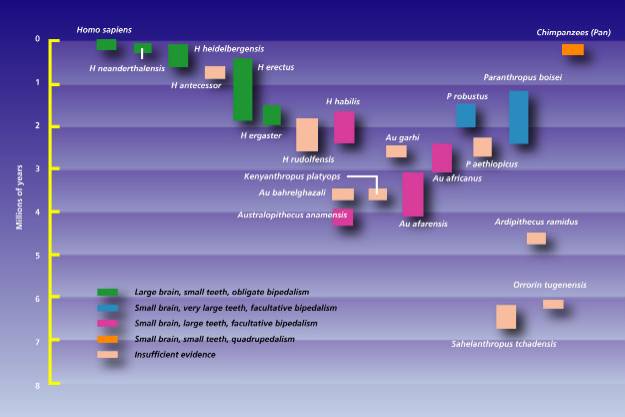
Creationism may argue that a single phenotype of "intelligence" arises from a pair of specially-created humans, but in order to provide at least 1.4 million neutral or slightly deleterious single-point variations currently observed across the human population from one specially created pair, mutation must have been extraordinary high to give us this current phenotypic diversity. Can creationism explain this vast distribution of "single nucleotide polymorphisms" within the living human population? Evolutionary theory actually requires these variations as they provide a distribution of variation across the population. As phenotypes certainly manifest across the human population, and each human bears in their genome over a million individual variations in comparison, past phenotypes of intelligence would vary across a population of individuals. For a definition and a primer of these polymorphisms, visit NCBI's SNP primer. For evidence of these polymorphisms and summaries of the number of polymorphisms in human (and other organisms) see the summary of dbSNP pages. Population distribution of phenotypes, which evolutionary theory recognizes, provides a medium through which natural selection can operate. Therefore, it should be clear to anyone who has read my definitions that evolutionary theory must not only account for phenotype distribution, but actually require it, and thus has no need to draw a line where the "first" H. sapiens appears, since the theory by definition operates in populations through actions on phenotypes which are themselves distributions in a larger field of characteristics in the ancestral population. Therefore, according to evolutionary theory, H. sapiens as a species arose through a mechanism of selection on the phenotypes of our ancestor species and we see evidence of this both from the fossil record and from the human genomic evidence. We observe fossils that show a variation and progression in earlier hominid species that varied within the species, and the timeline for the strata in which these fossils fall is acceptable to evolutionary theory. I have presented the evidence for this in my previous post. Evolutionary theory does not need to suppose an immediate speciation event. Speciation could have occurred regionally, so that previous ancestors in some regions were retained and later went extinct. In fact, several hominid species overlap in time, as we would expect if "child populations" branched off (speciated) from an ancestral population. See for example a explanatory figure and see my previous post for examples. Evolutionary theory is strongly supported by the fossil evidence, and the fossil record is one of the first "laboratories" where evolutionary theory was applied -- tested, and adjusted to fit the observed data. Relationships observed in the fossil record -- which is obviously independent of the genetic data -- predict certain relationships between organisms. These predicted relationships are easily examined with the molecular evidence, and the data support the predictions made by evolutionary theory in light of the fossil record. I once again invite my opponent to re-visit the ERV evidence I have provided. in the previous post. |
||||||||
|
The second point you make is that theories should be supported by evidence. Keep in mind that this debate is about explanations not scientific theories. Even still it true that evolution theory does not support it's largest claims with evidence. Creation theory does. The holes in evolution theory and the strengths in creation theory will become clear as I progress through this reply. |
This debate's purpose, by the rules, is to see which explanation best fits the evidence. Therefore, evidence requires an explanation. Since we are explaining evidence, and the most rigorous explanation of evidence would be within the body of a scientific theory, then Creationism must show how it is a valid scientific theory in order to adequately compare with evolution as the best explanation. My opponent agrees on my stated definition of scientific theory. A scientific theory, I will remind him, is "A set of statements or principles devised to explain an empirically-observed group of facts or phenomena, especially one that has been repeatedly and successfully tested with the scientific method, widely accepted after many empirical observations and tests of the body of the theory, and can be used to make further predictions about natural phenomena." Note the phrase, "devised to explain". Is it not obvious to my opponent that a scientific theory is the best and most impartial explanation of physical evidence? It is surprising if it is not, especially since he agreed on the definition of scientific theory and then claimed Creationism was a valid scientific theory. |
|||||||
|
How Does Evolution Theory Explain Human Origins? According to evolution theory man is descendant from a primate species and was not a direct and separate creation from other primates. So the first humans slowly came into existence moving from ape-like grunts to basic language skills over thousands of years. The first ape-men to gain language skills would not have been humans by my definition because they would not have been able to learn the complex language in the Bible. It would have taken some time to develop to that point. But eventually, according to evolution theory we reached the level of intelligence and language ability to meet my definition of human. |
Humans are defined by a series of traits that agree with evolutionary history. My opponent's first sentence in that paragraph is correct yet incomplete, as man is a primate species in itself. It is further incomplete in that it seeks to define "the first humans" by a single characteristic, that of understanding the complex language of the Bible. There is no evidence that humans "became" humans with the advent of complex language. My opponent is offering an ungrounded supposition that depends on his own definition of "human"; this definition is wholly inadequate for the task as it begs exceptions to the rule in even living members of the human species. There exist adult human beings who are brain-damaged or special-needs and learning-disabled who communicate in sign language or in what my opponent would view as non-human vocalizations, and who cannot comprehend the language of the Bible, but they are no less human than those who can. Additionally, if one reads a basic passage in Genesis or from the New Testament to a three-year-old child, it is unlikely that the child will understand or comprehend the words, yet they are obviously human and will be no more human once matured. Additionally, my opponent's definition also excludes a human embryo or fetus who has no language abilities whatsoever. That said, it should be laid down that the definition of human must encompass all possible characteristics of a member of the human species. Language comprehension is one ability that most humans share, but it does not define a human being, any more than the definition of "red" completely defines the general object of "apple" as an apple is much more than red, and not all apples are red. I submit, therefore, the true definition of human must include the definition of species as given in my "Definitions" section, with the species definition of "composed of individuals possessing common characters distinguishing them from other categories of individuals of the same taxonomic level" to include the common human characters within a range of morphology including genetic/genomic structure. In that sense, the exact beginning of "human" cannot be determined by language comprehension alone. If my opponent wishes to insist that there were such things as "first humans" with characteristics based on language, my opponent must point out where in the fossil or archaeological evidence the "first humans" according to his definition appeared and how one can discern them as "first humans" using his definitions and not some other species. |
You are attempting to dismiss my definition by being rediculous. My definition clearly explained what a human is according to creation theory. It cleary stated that a healthy member of the human species would have the ability to learn language and read the Bible. Any reasonable person would agree that a person with brain damage or a learning disorder is not healthy. If they are healthy then there is no use for the word healthy. No reasonable person would suggest that these people are not human either. But a healthy member of the population they are a part of could indeed learn language and read the Bible. If you'll take the time to actually read the definition you'll notice that I used the accepted taxonomic classifacation of H. sapien. I added the extra part to my definition because by creation theory there would be no population almost ready to learn language and read the Bible. To say that a definition has to match your preconcieved idea of the truth is a logical fallacy called assuming the conclusion. |
My opponent says, "It cleary stated that a healthy member of the human species would have the ability to learn language and read the Bible". Recall my initial objection was the incompleteness of my opponent's definition. I observe that the human population is a distribution of phenotypes. "Health" is a general and average term, and the definition of those boundaries when applied in detail to any group of people is a matter of opinion. I define health to describe an arbitrary level of optimal physiological function. However, given the distribution of phenotypes in our population, it is unusual that any one individual is an example of optimal physiological function. My opponent's definition of human is inadequate, and I say this because it must make assumptions of particular "health", which reflects that particular optimal phenotype in a population. It is not a sufficient definition of human to target only the average healthy phenotypes (who can understand the Bible) as exceptions to the definition can be found. The term "human" must umbrella all possible forms of "human" that exist. Again, any definition that must make exceptions is not a complete definition. The term "human" should be a general term that encompasses all members of our species. If there were no "healthy humans" to compare against, how could you tell that a class of learning-disabled children was all human? By including the level of specificity to include Bible-language-comprehension, my opponent must add the caveat that non-healthy individuals are humans who are unable to read the Bible, which defeats the specificity of that definition in the first place. My opponent may wish to consider how he can establish that non-Bible-comprehending humans are truly human in their own right without comparison to "healthy" humans, since by his definition they cannot be defined as human without resorting to a reference of other, "healthy" individuals in comparison. |
|||||
|
Definitions are for us to use as they help us. The same faulty logic could be used against your accepted definitions. Some humans are born with "tails". Primates are tailess. Does this mean that you are saying these humans are not really primates and therefore cannot be humans? Some humans are born with two heads or are born without other defining H. sapien characteristics. Does this mean they are not humans or are not H. sapiens? Of course not. This is rediculous and you should not use this silly logic against me. This also includes her claim that definitions must be supported by evidence. She suggests I can't define humans like I did because I can't prove that no human existed that broke my definition. This is even more rediculous. A dragon can be defined as a "lizard-like fire breathing monster". But do I have to show that dragons existed before I can define them this way? No I only have to do this if I want to demonstrate that dragons existed. My definition is reasonable. You should worry about my explanation not my definitions. |
Primates are not tailless. I'm not sure what my opponent is getting at, here. He can examine the taxonomic classification of primates to see where they fall to include those with tails. Further, I see that my opponent is giving me back the point that I've been delivering in respect to the definition of "human" for the past two posts: a definition must encompass all individuals no matter what the phenotype. As he points out, fringe phenotypes are no less human than average phenotypes. A definition should be general enough to include all members of Homo sapiens no matter what their phenotype. A definition of "H. sapiens" must include the ability to recognize and classify individual Homo sapiens of all phenotypes within the species. That is the whole point of recognizing phenotypes. Phenotypes of H. sapiens are still H.sapiens, with two heads, or with no legs, or with missing eyes, or small brains. A definition of H. sapiens must include all individuals, not just those who can read or understand the Bible. Evolutionary theory says that such definitions may have to be wide, as there could be a very wide distribution of phenotypes in the first place (as we see even in simple polymorphisms on the human genome). |
|||||||
|
What about DNA external similarities? Well this is an easy one for evolution. Evolution theory says that those species that share the most DNA and external similarities evolved from a common ancestor. Since primates share the most in common with us then we all evolved from a common ancestor. But primates are defined as those who share the most in common with us. This is a logical fallacy known as begging the question. The important thing to keep in mind is that evolution theory says DNA similarities are caused by species sharing a common ancestor. |
Clearing the air of a straw man, and other fallacies. Unfortuately for my opponent, he is indulging in a few fallacies in this paragraph alone. He is accusing evolutionary theory of an inability to be falsified due to circular reasoning. This is a strawman of modern evolutionary theory. There are numerous physical homologies between primates that are obviously not simple similarities and rely on their existence alone to establish primates as sharing a common ancestor. My opponent is also confusing evolutionary theory with taxonomy. Taxonomy historically is a systematic science interested in classification. Taxonomy classification can define "primate" without a reference to evolutionary theory, and in fact many species were classified by taxonomists in a recognizably modern way well before Darwin took his trip on the Beagle. See Carolus Linnaeus 1707-1778 who was the "father of modern taxonomy" who founded the modern science of taxonomy and was in fact, like many of his day, a Creationist. By taxonomic standards, primates are defined not by their relationship to humans but rather, like any other taxonomic classification, defined by their relationships to one another. It is true that as time has gone on, taxonomic classification has been further refined to include evolutionary relationships. However, in order for my opponent's strawman to assume flesh and bone, it would require that taxonomy define primates in terms of humans, in order to define humans in terms of primates! However, that clearly is not the case, for taxonomy defines primates through an independent series of physical definitions shared by all species and defined in relation to those common characteristics, and NOT human characteristics. See for example here. Therefore, it can readily be seen that evolutionary theory does not need to rely on the definition of "primate" to make a prediction for the evolutionary origins of humans. If there was no taxonomy of "primate", the use of evolutionary theory would allow researchers to deduce from all other species those species most similar to the human species. Researchers can accomplish this by physical and genetic phylogeny studies without the actual taxonomic classification of "primate" to guide them. |
You are putting a false claim in my mouth so that she can easily destroy it. This is a logical fallacy called a straw man. She claims I accused evolution theory of being not falsifiable because of circular reasoning. This is not at all what I really said. I said that some of the evidence for evolution is only circular evidence. By misapplying my argument she actually reinforced it. She showed show primates are identified by criteria that is separate from humans. Then humans happen to fall into the category of primates. This is all true and also revealing. All can see that humans are primates because we have primate characteristics. But how do we really know that humans and other primates all evolved from a common anscestor? Here's where the circular reasoning comes in to play. The evolutionist assumes that similarities mean that we evolved from a common anscestor. We all evolved because we're all primates. This is tunnel vision and more of that good old fashioned assuming the conclusion. |
My opponent's initial argument, that evolutionary theory has SOME evidence that is only circular evidence is exactly what I was replying to in the first place. He says that he was not accusing evolutionary theory of an inability to be falsified because of circular reasoning, but then he brings back circular reasoning in his argument in support of his original argument. Perhaps my opponent is not aware of the vast wealth of fossil and genetic evidence. As I suggested in my original reply, no scientist would depend on taxonomic classification alone to deduce evolutionary history. To once again repeat, I had said in the earlier post, "If there was no taxonomy of "primate", the use of evolutionary theory would allow researchers to deduce from all other species those species most similar to the human species. Researchers can accomplish this by physical and genetic phylogeny studies without the actual taxonomic classification of "primate" to guide them." Clearly in my original statement, I was stating the fact that morphological and genetic evidence can also be used for classification. Perhaps my opponent does not realize that morphological classification will include not mere taxonomic classification, but also detailed characteristics of bone, flesh, and molecular type. As my opponent has not shown why physiological or genetic evidence cannot be used for classification of related organisms, or cannot be used to establish evolutionary relationships, my support of evolutionary theory in this respect still holds. Also, my opponent has done nothing to support his creation hypothesis in reply. |
|||||
|
As for my opponent's assertion that evolutionary theory predicts that DNA similarities result from a common ancestor, he is only correct if he means to imply that modern evolutionary theory predicts that all genomes at one time or another originated in a shared ancestral state (a single species) which diversified through the action of evolution as defined at the top of this post -- and that more recently diverged species are more likely to have similar genomes than more distantly diverged species. |
Naturally... |
Then my audience can observe that this particular point -- of genetic similarity appearing as if the genomes once shared a common ancestor -- supports evolutionary theory in that evolutionary theory predicted, pre-genomic era, the similarities we now observe through the independent observation of the fossil record. The similarities are not just similarities, but predictable TYPES of similarities from the central core tenets of evolutionary theory --mutation and selection -- at a level of detail that is remarkable for its predictive power. |
||||||
|
What about human intelligence? Evolutionary theory fails to give a satisfactory explanation for human intelligence. There would have had to have been a sudden swelling in brain size to fit humans onto the evolutionary timeline. Evolutionists propose that intelligence enabled early ancestors of humans perform tasks that gave them an advantage. But this really explains nothing because it fails to explain why no other species has benefited from greater intelligence. Evolutionists say humans evolved intelligence because it was beneficial for them. But humans came from the same common ancestor as chimps and other modern primates. Why was intelligence not beneficial for them? Why was just once branch of that common ancestor selected for smarter and smarter ape-men? Why were the other branches not selected for smarter and smarter ape-men? It might be expected that once branch be slightly smarter than another because of random influences but not anywhere near the gulf of difference between us and all other primate species. It is not satisfactorily explained by evolution theory. To be more specific evolution theory does not predict that humans should have gotten smarter. Evolution theory cannot explain with any level for satisfaction why humans should have evolved smarter than other primates or why other primates should not have evolved to be roughly as smart as we are. |
My opponent is guilty of stringing together multiple topics in this one paragraph, but this may be out of ignorance of the separate nature of these topics. In this paragraph, my opponent builds several straw men - cariactures of what evolution does or does not say. This is again, probably out of ignorance of what evolution really does or does not predict. My opponent once again deftly avoids using empirical evidence for any of his assertions while simultanously ignoring the evidence against his assertions. Evolutionary theory can provide satsifactory explanations for human intelligence because it can declare that human intelligence arose from an earlier, less-intelligent state by the action of evolutionary change (see definition above), a hypothesis that can be tested by the scientific method. In fact, some work has been done to link the complex necessities of larger social groups with the evolution of human intelligence. Indeed, humans are both highly social animals (a trait that evolved within the primate line and not unique to humans, see [ref 5]) while also being superb generalists in that we are able to deliberately adapt ourselves to nearly every macro-environmental niche on the planet from extreme heat to freezing cold. Some researchers have linked prey hunting and the demands of successful hunting in a species not well adapted (as are large carnivores, for instance) to intelligence. Early humans would have needed to eat meat to be able to sustain movement and migration to other environments as well as for further survival, and had to become better and better prey hunters despite the fact that human evolutionary history was limited by its primate (food gathering) origins, necessitating cognitive advances [ref 8]. The researchers in [ref 8], in fact, give predictive power to their hypothesis that the need for hunting -- both in the actual fact of hunting and the teaching of hunting to the younger generation -- gave rise to human cognitive ability and many of it its traits in the context of the human social group. Therefore, it is not beyond the ability of evolutionary theory to explain that human cognitive ability could have arisen over the span of several hominid species, especially since hominid species engaged in activities that were demanding of cognitive ability: hunting, food sharing within social groups, and nomadic lifestyles that demanded generalization. The historical limitations of the primate physiology coupled with the demands of nomadic life (hunting and generalization) are certainly two powerful forces that would have guided selection for greater intelligence, as there certainly is more plasticity in an increase of intelligence versus large morphological changes to make humans more like big cats, for example. |
You have done three things in this paragraph. Ignore my argument, call it a straw man without showing why it is false and provide evidence that human activities require great intelligence. She is showing that evolution theory only makes predictions about human origins after the fact. Before the alleged splitting of the line that would evolve into humans... an evolutionist couldn't have told you squat about what was going to happen. All he could have said is all that he can say now, "According to my theory these species are going to adapt to their environments. Maybe they'll become new species. Maybe they won't. Maybe they're get alot smarter. Maybe they won't. Darned if I know." Evolution theory has it's value but it predicts little about human origins. If you asked someone with creation theory he would have had some good predictions to make, "Humans will be created and they will have superior intelligence over all other life. They will build, worship, learn, create, and explore. They will be part of the system of nature so they will have many similarities with other species. If they don't sin they will live forever but if they do they will die just like animals do." Creation theory actually explains why humans are the way they are. Evolution theory can only assume that all of our characteristics must have been benificial for our brute survival and surely that is why we have them. An explanation tells us why something is one way instead of another. Evolution theory can't tell us why humans are the way we are instead of another possible way. It can only look back and make assumptions. |
My opponent is trying to make an end-run around my reply which was answering a statement of his own. Recall that my opponent's first objection was that evolutionary theory (and I quote him), "...does not predict that humans should have gotten smarter. Evolution theory cannot explain with any level for satisfaction why humans should have evolved smarter than other primates or why other primates should not have evolved to be roughly as smart as we are." I gave him an answer using evidence, directly in response to this, and once again my opponent is trying to attack evolutionary theory without giving adequate evidence for Creation theory. Note that the evidence I provided was not mere hand-waving, but actual evidence, with numbers and with observations. Now, with that noted, my opponent claims that evolutionary theory cannot make predictions of observations in nature based on the body of the theory. Evolutionary theory predicts that current and future genotypes best suited to reproducing in a particular environment will eventually dominate the population. If you begin with a non-optimized population, the population will eventually optimize for that environment through mutation and natural selection. Evolutionary theory makes this prediction independent of the evidence OF the events occurring, for instance in the genomic fossil record in the living populations of humans and chimpanzees. I invite my opponent to invoke Creation theory to make a prediction of the particular TYPES of genetic similarities in chimpanzees versus humans. On the very simplest level, to start, evolutionary theory, before the chimpanzee genome is fully sequenced, will predict that the similarities between the two species are closer than any other species, down to similarities that show that chimpanzees and humans once shared a common genome in the person of a common ancestor. Creationism might wave its hands and say it can predict this, too, yet Creationism will not predict the characteristics of a common ancestor. I would like to see the creation-theory justification of exactly why chimpanzees and humans have overwhelming evidence of sharing a common ancestor (identical genome) at one point in their histories, outside of "oh, they look similar so therefore they must have similar genomes" as this is certainly not strong enough to explain the data. Include explanation of shared errors in their respective genomes, as well, and why other species do not share these errors to the same high level of similarity. Evolutionary theory predicts these shared errors should appear between the two genomes, as they must have shared a common ancestor (the same genome) at one point. What can Creationism says in response to the genomic evidence of particular TYPES of genetic similarity? |
6. Once again she ignored the fact that evolution theory makes almost no predictions about human origins. It only make one prediction and that is "Humans will adapt to their environments or they will go extinct." Not a very difficult conclusion. Evolution theory (which only says species will adapt to their environments with mutations and selection) does not (and cannot!) make any specific predictions about how any species will actually evolve. How will humans evolve in the next million years? Evolution theory doesn't have a clue. And evolution theory couldn't have predicted anything of that sort a million years. Evolutionists are only looking back after the fact and assuming that changes must have been from evolution. Please acknoledge this and request that Lilith retracts her statements. |
Claim 6. Evolution theory does not predict actual adaptations in populations, it only predicts that they will adapt. Lilith should remove claims that evolution theory predicts actual adaptations. Steve: Claim is rejected. There is not sufficient grounds to warrant a ruling on this claim. The point has not been effectively demonstrated and should be continued in debate. Mike: This point has not been sufficiently demonstrated. Debate should continue. The claim is rejected. Tim: No comment. Claim Rejected (2/3) |
|||
|
My opponent further states that a sudden increase in brain capacity would be needed. This is an incredibly ignorant argument that ignores any knowledge of the fossil record of early-to-late hominid braincases. The fossil record, on its own, in fact, does not exhibit an accelerated rate of "brain swelling" and there is no evidence that within living human individuals that brain size indicates level of intelligence. It was previously thought that the human frontal cortex was significantly expanded in relation to living primates. However, that has been shown not to be the case, in that actual physical size is not an indicator of human intelligence. Semendeferi et al have shown that "We compared the relative size of the frontal cortices in living specimens of several primate species, including all extant hominoids, using magnetic resonance imaging. Human frontal cortices were not disproportionately large in comparison to those of the great apes. We suggest that the special cognitive abilities attributed to a frontal advantage may be due to differences in individual cortical areas and to a richer interconnectivity, none of which required an increase in the overall relative size of the frontal lobe during hominid evolution." [ref 10] Indeed, even in the fossil record, we certainly see slowly increasing cranial capacity with only an average difference between any two species in the fossil record. Brain case size is not exclusive of species. For instance, see ref 10]. A significant increase in intelligence for a modest increase in brain size over evolutionary time certainly speaks well for evolutionary theory, as evolutionary demands for greater hominid intelligence would manifest first as a change in brain organization to create an increase in intelligence within the existing morphology of the brain case which would later increase slowly as on-average demands for larger brain cases gave more and more space to optimize brain organization within certain hominid lineages. There is no need for evolutionary theory to suppose a sudden swelling in the brain; nothing of the sort is observed or expected and my opponent exhibits a complete lack of understanding of brain organization to suppose such a ridiculous assertion. |
Brain sizes in humans are double the sizes of both the alleged anscestors of humans and modern apes. If a sudden swelling in brain size is "such a ridiculous assertion" on your part then maybe you can give me a better one. |
A doubling of brain size over (at least) six million years is assumed by my opponent as "sudden" My argument holds. Gradual increase in brain size is supported by the fossil record. |
7. Many evolutionists agree that the growth of the brain would have to be sudden. Even basic reasoning support this. Lilith is having trouble with the concept of "geological time". She assumes that if something took 6 million years it is gradual. This is no grand revelation. Most evolutionists agree that all evolution is gradual in that way. But if we think in geological time and do some math, we see that the alledged evolution of brain size is obviously a sudden thing. If it's gradual that means that it did not stand out. That means evolution of brain size has been going on a steady rate and no sudden growth has happened. According to Lilith this "gradual" rate is a 100% increase every 6 million years. So 12 million years ago brains were about 250cc. 18 million years ago brains were about 125cc. 36 million years ago brains were about 15cc. 60 million years ago brains were about 1cc. Now what was our supposed anscestor about 60 million years ago? I request that the judges acknolodge this continued fallacy and that they ask Lilith to either provide evidence that 60 million years ago our "ancestor's" brains were 1cc (and that 90 million years ago they were 0.03cc) or withdraw her claim the brain size growth in humans would not have had to be sudden. |
Claim 7. Brain size growth in human evolution must have been sudden in comparison to overall brain size growth in evolution. Lilith should retract her claim that evolution of the human brain size would have had to be sudden. Steve: Claim is rejected. There is not sufficient grounds to warrant a ruling on this claim. The point has not been effectively demonstrated and should be continued in debate. Mike: Nowhere Man has not provided evidence that the increase was sudden, nor has he defined "sudden". The claim is rejected. Tim: NW again is using the point that God created us to brain size was sudden. If NW has evidence he is welcome to back it up, but we must learn that creationist believe we created "ok" back them. So lilith must take this into account, however she will be looking for evidence, and is quite welcome to challenge him on this but also she must take into account of his theory as well. This is again a compromise. Claim Rejected (3/3) |
||||
|
My opponent then goes on to ask why no other species has gained intelligence. First, evolutionary theory predicts the evolutionary pathway of any one species will depend on its history as well as its current environment. There is no evidence that chimpanzees have at any time moved outside of their niche in which they are well adapted without large evolutionary pressures for increase in intelligence. More generally, selection is geared toward fitness for an organism's niche. Evolutionary theory can explain that our ancestors found advantage in adaptation and generalization because of a nomadic and hunting lifestyle, and this spurred the gain of increasing orders of intelligence in order to learn how to cope with new environments. Intelligence increased in those social groups (tribes/families) who were able to sustain a hunting lifestyle. Additionally, only those early hominid social groups who were able to adapt themselves to changing environments would be selected to survive. Our early ancestors may have become more intelligent specifically because of nomadic requirements. Predictions for this kind of hypothesis, and how it can be tested or falsified in the context of evolutionary theory, are given in [ref 8]. I therefore request that my opponent either support his statements in his paragraph with evidence against the out-of-Africa genetic evidence, or retract his statements. |
You fail to understand the workings of an explanation. She suggests that in order to support my theory I must give evidence against her theory. That is just not how it works. I am showing how the evidence better matches creation theory. I only need to support my theory. I don't need to disprove hers. Once again you'll notice that her speculations about human history only work after the fact. She cannot show why humans had turn out the way they did. |
I will ask my opponent to re-read the last sentence in my earlier response, again. He will note that I did not say my opponent must argue against my theory. I said he must supply "evidence against the out-of-Africa genetic evidence". This evidence was presented in references. My opponent has not shown contradictory genetic evidence that shows that humans did not all originate in Africa several million years ago. As the genetic evidence, taken from living humans, shows that humans originated in Africa millions of years ago, Creationism must respond to that evidence. If my opponent wishes to show that this evidence is incorrect, he must show why it is incorrect. Creationism must be able to explain the genetic observation that our genetic ancestors originated in Africa, an observation independently supported by the fossil record, and which is another strong case for evolutionary theory. |
8. Here she repeats a mistake I kindly showed her needing fixing. She even repeats her mistaken quote of what I must provide. That is "evidence against the out-of-Africa genetic evidence". Her explanation is that we came out of Africa. So she is directly asking that I supply evidence against her "theory". Of course a proper understanding of science shows us that explanations explain evidence. Evidence is not "out-of-Africa" evidence, it is just evidence - "out-of-Africa" is the explanation of the evidence. So I request that this is fixed as well and that she acknoledges her mistake. |
Claim 8. Lilith is requesting that her opponent provides evidence against a claim of her explanation. It should not be required of an explanation to provide evidence against competing explanations. Steve: Claim is rejected. There is not sufficient grounds to warrant a ruling on this claim. It is not apparent what rule is being broken. The matter should be continued in debate. Mike: Since this debate does concern which position is the best explanation for the data, it is hardly unreasonable for Lilith to ask NowhereMan to explain how his position accounts for specific pieces of that data. The claim is rejected. Tim: AGREED. Lilith is more than welcome to request evidence against her theory. That the idea! Claim Rejected (3/3) |
||||
|
What about human language? The evolutionary explanation for human language follows the same reasoning as for human intelligence. It must have benefited human ancestors somehow. But just as with human intelligence evolution theory fails to predict language ability. But evolution faces another problem with human language. Why are the first known languages so complex? Evolutionists point out cave drawings and symbols The truth is, there are no known Neanderthal cave paintings. What they ignore is that humans have always used simple symbols to represent things and have always drawn simple drawings. Not everyone is an artist and not everyone uses needlessly complex words represent simple things. People still draw very similar things today. Does that mean they're cavemen? One possible explanation is that simple languages never were preserved. Indeed, in recent times even fairly modern languages are almost lost. What we can conclude from this is that simpler intermediate languages may or may not have existed but we have no evidence to decide one way or the other. And at the very least evolution theory failed to predict language ability to develop. |
No empirical evidence has been given in this paragraph, just supposition and hand-waving without testable hypothesis or empirical evidence. I would ask my opponent what the "earliest known languages" are that are complex, and how are they defined as complex, in relation to what metric? My opponent does not cite the source of his examples of written language and conflates it with spoken language. What is his evidence that written symbols have anything to do with spoken language, or evolutionary evidence for human language? Evolutionary theory does not have difficulty with predicting human language development. Generally, some authors cite the demand complex language within a large social group in the formation of human intelligence [see ref 7]. Language most certainly would have provided an advantage to early hominids in social communication of abstract concepts in hunting and tracking prey as well as communication of nomadic patterns and understanding of each local environment would have required early nomadic hominids to develop a language. But most striking, human language ability has been shown to have a genetic link. In fact, recent work on the FOXP2 gene in humans with severe language disorders has allowed researchers to propose that disruption of the region around this one gene causes abnormalities in orofacial control needed for the fine movement necessary for the spoken human language. See OMIM 605317. The developmental defects in the brain created by mutations within this genetic region are still being studied but are suggested to have a role in brain organization that allows for the fine orofacial movement. Studies in fetal brain show that FOXP2 is likely affecting post-migratory neuronal differentiation during development. [refs 11, 12, 13] Indeed, FoxP2 has been shown to have a strong pattern of recent positive Darwinian selection. Svante Paabo's group published on the evolutionary evidence in FoxP2: "We sequenced the complementary DNAs that encode the FOXP2 protein in the chimpanzee, gorilla, orangutan, rhesus macaque and mouse, and compared them with the human cDNA. We also investigated intraspecific variation of the human FOXP2 gene. Here we show that human FOXP2 contains changes in amino-acid coding and a pattern of nucleotide polymorphism, which strongly suggest that this gene has been the target of selection during recent human evolution." [ref 14] Although study of FOXP2 and development needs to be moved to other primates, the disruption of the loci around FOXP2 and its links to language disorder indicates that the developmental, brain-organizing role of a single gene controls some aspect of human language ability. Since genes are themselves subject to mutation and selection, and since Svante Paabo's group has found that the specific mutations in FOXP2 relative to other primates may indicate selection for these changes in humans, it is clear that evolution has evidence in favor of mutation and selection allowing for the development of verbal language in humans, which certainly pre-dated written language. I therefore request that my opponent retract his claim that language cannot have arisen through known evolutionary mechanisms (mutation and selection). |
You point out evidence which supports the fact that ability to learn language is beneficial for survival. But of course this is not an explanation of why ability to learn language actually developed in us and not in other species and why it developed the way it did and not another way. This is no explanation at all. You then go on to make a very uninformed statement. The most telling point is this: "...it is clear that evolution has evidence in favor of mutation and selection allowing for the development of verbal language in humans..." What is that evidence? You say that a single gene mutation can effect "some aspect of human language ability". This is of course complete silliness. Biologists have discovered that single genes can act as "master control genes" for other complex networks of genes. If you turn the gene off so to speak then the "controlled genes" are not activated. You might think of a light switch. When you turn a light switch on a whole long series of events takes place that results in light being generated from a light bulb. But no informed person is so ignorant as to suggest that a light switch is all we need to get light. The ability to learn language is doubtlessly a process involving countless genes working in concert. Certainly breaking a "light switch" is not evidence that the whole system is evolvable. |
My opponent originally stated (in his first post) that "But just as with human intelligence evolution theory fails to predict language ability". I counter that evolutionary theory predicts that language will evolve based on allele change and natural selection, two events which obviously occurred in the case of FoxP2. The simple and powerful mechanisms of variation and selection can be applied across biology at any scale, and this is one of the strengths of evolutionary theory. But here is the important point: the principles of evolutionary theory have no problems predicting the evolution of language. What is actually lacking is a complete data set in order FOR evolutionary theory to make the prediction, but evolutionary theory is not lacking THE predictive power to show when such a thing occurs. My opponent's inherent misunderstanding is in his inability to separate out, in this case, the structure of evolutionary theory from the detailed resolution of data required for the detailed predictive power he is requiring. This is not a failure in evolutionary theory; this is merely a lack of data in order to "feed" to evolutionary theory in order to allow it to make this level of prediction. With a system with as many degrees of freedom as found within these complex systems of increasing hierarchy ( example: gene->metabolic pathway->subsystem->cell->organ->chordate->species population->interdependent species-> ecosystem), there are obviously a number of solutions in response to fitness selection pressures; these will manifest as an overall increased fitness in the population in response to the equally complex environmental pressure. My opponent is perhaps unaware of the sheer layers of kludged-in complexity that a single multicellular organism presents, let alone a population of multicellular organisms operating in an ecosystem. Researchers are still researching the details of unicellular metabolic pathways in simple ways, using principles of control theory and network systems. Due to current technology limitations, and not to limitations in evolutionary theory, we are still in the early stages of complex systems study. Therefore, to state that evolutionary theory cannot predict a systematic increase in fitness, such as language, in a particular environment under certain evolutionary pressures, is merely a result of ignorance of the current state of the art, and no reflection on the abilities of evolutionary theory itself. To allow evolutionary theory the predictive power to show the evolutionary pathway of an organism in a complex ecosystem, a deep and huge systematic set of data must be made available. Such data is not yet available, and it is only that limitation in the data, not the limitations of evolutionary theory, that currently limits scientists from predicting large systematic evolutionary changes in organisms. |
9. Here she tries to claim that evolutionary theory really can explain human intelligence if only enough data was available. The fact of the matter is that the data is not available and this is only wishful thinking. Any theory can claim to be able to explain something "if only enough data was available". But that's not how science is done correctly. Please request that she retract her claim that evolution theory explains complex things like human intelligence. |
Claim 9. Evolution theory does not explain the existence of human intelligence. Lilith should remove claims that evolution theory explain the existence of human intelligence. Steve: Claim is rejected. It is not clear where Lilith made this exact claim. The matter should be continued in debate. Mike: NowhereMan has asserted that evolution does not explain intelligence, but he has not in any way demonstrated that this is the case. Debate should continue. The claim is rejected. Tim: No comment. Claim Rejected (2/3) |
|||
|
And, due to the responses of even non-biological complex systems, we know that even if vast amounts of data were available for modeling, no theory may ever be able to fully predict all detailed evolutionary behavior in any one population. By definition, complex systems can respond in unpredictable ways to miniscule changes in input parameters. Even simple complex systems exhibit behavior whose dynamics are unable to be predicted in trajectory detail by any theory, which is the point of the study of "complex systems" in the first place. Evolutionary theory predicts that phenotypes are selected on fitness for the environment, and the selection is conditional on the evolutionary history of the organism itself. If my opponent is objecting to the idea that evolutionary theory does not currently and explicitly predict the "next stage" in evolution of an organism in fine detail, then he should understand that evolutionary theory will indeed be able to do this kind of prediction when we have all the data necessary to make the prediction. Meteorologists have relatively more data about weather patterns than biologists have about ecosystems, populations, and organisms. However, much as a meteorologist can make general predictions about the weather, scientists will be able to predict evolutionary responses to environmental changes. Since we cannot accurately predict the weather even with a vast wealth of past weather patterns and prediction algorithms past a certain level of general detail, so too will the complex systems inherent in the natural world likely present an ambiguous picture on future evolutionary responses outside of general trends. If a scientist had all biological and ecological variables and their ranges known, such as the entire biochemical system of an organism and its entire ecological niche and interactions, the evolutionary behavior of the complex system (organism) would be able to be generally predicted using evolutionary theory. To infer the next evolutionary step of an organism requires a vast data set that we are only beginning to accumulate. However, in a limited sense, we are beginning to be able to predict evolutionary changes in systems with limited degrees of freedom. See, for example, Walter Fitch (UCI) and his work on predicting the evolution of influenza virus (which still suffers from lack of data). There is no fault in evolutionary theory in predicting general evolutionary trends; it is the lack of data that is the restriction, as can be shown in the predictive success on the level of the available data. |
||||||||
|
In kind, I challenge my opponent to show how his creation"theory" can make predictions on any complex system, including the behavior of metabolic systems of organisms, while using the principles he will no doubt outline in his reply to the response to the post preceding this one. Since creation theory cannot address the mechanisms of mutation and selection explicitly, it lacks the ability to explain the evidence of mutation and selection we currently observe. Evolutionary theory, however, predicts that the evolution of language depends on mutation and selection. Since mutation operates on genetic material (genes), and the effects of positive selection can be detected on genes, I showed that FoxP2 was a gene that can be presented as evidence for the fact that language evolved as predicted by evolutionary theory. What my intention was, in last week's reply, was to present evidence that evolutionary change does apply to at least one aspect of human language (speech) -- that of fine orofacial muscle control. This control depends on the function of a single gene. Since genes are alleles, subject to variation within a population, and can manifest as phenotype variations, then selection can operate on phenotypes that arise from these genetic variations. . Evolutionary theory predicts that in order for humans to have developed language, they did so from a pre-language-ability state, in which a copy of the FoxP2 gene existed but existed in another allelic form (for instance, in an ancestral form to both chimpanzees and humans). Evolution predicts that the ability to use language, as well as understand language, must have evolved through the action of mutation and selection and only those two mechanisms. In fact, the differences in the FoxP2 gene between chimpanzees and humans are exactly the type of mutational differences one would expect if FoxP2 had been undergoing positive Darwinian selection on this single gene. I have presented evidence on a gene that has evidence not only that it controls the development of facial control, but also that there is evidence of selection on this gene, which manifests as distinct changes within the gene as evolution would predict if there was indeed positive selection. I invite Creationism to offer its explanation for this evidence in detail, down to the type of mutations observed in FoxP2. |
||||||||
|
After that you ask that I retract a claim that I never made. That claim is that "language cannot have arisen through known evolutionary mechanisms". If you show me where I made such a claim I will retract it. What I will say is that there is no solid evidence that the ability to learn language can rise through known evolutionary mechanisms working on life systems. So now I ask that you retract your claim unless you can show exactly where I said such a thing. |
I cannot see what his objection comes from, unless he cannot see that his statement demands the conclusion from the definition of evolutionary theory. He said, and I quote from two sentences in his paragraph, "But just as with human intelligence evolution theory fails to predict language ability. " and "And at the very least evolution theory failed to predict language ability to develop." Since evolutionary theory predicts that language would have arisen through known evolutionary mechanisms, and my opponent is claiming that evolutionary theory "fails to predict language ability to develop", he is claiming that evolutionary theory fails to predict language ability to develop because it cannot use its predictive principles that use known evolutionary mechanisms. They are one and the same. With that explained, I invite my opponent to show where the substantial difference exists between:
and
and
|
10. Here she is change the claim again to try to appear right. She said that I made the claim that "language cannot have arisen through known evolutionary mechanisms". What she is trying to do is change my statement so that is looks like I made a negative arguement. Everyone knows that you can't prove a negative so if she succeeded in this it would make it look as if I was making a bad argument. What I really said is that evolutionary theory failed to predict the ability to develop language. A different claim. Please request that she retract her statements. |
Claim 10. Lilith stated that her opponent claimed "language cannot have arisen through known evolutionary mechanisms". Her opponent did not claim this and the statement should be retracted. Steve: Claim is rejected. It appears the statement in question is based on a misunderstanding of Nowhere Man's statements. The matter should be continued in debate before a ruling can be made on this claim. Mike: Lilith's understanding of NowhereMan's position may be mistaken here. In fact, she has admitted as much, and has asked that NowhereMan clarify his position for her, and point out where she is mistaken. That is a reasonable request. It is difficult to say that a mistake actually rises to the level of a "straw man" when such a request has been made. At worst, Lilith is mistaken, and mistakes are not rule violations. Nowhere Man should clarify his position in his response, but is free to resubmit the claim if the issue continues in the next round. The claim is, for the moment, rejected. Tim: No comment. Claim Rejected (2/3) |
|||||
|
What about human behavior? Once again we see the same thing. Evolutionary theory expects no particular type of human behavior. There's no reason evolutionary theory should prediction apes to develop one type of behavior and humans another. Humans have specific behavior patterns that do not make much sense in evolution. Humans have a conscience that allows them to know inside what is good and what is bad. Humans would do better in evolution if they always killed off the weak but the development of a conscience would work against that. However in other species we do see a consistent setup where the weak are killed off. This is very visible in species like Himalayan mountain goat. After hours of competing the most fit male pursues the female. But the female flees from the male to make sure he has the most fit genes. Talk about playing hard to get. Evolution should favor those who reproduce more not those who run from their potential mates. Such a pattern would never get a chance to evolve because the species with females running from males would get beaten out for resources before it got a chance to become more fit. Humans also engage in a competitive behavior but humans are driven by inner ethical guidelines. Humans also have a built in desire to worship, a desire to explore, and a desire to express themselves through artistic achievement. No satisfactory evolutionary explanations for all these things have been developed. And also evolution theory does not specially predict any of these behaviors. |
Evolutionary theory certainly does specifically predict human behavior. Evolutionary psychology seeks to understand human behavior and explains it through the understanding of human origins as predicted by evolutionary theory. Unfortunately, my opponent is exhibiting an ignorance of an entire field of study linking evolutionary theory to human behavior. To suggest that evolutionary theory has no explanation for human behavior is to ignore a body of work in evolutionary psychology well over 50 years old and to wave one's hand in ignorance. This is an egregious example of my opponent's ignorance of a body of work that can be revealed with the simplest of internet searches! While this might seem frustrating to some reading this debate, I am more than willing to fill my opponent in on recent developments in human behavior and evolution. My opponent can begin by going to the Human Behavior and Evolution society webpage where he can find links to vast resources on evolutionary psychology, and where he can see that his hand-waving arguments towards evolutionary behavior are unfounded. For instance, I can offer several dozen references linking human behavior to evolutionary theory, but let us begin with a simple introduction to the field for my opponent. There are some basic principles of evolutionary psychology.
[taken from ref 15 and journal references therein]. For instance, qualities of "conscience" can be explained by the selection of individuals who participate in a cooperative social group. It's known from even human directed breeding of domesticated animals, among them the horse and dog, that behavior can be selected for, and general temperament is inheritable. I suggest that my opponent go to reference 15 and start reading at least the primer on that site, and extend his reading to journal articles cited there, before he attempts to extend his claim that evolutionary theory has nothing to say about human behavior. I therefore request that my opponent retract his claim that evolution has nothing to say about human behavior or provide evidence against the citations I've provided him. |
I could actually just cut and paste my last paragraphs here and replace "ability to learn language" with "human behavior but I won't. Once again you faithfully (or maybe un-faithfully might be more fitting) fail to understand how an explanation works. I never said that evolution has nothing to say about human behavior. You made that claim up and that is bad debating. Evolution theory does have a little bit to say about human behaviour. It says that the behaviour of a species will be adapted to its environment and influences or the species will go extinct. But there's where it ends. Everything else is just after the fact hand waving. |
I will quote my opponent from his first post. He said, "What about human behavior? Once again we see the same thing. Evolutionary theory expects no particular type of human behavior. There's no reason evolutionary theory should prediction apes to develop one type of behavior and humans another. Humans have specific behavior patterns that do not make much sense in evolution." If he indeed says that evolutionary theory is unable to make claims as to the SPECIFICS of human evolution, then how can he suggest that "humans have specific behavior patterns that do not make much sense in evolution" if evolution is unable to make specific predictions in the first place? Therefore, I took him at his word: that humans have specific behavior patterns that do not make much sense in terms of evolution. He also claimed that "Evolutionary theory expects no particular type of human behavior" but and then a reader could move down through his explanation of various types of human behaviors, and further read, "No satisfactory evolutionary explanations for all these things have been developed. And also evolution theory does not specially predict any of these behaviors." Additionally, he goes further to say, "Evolution theory does have a little bit to say about human behaviour. It says that the behaviour of a species will be adapted to its environment and influences or the species will go extinct. But there's where it ends. Everything else is just after the fact hand waving." Perhaps my opponent can be more specific as to what evolutionary theory says before he calls me on my interpretation of his ambigious presentation of what he believes evolutionary theory has to say on human evolution. I invite my opponent to choose ONE of these three positions, or invent a consistent one: 1) Evolutionary theory expects no particular type of human behavior. 2) Humans have specific behavior patterns that do not make much sense in evolution (in order for human behavior patterns to not make sense in light of evolution, evolution MUST have something specific to say about human behavior patterns to contrast against. Contrast with #1.) 3) Evolution theory does have a little bit to say about human behavior (and how does his "little bit" in adaptation has anything meaningful to say about human behavior to establish any kind of credible position, especially given the following of "But there's where it ends."? Contrast with #1 and #2. |
|||||
|
You also make the suggestion... actually you flat out state that I'm not familiar with the field of evolutionary psychology. Of course this is not true. |
If he is indeed familiar with the field, despite his blanket dismissal of its contribution through denying it has anything meaningful to offer beyond "after-the-fact handwaving", then I believe my opponent will have little problem citing research and evidence to show that any one of his three positions above (or any of his others on this subject) are supported by evidence and show that published works on evolutionary psychology involve only alleged hand-waving. |
|||||||
|
What about the fossil record? This is actually a part that evolution theory makes a prediction about. It predicts there will be a gradual transformation found in the fossil record. Evolutionists say that fossilization is difficult and that they do in fact have transitional fossils. The fact is that literally millions of fossils have been found and they've been categorized and placed all over museums and laboratories around the world. We keep collecting more and fossils but not more and more missing links. What about the so-called missing links that we do have? There is a great deal of variation in populations. There are midgets and giants and everything in between. But if a rare human fossil happens to look ape-like or a rare ape fossil happens to look human- like it gets lots of attention. Evolutionists point out that even creation supporters can't decide if some fossils are apes or humans. This does not prove that they were intermediates. This only proves that they were variants that look a lot like ape-men. It is also rude to display these people as primitive ape-men when they were no doubt civilized people or ordinary apes. A bird belonging to one species might look like a bird belonging to another species. Does this mean that bird is a missing link between the two? The so-called intermediates between man and ape could fit on a desk. A key prediction made by evolution theory has been falsified. |
First, I will ask my opponent what key prediction of evolutionary theory has been falsified by his handful of hand-waving arguments with no citations to actual data in metrics or observations. My opponent acknowledges that in-population variations in size and morphology can occur, but how can he suggest that species-wide morphology changes, for instance, between H. erectus and H. sapiens, can exist? Does my opponent have evidence that in recent or existing humans there exist those who have ape-like features and whose skeletons would be mistaken for an "ape" (not-human)? If so, my opponent is required to provide evidence for this assertion. My opponent also notes that when creationists attempt to classify early hominid remains as "ape" (not-human as per his definition) and human remains, they run into difficulty. However, if these fossils were truly human and representative of a range of normal human skeletal morphology, why do creationists have such a hard time classifying them? We certainly do not have Homo erectus-like humans walking around Wal-Mart now-a-days (though some in t.o. might argue this point out of humor). There is no evidence for these kinds of hominids occurring in the recent human lineage. If hominid fossil remains were not human but instead "ape", why would it be difficult to classify their remains as "NOT-human"? Why do we not see living humans or primates with the same morphology as evident in Homo erectus, H. habilis, or other fossils classified by creationists as belonging to either human or "ape"? (see for example ref 16). |
A key prediction that has been falsified is that there should be gradual transitions in the fossil record. But we don't see that.
Mysterious that is if you refuse creation. |
My opponent is arguing from authority, here. Real evidence, and real data, please. Quoting opinion as fact in decade-old popular magazines, without background references to support your claim, is just hearsay and dependent on opinions, not the facts. I ask you present the evidence as I requested, showing the specimens, the measurements, and an argument of how they could all fit onto a desk, a billiard table, or in a single coffin. |
11. Here she is having trouble with logical fallacies. An appeal to authority is invalid if:
Please request that she chooses one of these options or retracts her claim. |
Claim 11. Lilith stated that her opponent's appeal to authority is invalid. Her opponent's appeal to authority was valid and Lilith's claim should be retracted. Steve: Claim is rejected. Lilith did not claim that NM's appeal to authority was invalid. She only identified it as an appeal to authority (which of course, it is). She did not claim that his *appeal* was fallacious, but that his statements were not supported by evidence. Mike: Just because a reference is provided for a particular claim does not mean that the claim is necessarily correct. In this case, Lilith is asking Nowhere Man to use actual data to support the claim, rather than relying on authority. Such a request is reasonable. The claim is rejected. Tim: No comment. Claim Rejected (2/3) |
|||
|
On to the matter of variation. My opponent can ignore it but there is much variety inside our species. There's little tiny pygmies and giant... well giants. There are those who are more attractive and those who are more... well ape-like. It's a harsh but true fact about people. There are going to be people who look as if they have ape-like features. I've seen people in person that have an ape-like nose and skull shape and other features. Most of people won't stand out in the fossil record but evolutionists are digging for ape-men and when they find them those are obviously the ones that going to get the attention. |
Perhaps he can show how the complete skeletal features of transitional species show up in today's population. I require proof and evidence for such an extraordinary claim. Give me a modern human skeleton that looks like Homo habilis, or Homo erectus, down to the details of the bone structure. As my opponent will recall, arguing on anecdotal evidence is not allowed. Furthermore, I demand my opponent show where "evolutionists" ignore modern-looking humans from fossil records but keep the "ape-men". |
|||||||
|
It is clear that my opponent dismisses the existence of transitional fossils with a hand-waving implicit appeal to ignorance. There is a vast wealth of data refuting his misconceptions, all of which are contained in the talk.origins archive, especially in Jim Foley's hominid FAQ [refs 16, 17, 18, 19, 20]. but perhaps my opponent would like me to spell some of those arguments here if he cannot search the requisite literature to refute the evidence provided by the archive. Let us begin with Jim Foley's Fossil Hominid FAQ and references therein, and allow my opponent to address each transitional as either human or non-human. Can my opponent claim which one is ape, and which is human? Can he give his reasoning for the specific classification of ape or human for any of those fossils? Notably, earlier in the debate, my opponent takes the stance that brain size indicates human intelligence, but all Homo erectus fossils have brain sizes that are much smaller than the average human size (see new 2002 evidence at ref 17). But erectus is often classified as human by creationists. Therefore, my opponent must make up his mind: Is Homo erectus really human, or is it an "ape" per his definition, when given reference to morphology and brain case size? My opponent must state his criteria for discerning the two, for if mankind was a separate creation, why is there no demarcation between "apes" as he defines them, and humans? If my opponent uses the old creationist argument of disease affecting the stature of Homo erectus, he should provide evidence that the same disease was affecting such a widely scattered group of individuals, and provide the observable symptoms of such a disease. He must also provide a hypothesis as to why in this particular span of fossil time, all hominids found look as if they were affected by the same disease. |
If there is a fossil which is hard to distinguish between and ape and a human it will be because the fossil it too damaged or incomplete to make a good judgment call. If the fossil is so damaged or incomplete that a professional can't tell the difference then how could I tell the difference? |
How is Turkana boy too damaged to tell the difference between ape and human? Why are creationist fossil 'experts' not immediately saying, "No way, can't classify these...too damaged for me to tell the difference!" Or is my opponent apologizing for those who tried to judge the transitional skulls? Again, I invite him to examine the review with references. |
||||||
|
You try to say that a human looking fossil with a small brain would contradict my definition of human. The only was that this works if you say that brain size is connected with intellegence and the human's brain was so small that he couldn't possibly have been human. Of course if you were up on your scientific research you would know that brain size and intelligence are not connected. Also we know that humans with very small brains have been documented. (Ref. 2) Small brains do not pose a problem for something being human. |
So why does my opponent insist that evolutionary theory insists that a sudden brain swelling was necessary for increase in human intelligence in order to allow for transition from ape->human? Why would he believe both that the growth of a larger brain capacity is so extraordinary in the human fossil record on one hand, but on the other hand try to point out to me that brain size does not matter after all? Recall that he said, "What about human intelligence? Evolutionary theory fails to give a satisfactory explanation for human intelligence. There would have had to have been a sudden swelling in brain size to fit humans onto the evolutionary timeline." Perhaps my opponent, in addition, can read my replies more carefully, where I say in response to his statement on brain size, and I quote, "as modern human intelligence can be comfortably sustained in brains of various sizes with no correlation between intelligence and brain size. It is rather the organization within the brain, such as the interconnections and developmental characteristics that would first increase intelligence [ref 10]. A significant increase in intelligence for a modest increase in brain size over evolutionary time certainly speaks well for evolutionary theory, as evolutionary demands for greater hominid intelligence would manifest first as a change in brain organization to create an increase in intelligence within the existing morphology of the brain case which would later increase slowly as on-average demands for larger brain cases gave more and more space to optimize brain organization within certain hominid lineages." So why is my opponent suggesting that I'm not "up" on my scientific research when it seems he can't even read what I had posted in my last reply? |
|||||||
|
The reason Homo erectuses all have a smaller brain size on average is that you classify Homo erectuses as the variant fossils with small brain size. If the brain size was normal and everything else was fairly normal you would just classify it a more modern human. To say that the brain size of Homo erectus proves anything is a logical fallacy known as circular reasoning. |
Homo erectus has more morphological features - in skull traits and skeletal differences, than merely brain size to discern it from modern Homo sapiens. See for example Turkana boy. I invite my opponent to show me how Homo erectus is classified just on brain size and not on traits such as a particular sulcus/brow ridge and skull morphology. My opponent can perhaps show me references where the researchers said, "This is just a smaller brain size, so it's Homo erectus." while ignoring all the other skull and skeletal characteristics that would define the skeleton as posessing characteristics of either H. sapiens or H. erectus. |
|||||||
|
As for intermediates, the very intermediates he dismisses as humans with "ape-like" characteristics or vice-versa are clearly what evolutionary theory would predict of transitional fossils. My opponent claims that transitional fossils do not exist. But we know there are clear trends from early hominids to modern humans, "increasing brain size, increasing body size, increasing use of and sophistication in tools, decreasing tooth size, decreasing skeletal robustness. There are no clear dividing lines between some of the later gracile australopithecines and some of the early Homo, between erectus and archaic sapiens, or archaic sapiens and modern sapiens."[ref 17] My opponent must show how his theory can explain these transitional fossils which were dated appropriately and whose dating follows an apparent transition from early hominids to modern humans. My opponent is also charged with dismissing the evidence for Turkana Boy, and show that Turkana boy is not a transitional fossil using the scientific method. See ref 18. He is also challenged with showing why the Dmanisi fossils are not an adequate transitional form between habilis and erectus [ref 17] when they share the qualities of both fossils. If he cannot dismiss the evidence for these specific transitional hominids, he must retract his claims that none such exist. |
The ape-like forms are selected because they stand out and the dating is just wrong. Popular Science reported on studies showing that "dates determined by radioactive decay may be off-not only by a few years, but by orders of magnitude." It said: "Man, instead of having walked the earth for 3.6 million years, may have been around for only a few thousand." (Ref. 6) [comment] Which would of course be consistent with creation theory. |
It's amazing to me that this myth (courtesy of Robert Gentry's multiple-assumption theory of radioactive decay) keeps on appearing, especially since it's been refuted numerous times at this newsgroup as well as at talk.origins.org, in the polonium halos faq, at http://www.talkorigins.org/faqs/po-halos/gentry.html and this has been pointed out, time and time again, on this newsgroup. What more can I type to refute this argument, other than point my opponent to the well-dogeared FAQ on the subject? Let me quote for my opponent the summary from that FAQ, which refutes the claims made by Gentry in a popular science magazine: "Gentry's polonium halo hypothesis for a young Earth fails all tests. Gentry's entire thesis is built on a compounded set of assumptions. He is unable to demonstrate that concentric haloes in mica are caused uniquely by alpha particles resulting from the decay of polonium isotopes. His samples are not from "primordial" pieces of the Earth's original crust, but from rocks which have been extensively reworked. Finally, his hypothesis cannot accommodate the many alternative lines of evidence that demonstrate a great age for the Earth." In other words, Gentry doesn't have a leg to stand on, to criticise radiometric dating, and by association, neither does my opponent. |
||||||
|
My opponent had said the so-called intermediates between man and ape can fit on one desk. Let us assume that a largish desk is five feet long by three feet wide. That is 15 square feet. The evidence for human transitional fossils can be found at reference 19. Jim Foley has said, "One sometimes reads that all hominid fossils could fit in a coffin, or on a table, or a billiard table. That is a misleading image, as there are now thousands of hominid fossils. They are however mostly fragmentary, often consisting of single bones or isolated teeth. Complete skulls and skeletons are rare" [ref 19]. I leave it to my opponent to prove that all of these intermediate skulls and remains can adequately fit on a 15-foot square desk without piling them up atop one another. My opponent is invited to use basic mathematics and the estimated size of each of the fossil remains for his calculation, and a justification for his estimation. If he cannot do this, he is requested to withdraw this claim. |
Fragment fossils are sometimes assumed to be transitional and later they have to be dismissed when actual evidence arives. At one time the best transitional fossil was a fragment of a jaw bone from which evolutionists constructed an entire ape-man! This most clearly demonstrates the level of wishful thinking by some to contruct something that does not exist.
The New York Times reported, for decades Ramapithecus "sat as securely as anything can at the base of the human evolutionary tree." (Ref. 8) [comment] But did it exist? Did their wishful thinking turn out to be true? No. When they found better fossils they had to abandon the previous fossils to accept the new fossils.
There is no reason to think that these "thousands" of fragments would not be abandoned if more evidence was available. |
There is no reason to suggest that the "thousands of fragments" would be abandoned, either (and this is begging the question -- can his thousands of fragments fit on a billiard table as he claimed?) Ramapithecus sat at the base of the human evolutionary tree until scientists -- the same scientists who are active in the field of discovering and classifying new fossils -- decided it didn't belong there. I fail to see the shocking failure in evolutionary theory within a re-working of the primate evolutionary tree on the arrival of new evidence. I would demand, in fact, as a scientist, that the evolutionary tree be examined and re-examined, and brought up to date with every piece of new evidence. This should instill confidence in science, not doubt. When evidence arrives, science can correct itself, instead of blindingly going forward in its previous mode. Science builds itself up on evidence. One can tell non-science by its adherence to its own principles without reference to the evidence (and I am still waiting for my opponent's evidence). Creationists will criticise evolutionary theory as weak for being too accepting of change, too plastic in its approach to evidence, but in the next breath accuse science of being blind to the "truth" and dogmatic in its approach. Which alternative does science best fit into, truly? Are scientists blindly stubborn and sticking to their own ideas of evolutionary theory, or are they willing to change given new evidence? Which alternative would creationists best like to complain about out in either of these? Perhaps my opponent can kindly qualify that for me, without resorting to what I see as typical Creationist comfortable yet ambiguous fence-walking. |
||||||
|
Now as for the more complete "ape-like" fossils. Even a complete skull is not a square foot in size. 15 square feet would still be plenty of space to place all the "ape-like" fossils without stacking. Though I must say I think that a coffin would be a much more appropriate place for the fossils. |
How can we have "thousands" of fragments fitting in fifteen square feet? If thousands of fragments were to be re-ordered on the family tree with the arrival of new evidence, what would we do with the thousands of fragments plus the new evidence? Are these very tiny fragments? Now, how about including the complete skulls and large skeleton pieces? There are many more than fifteen skulls known. |
|||||||
|
Another problem with the fossil record is the location and supposed dates of the ape-men fossils. Supposed ape-men fossils are found all over Africa from 200,000 years old to over 6 million years old. One of the youngest fossils is found in south Africa but one of the oldest is found in north Africa. But yet some of the links between these fossils are found in even more northern sites like Beijing. We see a scattered array of cracks skulls flung across entire continents. Unless we discover some ancient airplanes it is just impossible for these fossils to be links to each other. |
My opponent is in some ways recapitulating the multiregional hypothesis of human origins, which has in recent years fallen into disfavor. The single uniregional hypothesis, in which early hominids stayed in Africa and expanded in a single wave and never returned toward Africa, is under discussion, but multiple waves of migration out of Africa are best supported by the evidence. The fact that humans originated in Africa is not under serious debate. This hypothesis has been upheld by both fossil and genetic evidence through the study of both human mitochondrial and nuclear DNA signature regions [see ref 9]. This genetic data shows that humans moved out of Africa in several discernable "waves" over a long span of time, which is apparent in the genetic record of extant human beings. Therefore, based on the independent data gathered from human genetics as well as the fossil record, a hypothesis on human origins is proposed: Early hominids may have found migration necessary for survival because of environmental changes or demands for food, and this migration originated from Africa but in successive waves moved across Asia and then occasionally back into Africa over hundreds of thousands of years. My opponent is charged with showing how it is impossible that groups of hominids could not have migrated from Africa to Asia in the span of hundreds of years, let alone thousands of years, or tens of thousands of years. All of these time periods would look nearly "simultaneous" in the fossil record. If my opponent cannot do that, he must retract his claim. I have evidence that a human being can walk vast distances in a few years time, certainly more than we are demanding of nomadic hominids. The "Footsteps of Man" trek is currently involved in this. [ref 21]. Certainly seven years of trekking around the world is extraordinarily fast and no migrating hominid group would attempt such a feat, but it's obvious that migratory movements of early hominids could have easily placed hominids of the same species across continents in the space of a few thousand years, a span of time too short to show morphological/evolutionary changes in the migrating species. How does my opponent explain the lack of homo erectus or homo habilis fossils outside of the connected continents of Europe, Asia and Africa? |
One wonders how all these "waves" managed to evolve in the same way, all resulting in the very same levels of intelligence and other abilities. If they were interbreeding then they would not be separate waves. If they were not interbreeding then they should not have developed in the same way. How do you explain this? |
From my opponent's earlier statement, that variation (including brain size) is distributed thorughout the population, how can it be said that all humans are as exact as he'd like them to be for purposes of "resulting in the very same levels of intelligence and other abilities"? How can my opponent say that humans of different geographical origins evolved in the same way? We have a vast distribution in the details, from the American Indians to African, to Fins down to aboriginal Australians. Obviously the humans indigenous to each geographic area are specialized for that area. I don't see my opponent's objection to the idea of waves, perhaps tribal waves, of peoples emerging out of Africa over the course of millions of years. The genetic evidence is there within the seperate data of the mitochondrial and Y-chromosome evidence, as I pointed out in my earlier post. |
|||||
|
There's a simple explanation why more ape-like fossils are found in Africa. It is very obvious that African people have more ape-like skull shapes than other humans do. So simple probability tells us that we will find most ape-like fossils in Africa. A person need not to invent a long drawn out explanation involving millions of years of little tiny changes from apes to humans when a more simple one exists. This also explains the lack of homo erectus or homo habilis fossils outside Europe, Asia and Africa. |
The African peoples are us. Those of us with pale skins are pale Africans. I would suggest my opponent treat others with more respect other than trying to suggest that they have throwback traits. Secondly, there is nothing simple about that suggestion, other than perhaps in that it reads like a bedtime story out of a racist storytelling book. And to add insult to injury, my opponent should go read the homind fossil record again. Erectus fossils are found in Asia, but none in the Americas. Neandertal remains are found in Europe but not in the Americas. Does this mean the American Indians are somehow superior to Asians and Europeans in terms of creation, as they are not found with Habilis or Erectus fossils? See the talk.origins fossil FAQ, especially entries like:
|
12. Here she makes many uncalled for and inappropriate racist comments. Please ask that she removes them. |
Claim 12. Lilith makes racist comments. Her comments are improper and should be retracted. Steve: Claim is rejected. There are no apparent racist comments which Lilith supports. She is claiming that NM premises are racist -- which is another issue entirely. This particular claim is not valid. Mike: I personally fail to see what is racist about the claim that all humans are descended from a group of individuals which originated in Africa. The claim is rejected. Tim: No comment. Claim Rejected (2/3) |
|||||
|
And also as for DNA, you have failed to show how DNA indicates that we must have originated in Africa. Your Ref. 9 is just more scientific hand-waving. |
My opponent has been supplied the evidence. My opponent is now dismissing the evidence without reason. I challenge him to show why this is hand-waving. Can he say why it's hand-waving when it relies on actual genetic evidence? |
13. Her reference was just a short little claim by someone. She didn't (and the website didn't even) explain why this claim was true. Please request that she explains her claim or retracts it. |
Claim 13. Lilith did not present evidence for her claim that human ancestors migrated out of Africa. Evidence should be presented or the claim should be retracted. Steve: Claim is rejected. The evidence presented was in the form of a reference. The material can be researched or Nowhere Man can request further clarification on the subject. The matter should be continued in debate. Mike: Although only the abstract is available online, the reference is for a full length article in a major journal. It is not Lilith's fault that Nowhere Man is unable to locate the article. Lilith cited a summary article which is a toned down explanation of a relatively jargon-heavy research article published in the same issue. The journal selected, Nature, is one of the two scientific journals most likely to be carried by a public library. In selecting both the type of article and the journal, Lilith appears to have gone out of her way to provide a reference Nowhere Man had a reasonable chance of finding. The claim is rejected. In the future, should Nowhere Man have trouble locating this or any other reference, he is encouraged to ask the group for help. Tim: No comment. Claim Rejected (2/3) |
|||||
|
Here's why. According to evolution theory when a species evolves away from another species it has to do it by the process known as reproductive isolation. Without a gene pool where all members interbreed with each other changes don't get spread through the population. It is impossible for an ape-man in Beijing to breed with an ape-woman in south Africa. So if there were ape-men in France, Germany, China, Iraq, and all over Africa then why did they all evolve together? How did they all evolve the same traits together such as brain size? Of all these different groups, why did they all evolve in basically the same way? If apes continued to survive fine in Africa why didn't any of the numerous groups of ape-men find a suitable environment and survive to this day? |
Successive waves of migration by hominid groups could have very well stabilized the genetic compliment of any migratory hominid species by gene flow until a speciation event. By definition of a migratory species, members of that species will continue to interbreed within the migratory range. Fossils found in various places in Asia, Europe and Africa do not indicate that Homo erectus was non-migratory when they died. Evidence against gene stabilization by migration would show a range of regional speciation, not a wide dispersal of a certain species of hominid on continents connected by migration. As speciation is not believed to have a clock associated with it, as my opponent seems to believe that evolutionary theory dictates, even a small amount of gene flow could stabilize a hominid population such as H. erectus from speciation through successive migrations and interaction between nomadic tribes. There would have been nothing to stop such nomadic bands from occasional interaction, interbreeding, and therefore gene flow. Perhaps my opponent could supply evidence that speciation was required to have occurred in Homo erectus? For instance, my opponent can begin by showing that speciation would not have been prevented by gene flow during the time that Homo erectus was migrating throughout Eurasia. My opponent perhaps would also address the studies of dispersal efficiency study of Homo erectus as compared to other fossil primates, which of course assumes that Homo erectus was migratory. [ref 22-23] In fact, using data and observation, my opponent is required to show that H. erectus could not have remained a species within the fossil site's simultaneous time frames in order to support his claims. If he cannot use data and calculation to back up his claims as outlined in his paragraph above, I request that he retract them as they have no evidence. |
You attempt to explain the odd fossil record and wide spreading of "ape-like" fossils by claiming that all of our ancestors were one migrating species that spread over Asia, Europe and Africa. You are saying that for hundreds of thousands of years genes were spread from Asia to Europe to Africa then back to Asia then back to Africa then back to Europe and this cycle continued for hundreds of thousands of years. It is ridiculous to suggest that such constant levels of interbreeding and migration were actually taking place. For one there is no evidence that any documented migrating tribes ever have made such amazing journeys several times let alone thousand of times constantly for thousands of years. Two, tribes that we have actually observed and have evidence for develop cultural barriers between each other. Tribes that not familiar with each other do not begin interbreeding when they meet up. They are more likely to have developed different believes, customs and language barriers and go to war then to actually begin interbreeding. Your conclusion is an absurd one and it is derived from your assumption that must have evolved. You are the one making this extraordinary claim. You are the one who needs to present some evidence that such a thing possible and likely to happen - evidence other than you basic assumption that it must have happened. |
What is so amazing about large distances covered during a normal nomadic life? We have extant human tribes who still engage in travel of over a thousand miles a year. My opponent says, "For one there is no evidence that any documented migrating tribes ever have made such amazing journeys several times let alone thousand of times constantly for thousands of years." Why would we need documentation of nomadic travel when clearly we still have aborigonial peoples still engaging in it? I suppose my opponent has never heard of nomadic tribes that spend most of their time travelling, such as the Nenets. Clearly, early nomads would either have to be hunters or herders to support the nomadic lifestyle. As for the "lack of evidence" of migrating tribes travelling thousands of miles, he hasn't looked into existing nomadic tribes that still follow the customs of their ancestors. He can read about the Nenets, for instance, at the Anchorage Daily News at http://www.adn.com/epicks/story/3062510p-3085484c.html, I quote: "The Nenets do not answer to the clock, only to the weather and the seasons. With everything they own packed into sleds, they migrate alongside their reindeer herds to summer calving and grazing grounds, where Arctic breezes keep the mosquitoes at bay and predators are few. And when the weather starts to turn, they head back south. They cover about 1,400 miles a year" and "The family spans four generations, from Yahani, the 70-year-old great-grandmother who as a girl watched the Red Army confiscate her father's herd, to a great-grandson, Artur, who had nearly 4,000 miles of travel behind him by the time he was 3." Why does my opponent demand evidence for something already observed? Clearly if the traditional grazing grounds of these people were disrupted by environmental change, they would have to move their grazing grounds elsewhere. There is much less reason to suppose that this scenario could happen several times over the spans of hundreds of thousands of years than to assume that it would not. I have given one example of migratory indigenous peoples who travel over a thousand miles a year in their migration. The Nenets are well-known and are documented. As for impossibility of interbreeding between nomadic tribes, even assuming they have diverged into tribes that do not recognize one another, I have no idea why my opponent would claim that culturally divergent peoples would not interbreed. How soon after the first whites landed in America did they start interbreeding with the Indians? How often did blacks and whites interbreed among the various continents during the Colonial era? How many of us find a person from another culture attractive, mysterious, and fascinating for that reason, over and above the obvious personal attraction? Cultural differences are rarely a barrier to sex and interbreeding. In fact, several academics spend their time studying interbreeding among different "racial" groups: "American historian Clarence Walker can talk about the prevalence of interbreeding among Native Americans, African Americans and Anglos in the 17th and 18th centuries and the effects it has had on Native Americans. "On the East Coast, there was a great deal of intermixture between red, black and white," Walker reports. "In New England, as Indians were driven into towns, they married blacks and disappeared from the census." He can also talk about how the reality of a mixed-race America belied the 19th century political and cultural images of the United States as a "white" nation." [link] Despite my opponent's belief that two sets of culturally seperate people will not be attracted to one another, sex and interbreeding between culturally diverse people still happens today. Perhaps my opponent believes the opposite, but the numbers of babies born between members of different cultural groups will offer opposing evidence. |
|||||
|
The evidence is already very consistent with my claims. I don't need to disprove every crackpot and evolutionist theory to support my claims. |
My opponent should address the evidence with his "creation theory". So far, the only "evidence" he has offered has been of his own invention, and some quotes from popular magazines. |
|||||||
|
What about the archeology record? Evolution theory predicts a gradual development of structures from simple to complex. But some of the earliest structures we know of are extremely complex. The archeology record goes from no buildings strait to massive pyramids and other complex structures which still perplex modern engineers. There is a massive leap in technology which evolution theory does not predict or explain. |
Hyperbole is once again at the forefront of my opponent's argument, and this argument from incredulity includes lumping evolutionary theory as defined above with architecture of early human civilization. First of all, my opponent clearly has no idea of what evolution does or does not say. Evolution does NOT predict a gradual development of structures from simple to complex. My opponent clearly has never heard of bacteria, or mycoplasma, before, and perhaps my opponent is not aware that bacteria co-exist with other "more complex" organisms. If evolution was about making simpler things more complex, then simple organisms would not remain as such. Here, however, my opponent is attempting to use evolutionary theory not to discuss changes within living organisms, but to discuss human architecture. Any attempts to link architecture to evolutionary theory should be recognized as a red herring. If my opponent is instead trying to say that human intelligence (as evidenced by architecture in early civilizations) suddenly appeared, perhaps I should remind my opponent that early civilization, including its architecture, required the establishment of agriculture, farming, and settlements. There is no evidence that nomadic hominids settled in one place long enough to erect buildings over spans of human lifetimes. I request that my opponent provide evidence that nomadic peoples erect monuments like those found in farming and agriculture communities, if he wishes to make that assertion. Otherwise I request that he retract his statements. |
You engage in a rather twisted series of arguments here. First you attempt to show that evolution theory does not predict archeological structures should become more complex because bacteria and mycoplasma are more simple than complex organisms like humans. Can I even begin to count the logical fallacies here? First of all we're talking about archeology not biology. Second you've already claimed evolution predicted that humans would have gotten more and more intelligent. I've showed how it doesn't but your claim still remains that humans gradually became more and more intelligent. So if you don't predict that archeological structures will get more and more complex then what do you predict? Will they get less and less complex? Will they stay the same? Will you admit that evolution predicts nothing about this and useless on the topic of human origins? |
My opponent complains that "First of all we're talking about archeology not biology." Yet, my opponent said in his previous article, and I quote: "Evolution theory predicts a gradual development of structures from simple to complex." I was giving an example to my opponent, using the simplest structures in living systems, WHY evolutionary theory does NOT predict a gradual development of structres from simple to complex. Would he like to argue this point? Second of all, my opponent complains that I have claimed that evolution predicted that humans would have gotten more and more intelligent. He leaves out, of course, the caveat: that humans would have gotten more and more intelligent in response to evolutionary pressures, as a result of natural selection. That said, my opponent's objection should be examined again. My statement -- that evolutionary theory can predict that humans would have gotten more and more intelligent in response to evolutionary pressure as a result of natural selection on humans who became nomadic hunters is clearly logical. As some variant phenotypes of "more intelligent" individuals would exist in any population, and as these phenotypes are a result of genetic variations which can operate by mutation and then be chosen by selection as intelligent individuals would have reproductive advantage in a nomadic hunting environment, I invite my opponent to show how the prediction of increased intelligence cannot be either explained nor predicted by evolutionary theory. In fact, I invite my opponent to prove me wrong, by showing for example how it would be genetically easier for earlyhumans to become hugely muscled predators, complete with feline-like teeth, claws, and cheetah-like running on all fours, rather than simply selecting and evolving for brain developmental pathways that offered an individual phenotype more intelligence. |
|||||
|
And for the last time I don't have to disprove your wild assertions to show that the evidence supports mine. The reason neither one of us can show evidence that basic buildings built up to complex building over a long period of time is that it didn't happen. It happened all in a very short period of just a few thousand years. The evidence is consistent with this. |
Except that there is evidence for basic building by nomadic people pre-dating large settlements. See for example. |
|||||||
|
You are suggesting that all of the sudden after humans evolved the amazing intelligence they have today they all decided at once to start farming and building civilizations. Then in a few thousand years they went from piles of stones to pyramids. You are the one making this wild claim. You have to provide some evidence that someone with 95% human intelligence shouldn't farm. You have to provide some evidence that someone with 90% human intelligence shouldn't farm. You have to provide some evidence that someone with 90% human intelligence shouldn't farm. Etc... |
I never said that intelligence would or would not allow someone to farm. If my opponent recalls, I was originally responding to his complaint that "There is a massive leap in technology which evolution theory does not predict or explain." and other statements like that. I was showing exactly how evolutionary theory does attempt to explain the data of 1) a nomadic people during the paleolithic era 2) a slow appearence of civilizations over the neolithic into the bronze age. Nomadic lifestyles were good training grounds for increasing intelligence of nomadic peoples as we see in the growing sophistication of tools through fossil strata. As successful humans became more numerous, tribes may have found it easier to "stake out" a claim of fertile, rich and abundant land of their own in order to avoid competition with other nomadic tribes. A central stronghold (city) would enable a group to protect and defend this land claim (see recent modern castles). Since a small range of land would not adequately support large herds of animals, the nomadic tribes turned to cultivation of plants near to the city stronghold -- plants that were erstwhile gathered by ranging of hunting and foraging, and were now required to supplement their diet. |
14. Here she avoids presenting evidence for her claim. She claims that humans suddenly happened after farming and city building after they gained full inteligence. We obviously have much more intelligence than is needed for basic farming and city building. Please ask that she provides evidence that "human anscestors" with 95%, 90%, 85% ect for millions of years could not build farms or cities. |
Claim 14. Lilith did not present evidence for her claim that humans with less intelligence should not farm and build cities. Evidence should be presented or the claim should be retracted. Steve: Claim is rejected. It is not clear where Lilith made this exact claim. The matter should be continued in debate. Mike: I can't find anywhere where Lilith claimed that humans with less than 100% of modern intelligence levels should not be able to farm, etc. The claim is rejected. Tim: No comment. Claim Rejected (2/3) |
|||||
|
Then after you do all that you should explain why almost all humans decided to settle down and farm at once. Why is our level of intelligence the magic number that made almost all humans decide to become civilized? |
Nobody suggests that this happened "all at once" or "made all humans decide to become civilized". In fact, fossil evidence has alread shown that Paleolithic and Neolithic people were transitioning very slowly between nomadic and settled agricultural people, by slash-and-burn and other methods of cultivating plants long before these people"settled"into agricultural centers to become agricultural civilizations. See the article in Science with evidence (available in full text) here : http://cas.bellarmine.edu/tietjen/images/neolithic_agriculture.htm. Why wouldn't an increased population density due to increasing populations of the successful Homo sapiens, and competition for the most fertile land NOT cause competing tribes to stake out fertile "territory" for themselves, and eventually dig in (create cities) to defend those territories most successful in cultivating crops? That is certainly not unusual human behavior.. |
|||||||
|
As for the massive leap in technology, all evidence points to the fact that even in an advanced civilization such as Egypt, stone, bronze, and wood tools were still used to erect buildings. There is no evidence that a "massive leap in technology" was anything but a radical change in technology from that of a nomadic people to those within a city. Evolutionary theory certainly can speak to the difference in lifestyles. Clearly a farming civilization would offer its inhabitants an easier and more productive lifestyle than a nomadic one, as members could grow more food than they could eat. One must wonder why the advantageous change from nomadic to city-life, concomitant with the growth of city architecture, is so amazing to someone trying to discount evolutionary theory. |
Nicely done I must say. You explain the massive leap in technology as a radical change in technology. As enlightening as that is I must say you still fail to explain why such a thing was predicted by evolutionary theory. You also fail to explain why it was not a gradual process over hundreds of thousands of years and why this "advantageous change" could not happened earlier. Truely it is amazing to someone trying to discount evolutionary theory. For evolutionary predicts that if even a single tribe begins farming the advantage will be so great that the tribe will be surely selected to stay alive. So I must ask you to also explain why in the hundreds of thousands of years of human developement not a single human stumbled on this "advantageous change" of lifestyle. Could it be that there was no span of hundreds of thousands of years with humans 60%, 70%, 80%, and 90% as smart as us? |
I must ask my opponent to carefully consider how much further evidence he demands from me when he has produced none of his own. Creation "theory" does more hand-waving and supposition in these collections of posts than anything I have offered as I base all my scenarios on the empirically-derived evidence. I offer that early humans found nomadic life much easier to maintain because of the sparse distribution of early humans, and the lack of a need to stake out a claim for fertile or productive territory over these hundreds of thousands of years. I invite my opponent to reply to the evidence of thousands of years of nomadicism with his own explanation, and without trying to resort to the discredited tactic of trying to dismiss radiometric dating techniques. But, back to the predictive power of evolutionary theory. Evolutionary theory predicts that a species such as Homo sapiens, that has evolved under the conditions outlined by me in these posts, will have evidence of mutation and evolution within the genes controlling brain development and cognition, to not only show that intelligence was "increased" by mutation and selection but that we see the signature of the mutation and selection within the gene itself. In fact, we should see evidence of this mutation and selection on the "fossil record" of all affected genes on the human genome, for all to see. Now, some of this data has recently been produced as evidence of recent Darwinian selection on FoxP2 and the Paabo papers on chimp-human gene expression differences in brain. I invite my opponent to argue with this evidence. Genome Res 2003 May;13(5):831-7 Selection on human genes as revealed by comparisons to chimpanzee cDNA. (Hellmann I, Zollner S, Enard W, Ebersberger I, Nickel B, Paabo S.) [abstract] |
||||||
|
How Does Creation Theory Explain Human Origins? Creation theory says man was a recent creation and a separate creation from other animals. Man and woman were created in perfection and in the form of one human pair. They were designed to live forever. They did not evolve from an ape-like ancestor according to the creation theory. Later they brought sin on themselves and God punished them by removing his holy spirit from them. Without God's holy spirit life forms are left to their own mechanisms and they wear out, get sick and they die. |
There is no evidence for any of this conjecture in nature. I would require that my opponent provide evidence for hominids with infinite life spans. |
I proposed no such thing so why I should provide evidence for it? |
That was inaccurate wording on my part. I should re-word my question to be more accurate. Could my opponent explain what evidence we have that individuals (that would fit "human" in his definition) were designed for infinite life spans and where would we see this evidence? |
|||||
|
Creation theory has no problems dealing with DNA and other similarities. Man was designed with many functions similar to apes so creation theory predicts that we will see the same code in the similar species. Evolutionists claim that there is junk DNA inside us and that it matches apes. This is a problem for evolution theory, not creation theory. Evolutionists are quick to point out what they think are errors or junk DNA or vestigial parts but later these parts can be found to have a function. The evolutionist assumes that something is worthless because they don't understand it's purpose. There are some parts that do go bad in people. But that is also predicted by creation theory. Evolution theory predicts that humans will become better suited for survival and creation theory predicts that they'll become worse. The population wide deterioration of health and increase in disease rates supports the creation theory's predictions and falsifies evolution theory's predictions. |
The DNA evidence used to show that creationism is the wrong theory includes several different evidences, among them a page I made about endogenous retroviruses which I invite my opponent to dismiss away using creationist arguments using the data I have included, as well as web-live links to research papers within my web page at that address. My opponent should discuss why the observations of endogenous retroviruses are incorrect, why ERVs are not really viruses but instead functional elements deliberately part of the human and chimpanzee genome although they code for viral proteins, and why ERVs are likely to insert themselves at the same place in human and chimpanzee. Otherwise, I request my opponent retract his argument that "creation science" has no problem with DNA evidence, as it cannot explain chimp-human shared ERVs. |
This is another example of you putting a claim in my mouth. You have done this countless times and it is very tiring. If you do it in your next reply I will have to call you on it. What is "creation science" and where did I claim it has no problem with DNA evidence? Science is science. You cannot just call something creation science and then dismiss it. That said, creation theory has no problem with DNA evidence. Since you are the one claiming these sequences are retroviruses then please define "endogenous retrovirus" and demonstrate how you know this is a retrovirus. |
My opponent says, "Creation theory has no problems dealing with DNA and other similarities.". Let me define "science from Webster's: ". Science has many sub-definitions. One is, "Any branch or department of systematized knowledge considered as a distinct field of investigation or object of study; as, the science of astronomy, of chemistry, or of mind....Especially, such knowledge when it relates to the physical world and its phenomena, the nature, constitution, and forces of matter, the qualities and functions of living tissues, etc.; -- called also natural science, and physical science." I submit that "creation theory" must have an associated "creation science", and furthermore, I would remind my opponent that objecting to creation theory as a "science", calls into question the status of creation science as a scientific theory as he claimed in the first post to this three-party reply? I will understand if there is a dilemma, as Creationism must indeed still prove that it is a scientific theory. That said, I will turn the quibble over a quoted term into the original point of my paragraph's reply. I said, "I request my opponent retract his argument that "creation science" has no problem with DNA evidence" because it cannot explain chimp-human ERVs." My opponent countered with, "That said, creation theory has no problem with DNA evidence. Since you are the one claiming these sequences are retroviruses then please define "endogenous retrovirus" and demonstrate how you know this is a retrovirus." Researchers know that these sequences are retroviruses because they have a signature of a retroviral genome, which includes proteins unique to viruses, including code for virus capsid proteins -- proteins which are unique to viruses. and which are well-known and studied in depth in retroviral research, especially given the decades of intense HIV research. I will point out to my opponent that the definition of endogenous retrovirus has been supplied on the web page I gave a link to. Additionally, I have given the DNA example of one such ERV, I have given examples of how to re-generate the evidence, and the live links to PDF files that explain more about ERVs. If my opponent wishes to dismiss all this evidence and then claim I have not proven anything, then my opponent is guilty of dismissing the evidence as presented to him, as all his answers were supplied in live links to the literature and the web page provided here. |
|||||
|
Additionally, my opponent is guilty of a strawman argument when he says, "The evolutionist assumes that something is worthless because they don't understand it's purpose" In fact, "evolutionists", especially scientists who may or may not be named Steve, are always interested in something that they do not understand, as that is where new studies are found. For instance, in PubMed, a search on the quoted phrase "new purpose" found 14,688 hits. A search on the quoted phrase, "previously unidentified" found 1035 hits, "heretofore unidentified" found 32 hits, and of course, that ubiquitous word, "novel", found 186287 individual science papers that include the word. However, doing a search on "junk DNA" in the literature yields 65 papers. Do Creationists understand the implications of "junk DNA" or the mechanism of its incorporation into the genome? My opponent clearly confuses the identification of "junk DNA" with "non-functional". Clearly "junk DNA" can have a function if co-opted into a functional situation, as the ERV that deposited itself just upstream of the INSL4 gene was shown to have, recently. However, there is no reason to confuse the IMPLICATIONS of junk DNA with function. This is an error that many creationists make. Junk DNA is, on the whole, likely not to have an immediate function. This is an important point that my opponent must attend to: it is the mechanism of incorporating (in this case) the ERVs that is the key to understanding evolutionary relationships, not the presence of the ERVs themselves. If we were unaware of how ERVs place themselves into the human genome, we could easily dismiss them as functional elements that were shared between chimp and human. However, we know ERVs are viral sequences, and we know how they expand and re-insert themselves actively back into regions on the human genome. The fact that ERVs randomly insert themselves at a particular "sequence address" and the fact that we can see chimpanzees and humans have the same "fossil" ERVs in the same sequencing address within both genomes represent past insertion events that occurred in an earlier ancestor. It is up to my opponent to show that the evidence contained on the above referenced webpage is incorrect and that ERVs are not viral sequences, nor are they inserted at random, for within that webpage is the evidence or references to evidence that they are, and they do. |
You have yet to show how these sequences are retroviruses or how they can be said to be on the same position of humans and chimpanzees. Afterall, humans and chimpanzees have different genomes so how can there be one position where you can match them up? |
The same position is a sequence-dependent position. In 3.2 billion base pairs, there is unique sequence flanking any ERV insert region that is found no other place in the genome. The unique insertion point of this retroviral sequence is shared between chimps and humans. I suggest my opponent spend a few minutes reading up on ERVs and what is considered "the same position" in regards to sequence evidence." |
||||||
|
Human intelligence is also predicted by creation theory. Man was created to be superior over the domestic animals and the wild-beasts.It is very obvious that this prediction has been found true - man with his superior mind and technology is most surely over the domestic animals and all the wild beasts. Human intelligence was also predicted in the fact that man was created to learn, worship, explore and create. Intelligence is required for these things. |
This does nothing to strengthen the argument for creation. Wild beasts often ate early hominids for lunch. Has my opponent ever tried to go play with a pride of lions, and does he think they'd roll over and let him pet them? A human is not the lord over all animals, and to suppose such a thing ignores the fact that humans can very well be meat for most of the large carnivores on this planet. Creation theory does not do a better job at explaining human intelligence in a testable manner, than evolutionary theory, as I have given evidence for, above. I suggest my opponent limit his statements to those supported by empirical evidence. |
Of course it is possible for a human to be eaten by a wild animal. Thank you for pointing that out. I'm sure some of our readers had missed that point. That has nothing to do with dominion. For one, a normal healthy human has the intelligence not to go jump in a pen with a hungry lion. We also have the intelligence and the ability to create tools to destroy any other wild animal. This is proof that we have dominion over them. No other animal can boast such a claim. |
Is my opponent suggesting that any "healthy" human being has the ability to fashion a tool to kill a lion and would be for the most part successful in this? Is my opponent aware that modern animal-killing tools long post-date the time when humans were first sharing space with carnivores, and that even in the bronze age, feats such as lion-killing were a sign of exceptionally great strength and prowess? It was believed exceptional that any one person could kill a lion, until the invention of tools like guns and gunpowder. Invention of tools long after the supposed start of "dominion" over all animals is no proof that we have dominion. The relatively recent invention of tools such as guns and gun powder indeed makes it easy for mankind to destroy other animals, assuming that someone trying to hunt a large predator wouldn't get killed themselves in the process. That is not dominion; that is merely ability for long-distance destruction. I fail to see where "dominion" comes into play except at the gross level of "dominion means I can destroy anything I want". More to the point, mankind's interaction with animals can generally be placed in three categories: animals we've domesticated for use (and bred for docility), animals who will co-exist (notice, ignore, avoid) human beings in their own ecosystems, and animals which, if mankind intrudes on their ecosystem, will likely as not eat an average, solitary human being with or without ammunition if given the chance. Where do we see dominion, outside of domestication? If we truly had dominion, why would events like bullfighting be so exciting and dangerous to the people in the ring? |
|||||
|
Human behaviors are also predicted by these things. Evolution doesn't explain behavior patterns like worship, creativity, curiosity, love and ethics. These make perfect sense in light of creation. |
They also make perfect sense in Evolutionary theory, in which social conscience evolved over millions of years within primates that had better survival as part of structured clans and societies. Individuals as weak and defenseless as primates would be selected for survival and reproduction by their success in a stable social group. |
Don't you have it backwards? Wouldn't we have to first develop society then become "weak and defenseless"? Our supposed ancestors were much stronger than humans are. Surely you're not saying evolution selected ape-men to become "weak and defenseless", then selected them for groups. Maybe you would like to clarify yourself here. |
Comparitively speaking, primates are physically weak and defenseless, given we have no evolved "tools" for defending ourselves outside of our brain, our running speed can easily be out-paced by most four-legged running animals, our teeth and jaws don't have biting power like canines or felines, our claws don't exist, and our two-legged gait makes for some awkward center of gravity. I could go on. Perhaps my opponent misunderstood, for instance by comparing a current "modern man" in its overall gracile characteristics with the robust Neandertals. But I am comparing primates as a group, exterior to all primates within the group. |
|||||
|
Creation theory also explains the fossil record. We don't find the missing links because there are none. There are only variants. This is what is predicted. It also explains the problem posed to evolution of why so-called ape-men are found everywhere and yet they evolved the same. They all evolved from an intelligent common ancestor with the traits in place. |
Except creationism cannot show that there was any discontinuous gap between "ape-men" and "human" and why they evolved the same. All creationism can do is wave its hands and wallow in a contradiction: which is ape, and which is human? Evolution has no such problems, and does not have to suppose the instantaneous creation of hominids to explain the origins of the human species, as shown above. |
Creation theory does not need to show a gap between between ape-men and humans because it predicts there were no ape-men. Evolution theory is doing the hand-waving. Evolution theory just looks back after the fact and claims it must have evolved that way because it must have been beneficial. There are no real fossils that blur the line between apes and humans. This is a misconception presented by evolutionists. |
Creation theory must make a decision: If there were no "ape-men", and only "Men" and "apes", then where does creationism draw the line, and what criteria will it lay out? Certainly something as "true" as this creation theory must be able to draw a line between "ape" and "man"...and if it cannot, why can't it? I invite my opponent to examine the evidence and say what characteristics clearly show a man is a man, and an "ape" is an "ape". |
|||||
|
Creation theory also explains the sudden explosion of complex buildings and archeological structures. Because man was created intelligent they were able to get right work on creating complex structures. |
Creationism has provided no evidence that complex buildings did not arise by the simple fact that nomadic peoples transitioned into stable agricultural communities with additional food and resources to attempt such buildings. Evolutionary theory, while not directly concerned with human architecture, can certainly explain the advantages of an agricultural lifestyle over a nomadic lifestyle. Creationism cannot falsify this claim. |
Once again creation theory does not need to disprove evolution to be supported by the evidence. Evolutionists are responsible to explain the problems posed by the archeological record that I pointed out above. |
My opponent misunderstands the apparent "problems" in the archaeological record. When I say Creationism cannot falsify this claim, I am saying that Creationism, independent of evolutionary theory, cannot show that nomadic peoples did NOT settle into an agricultural lifestyle, because creation theory dismisses the evidence and instead has made some sweeping generalizations, INDEPENDENT of the evidence, and ignores the evidence that early nomadic peoples existed and pre-date agricultural civilizations for thousands of years. I invite my opponent to show how Creationism can make the claim that humans were specially created and did not exist as early nomadic peoples, based on the evidence presented to him. |
|||||
|
Why is Creation Not Accepted? Creation is rejected because it is more complex than evolution. But we can see this is no longer a valid excuse. Evolution fails to explain human origins so a new theory is needed. Even if evolution theory did give some explanation for human origins the creation theory is still better at explaining all the facts. |
The creation "theory" has, in my opponent's arguments, resorted to hand-waving, with no specific examples, no references to data, no references to peer-reviewed literature, no references to measurements, or metrics of any kind. The argument for creation has resorted to fallacies, to appeals to ignorance, to strawmen, to red herrings. As I pointed out to my opponent early in this post, the hypothesis that can best explain the data while using the scientific method is the hypothesis that should be considered the correct hypothesis. Creationism is unable to explain observed quantities using the scientific method, and it is unable to produce any kind of predictive power. In all of my opponent's examples, Creationism is unable to explain the facts without hand-waving arguments. I have yet to see my opponent provide one piece of empirically-derived evidence in favor of Creationism itself. I have only seen gross generalization or an attack on evolution. |
All of the evidence is in favor of creation theory. Your strange view of science leads you to believe that somehow evolution has a "copyright" on the evidence and evolution must be proven absolutely wrong for another theory to win out. Well, this is just wrong. Science doesn't work in such a way. |
I have yet to see what evidence is in favor of creation theory. In fact, I have presented evidence that my opponent has refused, thus far, to address in specifics and in the most part, has even refused to discuss in generalities. My opponent has also not provided evidence to the contrary thus far, nor has he delivered a reasonable definition of the "theory" of Creationism -- which he claims is a valid scientific theory but thus far has not shown how it fits that definition. I have yet to see how my opponent can show that Creationism will stand on its own feet as a scientific theory. |
|||||
|
In Conclusion Evolution theory fails to explain the facts and does not make good predictions about human origins. It does fine for explaining minor variations in species but not the complex story of human origins. Creation does explain the facts and makes good predictions about human origins. My opponent should recognize this and accept the theory of creation as the best explanation for human origins. |
In Conclusion I am surprised to hear that my opponent wishes to have me capitulate in favor of creationism, when my opponent is unable to offer evidence to convince me of its validity. I submit that the hypothesis of creationism, unlike the theory of evolution, not supported by the extant data; that it cannot make predictions in nature, and it cannot be falsified by testing with the scientific method. I have pointed out throughout this post the insufficiency of my opponent's arguments and I would further comment that his arguments seem to rely on observed data, but cannot make predictions. However, evolutionary theory does not need to contrast with creationism to stand on its own to qualify as a valid theory to explain the origins of humans. Since researchers can provide data and examples by which the theory of evolution can be tested, and falsified, I submit that the theory of creationism as presented here and in other venues has as much validity as a theory on a supernaturally-guided falling apple. Thank you. |
In Conclusion My opponent shows no signs of sumitting to creation theory. We can see that this is not based on going with the best explanation for the evidence but is based on a refusal to honestly examine the limitations of evolution theory. Eventually, my opponent will have no choice but to admit this. |
My opponent has delivered popular magazine articles for evidence, has refused to examine evidence supplied to him , and demands further evidence from the side of evolutionary theory without discussing or indeed supplying a set of valid, peer-reviewed evidence of his own. I suggest my opponent lose hope of anyone "sumitting" to creation "theory" until he provides an overwhelming set of evidence and logical structure to this supposed theory. |
That is all for these posts. I would like to thank the judges for their time and apologize for Lilith's behavior. I will respond to all the points after the judges have ruled on Lilith's behavior and after she has made the needed corrections. |
Additional Comments Steve: Many of the claims were trivial in nature. It is advised the judge's services only be requested for important debate issues and apparent rule violations. It's not required that Lilith reposts her material. The clarification on claim #4 should be presented in a follow-up post in the "Closed Debate (Re: Human Origins II)" thread. After the clarification is posted, NM should reply as usual. Mike: With regard to claims 3 and 4, both debaters should remember that the point being debated is what provides the best _explanation_, not directly over which is a scientific theory. |
|||
|
References
|
References
|
|||||||