The British Expeditionary Force
& the "New Army"
Unlike all the other major belligerents, Britain does not practice conscription, but relies on a professional, all-volunteer Army. As a result, the size of the force that Britain can deploy when war breaks out in August 1914 is extremely limited: compared to the eighty-two divisions (or 1,500,000 men) mobilised by Germany, and the seventy-two divisions (1,100,000 men) of the French Army, the British Army consists of only 160,000 men, organised into six divisions. On 6 August, the British government decides to send a British Expeditionary Force (BEF) of four divisions defend Belgium and France, keeping the remaining two divisions in the United Kingdom for home defence. (Though within weeks even these two divisions will have been sent to reinforce the hard-pressed BEF in France).

Lord Kitchener, the British Secretary of State for War (and the face in the most famous recruiting poster of the period, below left), is the only member of the War Cabinet to realise that the war will be a long one, demanding an expansion of the British Army to a level comparable with that of the other belligerents. On 7 August, he calls for 100,000 volunteers to man a "New Army", and within six weeks 478,893 volunteers have responded. By the end of 1915, Kitchener's volunteers have swollen the British Army from 160,000 to more than 2.25 million men. Without conscription, Britain now has a substantial army, albeit one of untrained volunteers. Many of the "New Army" men will see their first - and last - major action of the war at the Battle of the Somme, in July 1916. With the decimation of on the Somme of Kitchener's volunteer units, Great Britain will be forced to rely on conscription to man her armies from 1916 to 1918.
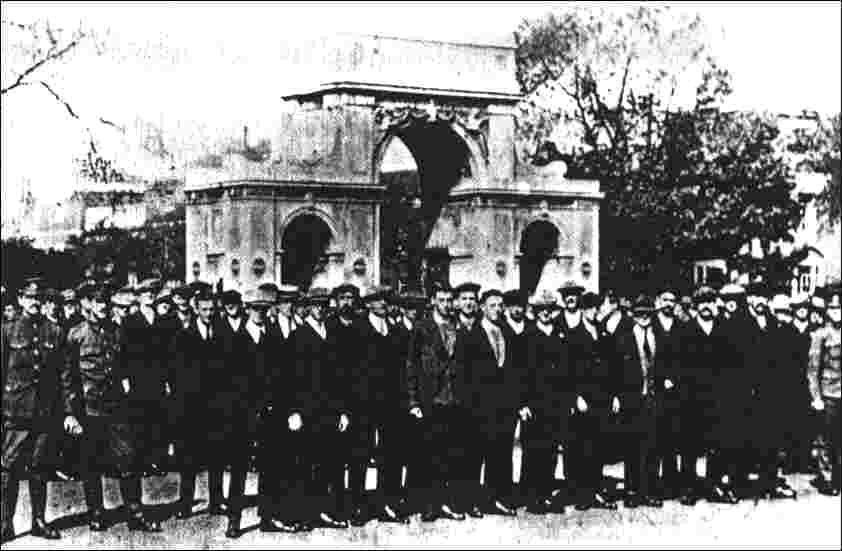
volunteers at chatham barracks
your country needs you_poster
Left - Kitchener appealed for 100,000 volunteers to man a New Army, capable of fighting a protracted war.
Right - Answering the call. Volunteers at Chatham Barracks, 1914.

To previous page To Home page
or return to The Great War home page

Hosted by www.Geocities.ws

1