History of Charlie Company 65-66 |
A CLASSIC INFANTRY BATTLE: CRAZY HORSE 19-23 MAY 1966 CAPT WILLLIAM B. MOZEY, COMDR CO C 29 JAN 2000 |
|
This presentation was put together by Capt William
B. Mozey, Comdr Co C, and Capt Roy Martin, Comdr Co B and the
officers, noncommissioned officers and men of both companies that
were there. Crazy Horse is about 250 well trained, highly motivated
and battle tested airborne infantrymen of Companies “B” and “C”, 1st
BN (ABN), 8th CAV (AMBL) fighting approximately 500 North Vietnamese
soldiers of an infantry battalion and their attached heavy weapons
company (at least ten 51 cal. HMGs). The battle commenced with an
NVA ambush at a time and place when they’d had at least 24 hours to
prepare at their previously existing well-fortified ambush site.
Triple canopy jungle, close proximity, zero to 80 meters apart of
opposing forces on steep 45-50 degree slopes and, soon after, very
heavy rain, darkness and fog prevented use of all available
supporting fires, including both companies 81 mm mortar platoons
which remained at our battalion forward base. The bottom line was
that we won this battle solely by expert use of infantry tactics and
our organic infantry weapons (M60 light machineguns, M16 automatic
rifles, M79 grenade launchers, and hand
grenades). |
| Here now is the
true, exciting story of brave young Americans personally selected,
trained and taught to fight as “A Band of Brothers”, solely by a
seasoned, hardcore combat veteran of three wars, Colonel Kenneth D.
Mertel. He’ll always be “Our Commander” and in spirit it was Colonel
Mertel who led us to victory that day, although no longer with the
Jumping Mustangs, having moved to Brigade HQ as Deputy
Comdr. 19 May 1966, 0800 hrs: B1/8 CAV under command of Capt. Roy Martin moves out to the “Green Trace” perimeter defense line of the 1st CAV DIV (AMBL) at it’s Base Camp, AN KHE, VN replacing B2/8 CAV under command of Capt. John Coleman, who’d recently assumed command after a staff assignment at Division. B 2/8 was going out “on a training mission” N.E. of AN KHE some 25 minutes via UH-1D helicopters. C 1/8 was soon to return from their latest combat operation. 20 May, 0900 hrs: C 1/8 CAV under command of Capt. Bill Mozey returns to AN KHE Base Camp after combat operations, enjoys a hot meat, cleans it’s weapons and replenishes it’s ammunition and grenade supplies. 1000 hrs: SP/4 Michael Vinassa, an expert with his M79 Grenade Launcher, previously named “C” Company’s finest solder and recently been assigned to help the Division Chaplain build a copy of the 1/8 CAV chapel, asks to speak to Capt. Mozey. SP/4 Vinassa explains that he greatly misses being with the company and asks to be returned to combat duty with his 3rd Platoon. Capt. Mozey is aware that he’s the last surviving male in his family, which consists only of his mother, has fought well in every battle the past nine months and has been selected to be the first member of our company to depart Vietnam within the next 3 or 4 weeks. He told SP/4 Vinassa he’d already done more than his duty and he should continue helping the Division Chaplain. He started to cry and said “C” Company was the only real home he’d ever had and begged to go out on “just one more operation and then he’d gladly help build the Division Chapel. Capt. Mozey should have said no but finally agreed to Vinassa’s plea. He’s never been able to forget that decision nor the battle spirit which truly made them “A Band of Brothers”. 1100 hrs: C 1/8 is ordered to make an air assault to assist B 2/8 which had made heavy contact with a large NVA force. There’s no time to replenish “C” rations but they’ll get more in the field. 1200 hrs: C 1/8 lifts off enroute to assist B 2/8. B 1/8 is ordered off the “Green Trace” to join C 1/8 in the same operation N.E. of AN KHE. B 1/8 will lift off at 1500 hrs. 1220 hrs: C 1/8 lands in a broad valley against ineffective 12.7 mm (.51 cal) HMG fire from surrounding hilltops. Quickly forming a combat formation, the company moves toward B 2/8 location. A 1/8 soon lands to establish a defensive perimeter for the 1/8 CAV Forward Base and C 1/8 81 mm Mortar Platoon ably commanded by 2LT Gerald Houchens. 1420 hrs: C 1/8 locates B 2/8 which is pinned down halfway up a steep ridge by heavy NVA fire emulating from bunkers atop a ridge. Using our organic weapons’ fire against the NVA, Capt. Mozey ordered both companies to pull back approximately 100 meters. 1500 hrs: B 1/8 lifts off from AN KHE to join C 1/8. B 2/8 moves to 1/8 CAV Forward Base and is airlifted back to AN KHE. 1515 hrs: Capt. Mozey orders his Artillery Forward Observer, (F.O.) 2Lt. Ron Emry, 2/19th Arty. BN (ABN), to “lower the NVA ridgeline” using heavy artillery. LT. Emry, a brave, experienced and expert artillery F.O. puts it exactly on target, pulverizing the NVA positions and all enemy bodies. 1630 hrs: C 1/8 seizes the ridge without further opposition. NVA positions are thoroughly destroyed. They were well-built log bunkers with commo wire connecting other positions on the axis of the ridgeline. Commo wire is cut and the situation is reported to 1/8 CAV HQ. B 1/8 lands and Capt. Martin establishes radio communications with Capt. Mozey. 1650 hrs: C 1/8 advances in column of platoons on top of ridgeline following it to the N.E. Immediately South of this ridgeline, 100 meters down a 45-degree steep slope, was a small creek coming from the N.E. heading S.W. towards a river. 1800 hrs: C 1/8 halts and forms a defensive night perimeter on the ridge. There hasn’t been any enemy contact since we seized the ridgeline nor would there be any during the entire night. This will become a critical factor in the coming battle. 21 May, 0500 hrs: C 1/8 eats breakfast before dawn. Capt. Mozey orders the platoon leaders to continue the advance to the N.E. atop the ridgeline which generally runs S.W. to the N.E. 2LT Jon Williams leads with the 2nd Platoon, 2LT Patrick Greiner follows with the 1st Platoon and 2LT Frank Vavrek remains in reserve with the 3rd Plat. The Company HQ element remains to the rear of the lead 1st Platoon. By coincidence, the point man, who’d recently returned from the hospital at Camp Zama, Japan where he’d recovered after being gut-shot a few months prior. Upon reporting back to the company, he said he was “so damn happy to be back with “C” 1/8 and wanted to be point man forever so he could shoot some NVA in the stomach and then they’d know how painful it was”. Capt. Mozey explained it was best that everyone rotated through the point man position but this just happened to be his turn as point this morning. |
| 0630 hrs: The point
man, a seasoned combat infantryman, silently snuck up on a NVA
Outpost and kills all five NVA who’d unwisely stacked their AK-47’s
and were eating breakfast. 0700 hrs: Capt. Mozey radios situation report to Bn Forward Hq, fully explaining that it’s obviously a large enemy force is in the area, including that LT. Vavrek (following last on the ridgeline as the reserve platoon) has heard NVA to his rear. Capt. Mozey radios SITREP to his friend Capt. Martin who is also heading N.E., nearby on the South side of the creek below which Capt. Mozey can sometimes observe from the very few places that the triple canopy jungle permits. Both experienced commanders concur that they’ve never seen such extensive evidence of NVA forces nearby and they agree they’ll coordinate their companies attack when the NVA are encountered. 0930 hrs: B 1/8 trooper is wounded by a NVA sniper firing from a position in a tree. A rifle squad carries him back for medical treatment to the 1/8 BN HQ approximately 2 km away. B 1/8 observes other NVA nearby. Considering the increased signs of the NVA, Capt. Martin orders this squad to remain and assist the 1/8 BN HQ at its Forward Base. AFTERTHOUGHT #1: Both commanders agree that the triple canopy jungle was so heavy that the commander of nearby NVA forces may not have heard his Outpost being wiped-out. Furthermore, if the NVA commander did hear the Outpost being wiped-out, B 1/8 was thought to be the U.S. unit which wiped-out this outpost. Thus, Captains Martin and Mozey are thoroughly convinced that the NVA were totally ignorant of the presence of C 1/8 advancing in control of the high ground of the ridgeline which C 1/8 had never relinquished control of since the previous day and didn’t until after the battle had been won. 0930-1200 hrs: B 1/8 and C 1/8 continue their advances paralleling each other respectively on the South of the creek and on the ridgeline North of this creek, both heading N.E. B 1/8 personnel periodically detect NVA on their Southern flank and to their rear. C 1/8 encounters no NVA but find numerous log bunkers and sniper positions in the trees. Commo wire connecting these positions along the ridge is habitually cut. These are overwhelming signs that a large NVA force is nearby! Both company commanders report these developments to BN HQ, making all concerned aware that heavy combat is imminent! 1205 hrs: BN HQ orders C 1/8 to depart their ridgeline position and link-up with B 1/8 at the creek below. Knowing that battle is eminent and that the high ground must be held, Capt. Mozey elected only to meet with Capt. Martin at the creek immediately below and South of his concealed position atop the ridge. Capt. Mozey informs Capt. Martin of his decision and both companies halt in place for lunch while the company commanders meet to discuss the situation. 1210hrs: Capt. Mozey halts C 1/8 and brief’s his platoon leaders. Lieutenants Grenier and Vavrek are ordered to secure the ridgeline while 2 LT Williams is ordered to spread his platoon across the approximately 80-100 meters down the steep 45-50 degree slope. Capt. Mozey, his RTOs and HQ element accompany him down to the creek where Capt. Martin and B 1/8 await their arrival. 1225-1300 hrs: Captains Martin and Mozey share one tin of jam for lunch and make plans for the battle they both expect at any moment. The small creek coming from the N.E. and flowing S.W. will be the dividing line and appropriate platoons will maintain visual contact at the creek line. They use their binoculars and note that the NVA had numerous bunkers and foxholes on a fortified finger coming down from the ridge controlled by C 1/8. This finger of land was some 100 meters East of us. Capt. Mozey ordered his F.O., 2LT Emry to call in 105 mm artillery on the finger. The fire was right on target but no enemy movement or reaction was observed. The captains correctly surmised that the enemy had no troops in these positions. However, after six months of fighting the NVA, they knew they were close by and that battle was eminent! Later they learned that NVA formerly in these positions had been ordered to temporarily leave, conceal themselves East of this fortified finger and reoccupy these same positions when ordered to bring deadly crossfires on B 1/8 which would then make it impossible for anyone to escape this NVA ambush. Would the 7th Cavalry defeat at The Battle of the Little Big Horn repeat it’s self? 1300 hrs: The NVA battalion (reinforced) suddenly starts the battle with overwhelming light and heavy machinegun and automatic AK47 rifle fire. At this same moment C 1/8 occupies the finger of land full of NVA bunkers and foxholes. Commo wires linking these well-prepared positions are promptly cut. At least two cooking fires are still smoking and there’s a slit trench latrine. All fires are being directed at 2/LT Crum’s, 1st Plat, B 1/8. Not one single NVA bullet is directed at C 1/8 which now not only holds the high ground on the ridgeline but the entire NVA fortified finger of land. C 1/8 quickly establishes a perimeter around the upper 70% of this finger, which includes all the NVA positions. |
| Capt. Martin was
soon on the radio explaining the B 1/8 situation to Capt. Mozey: B
1/8 was pinned-down by heavy fire, a platoon nearest C 1/8 was badly
shot-up and needed rescue. He needed “to borrow” a platoon and most
of all, needed massed machinegun and rifle fire commencing at the
yellow smoke extending 50 meters East to a tall teak tree. Capt.
Mozey assembled 50% of his M60 LMGs and immediately delivers the
requested massed MG fire at the designated area. In addition,
virtually all C 1/8 M16 rifles and M79 grenade launchers joined-in,
saturating NVA positions with many thousands of rounds. Capt. Martin
radios that NVA snipers are shot out of trees, bunkers are being
heavily hit and NVA not killed or wounded by C 1/8 fires are forced
to get down in their positions. C 1/8 carried at least double the
amount of ammo carried by most infantry companies, but Capt. Mozey
knew both companies would need more ammunition and blood plasma.
Unexpectedly, all NVA fire instantly ceased for some ten minutes
after being hit by the heavy C 1/8 fires. This enabled B 1/8 to
safely approach and grenade the NVA bunkers and foxholes. Throughout
the battlefield, B 1/8 started killing the surprised NVA who seemed
stunned by this immediate, unexpected and deadly fire. Capt. Martin
directed the massed machinegun and rifle fire via radio to Capt.
Mozey throughout the entire battle. Despite numerous changes of
targets, Capt. Martin’s skill in directing these fires resulted in
not even one friendly casualty! His skill was the result of his
experience as an enlisted man ranging from being a machinegunner to
being the MG Platoon Sergeant in an Airborne Heavy Weapons Company
which recorded the highest ATT score ever achieved in 7th Army on
duty in Germany. Very soon after C 1/8 commenced firing at the NVA
positions, numbers of NVA approached C 1/8 from the East side of
this fortified finger. They weren’t carrying their weapons in a
manner ready to fire and obviously didn’t expect to meet American
troops. They were promptly killed and/or retreated. LT. Vavrek’s
platoon ran into more NVA down by the creek who similarly weren’t
ready to fight, seemed confused and were easily
killed. AFTERTHOUGHT #2: Both commanders agree that the reason C 1/8 wasn’t fired upon even when the NVA saw them taking up positions prepared by the NVA, was probably due to THEIR troops to reoccupy these positions after NVA troops South of the creek had ambushed and pinned-down what they still thought was the only U.S. company present! Distance from the creek up steep 45-degree slopes was approximately 80-100 m to the top of each opposite ridge. The bunkers on each were merely 100 meters apart on a straight line opposite each other. Captains Martin and Mozey believe NVA leaders were stunned when troops they thought were their own and part of their ambush plan “fired on their own comrades”. They were so stunned that they halted their fires for 10 minutes while attempting to learn the identity of troops firing at their positions instead of at B 1/8 caught in the ambush. 1305 hrs: LT. Williams’ 2nd Platoon, nearest to the creek, is ordered by Capt. Mozey to rescue LT. Crum’s platoon. LT. Williams moves his platoon under the intense massed fires of C 1/8 and very quickly survivors of LT. Crum’s platoon, including the wounded, are brought into our perimeter. While this rescue is in progress, LT. Vavrek is ordered to move his 3rd Platoon down form the ridge, report to Capt. Mozey and be prepared to assist B 1/8. LT. Grenier’s 1st Platoon is ordered to hold the upper portion of our perimeter, including the ridgeline we’ve held since commencing this operation the previous day. Capt. Mozey radios BN HQ for resupply of ammo, blood plasma and C-rations. 1315 hrs: As survivors of LT. Crum’s platoon are being brought into our perimeter, Capt. Mozey greets them and asks SP/4 David Dolby, carrying his machinegun, where the NVA machineguns are. He replied that he wasn’t sure but had returned fire against them and encouraged those around him to stay low. SP/4 Dolby said one man stood up and was instantly killed by the heavy NVA fire. He also said that all but five of his platoon had been rescued and were now safely in our perimeter. SP/4 Dolby thought that the missing five men were dead. Capt. Mozey ordered him to assemble all members of his platoon still able to fight and report to LT. Grenier to help defend the upper side of our perimeter. The wounded were put into protected NVA bunkers and treated immediately. LT. Williams was ordered to occupy NVA positions and defend the lower half of the perimeter. 1300-1315 hrs: Amidst all that was happening, Captains Martin and Mozey quickly discussed their battle plan via radio and agreed their close proximity to the NVA and the triple jungle canopy over and surrounding them prevented use of air, artillery and ARA supporting fires. However, Capt. Martin said the massed machinegun fire was having a devastating effect on the NVA and he continued his personal direction of C 1/8 supporting fires throughout the entire battle. During this same “busy time” LT. Vavrek, C 1/8’s most experienced LT, reported to Capt. Mozey and was ordered to switch his PRC-25 radio to B 1/8 frequency and report to Capt. Martin for further orders. |
| Lt. Vavrek was
called “The Lead Magnet” as he was always at the point of heaviest
enemy fire. Standing nearby him was a very brave trooper, SP/4
Michael Vinassa, who could “tread a needle” with his M79, 40 mm
grenade launcher. Capt. Mozey put his hand on his shoulder and said,
“Frank, don’t let Vinassa do any John Wayne heroics.” LT. Vavrek and
his 3rd Plat immediately crossed over the creek to fight under Capt.
Martin’s orders. 1315 hrs: About this time the stunned NVA leader recovered his senses with a vengeance! After not firing a single round for approximately 10 minutes while trying to determine if it was his own troops mistakenly firing at them from NVA positions opposite them as planned to finish-off B 1/8 with deadly crossfire after the ambush commenced, the NVA leader directed heavy fires against C 1/8. Numerous .51 caliber HMGs raked our perimeter but did little damage. However, fire was so heavy that trees were being cut-down and Capt. Mozey told his RTOs, “God Damn, these woods are rotten.” Soon after the HMG fire commenced, the NVA launched a counter attack against the West side of the perimeter. As heavy fire was now coming from two directions, one of Capt. Mozey’s RTOs licked his finger, held it up and said, “I think it’s now heaviest from the West and we should change positions.” LT. Williams’ 2nd Platoon halted this determined attack with instant heavy fire. The NVA continued their determined but disorganized counter attacks by small isolated groups for the next hour. Capt. Mozey walked the perimeter, encouraging his troops, visited the wounded and repeatedly talked with Capt. Martin as he ordered a shift in the massed MG fire of C 1/8. Afterthought #3: Not only was the NVA leader confused and his troops not given orders for a least 10 minutes but numerous commo wires had been cut and subordinate leaders killed or wounded. NVA troops attempting to carry out existing orders to re-occupy their previously occupied positions on the “fortified finger” now occupied by C 1/8 were separated and confused to the extent that several didn’t realize these were Americans. As they approached they were easily killed. The NVA leader was under the added pressure of being observed by at least three VIPs who were invited to witness “the planned, easy annihilation of an American airborne company”. On top the NVA ridge the next morning C 1/8 discovered “an elaborate veranda” with three graves under it. Several shot-up, folding chairs were nearby. This was unusual. Why would the NVA take the time to give anyone “an honorable burial” when over 50 dead NVA were left where they fell on the battlefield? Capt. Mozey ordered these three graves dug-up. Two of average Asian height were dressed in safari suits as opposed to the dead NVA troops’ uniforms. The third dead man was 6’2” tall and wore a Chinese, dark blue, wool turtleneck sweater that we’d heard Chinese advisor’s wear. Capt. Mozey laid beside him for measurement and noted there wasn’t any blood on his sweater as a single bullet had hit him in the forehead and his head must have been in a downhill position when he fell. Beneath him was a knapsack unlike what the NVA used. It was full of documents, many in Chinese, which Capt. Mozey was able to identify as he’d collected Chinese and Japanese weapons and militaria for over 20 years. Even more interesting was an 8” x 12” photograph of him in the dress uniform of a high-ranking officer in the Chinese People’s Army. He’d signed the photo which was in a glass and wood frame and obviously intended for presentation to some dignitary. It gave Capt. Mozey a wonderful, warm feeling while smiling and taking off the Chinese’s sweater for his use during the cold nights. He also took the Chinese pistol, holster and belt as souvenirs, later giving them to one of his sons. What irony! These VIPs had been invited by the over-confident NVA officers to sit and enjoy watching Americans die! THEY PROBABLY LIKED THE INITIAL PERFORMANCE BUT WEREN’T AWAKE FOR THE DRAMATIC FINAL ACT. After their opening fire and being quickly hit by the massed return fire, the NVA leader had to be extra nervous and dismayed as he watched his well planned ambush crumble into a disaster in front of these VIPs he was so confidently going to impress. The NVA leader was certainly aware of the 1/8 CAV Forward Base a few miles away and the Air Cavalry’s instant response capabilities. All of these factors combined to destroy the methodical thinking mind of the NVA leaders. Unlike trained American combat leaders, they couldn’t “think on their feet” and quickly adjust to an unexpected and rapidly changing situation. 1420 hrs: It was raining fairly heavily by now but as the rains increased, the NVA attacks and gun fire against C 1/8 perimeter decreased. This was due primarily to the determined and highly effective attacks by B 1/8 lead by Capt. Martin and ably assisted by Lt. Vavrek’s 3rd Platoon from C 1/8. Capt. Martin and his men slowly destroyed bunker after bunker of NVA troops. Before long, the increasing rains brought fog and it got darker much faster than normal. This, added to the fact they were fighting in triple canopy jungle, increased difficulty of Capt. Martin’s command and control. |
| Despite all
problems, he and his troops continued the slow process of locating
and destroying each and every NVA position as they moved up the
slope, continually adjusting the massed LMG fire by radioing Capt.
Mozey. 1430 hrs: Capt. Mozey received a radio message that needed resupply would soon be enroute despite the lack of adequate visibility for safe flying. Two or three “Huey Slick” helicopters, and accompanying gunships, approach. They’re flown by very brave pilots who’ve eagerly volunteered to fly in this dangerous weather. There’s no LZ within several miles as a large enemy force surrounds us and it’s such bad weather that neither the helicopters nor “B” and “C” 1/8 can see each other. Illumination flares and strobe lights are totally ineffective. Considering the large number of NVA light and heavy MGs, Capt. Mozey warns the pilots to make a fast fly-over and throw the supplies out at his command when engine noise is the loudest. He didn’t want to lose a helicopter and crew and didn’t want a burning helicopter to crash into his defensive position. This is done on the second pass. Most supplies land within C 1/8 perimeter but some luckily land nearby B 1/8 troops who welcome the needed resupply of ammo. However, the day has gotten so dark that falling supplies weren’t visible until they’re only 5-6 feet above one’s head. Falling supplies strike at least two troops but they’re not seriously hurt. The gunship pilots offer use of their deadly machinegun and rocket fire, but Capt. Mozey declines these fires due to the inclement weather, triple canopy jungle trees and close proximity to the enemy. The entire battlefield is almost exactly the size of a football field. 1500-1600 hrs: C 1/8 perimeter was receiving only periodic and ineffective gun fire from various small groups or individual NVA who remained alive. They continued their massed machinegun fire in support of B 1/8 until about 1530 or 1600 hrs when Capt. Martin observed it striking the very top of the ridge (where we discovered the veranda and three dead VIPs the next morning). Wounded from both companies were receiving appropriate medical treatment in the safety of protected, formerly NVA positions seized from the NVA by C 1/8. Meanwhile, an inspired Capt. Martin continues leading B 1/8 efforts to destroy the NVA “down to the very last SOB”, as he radios Capt. Mozey periodically with quick progress reports. Throughout all this heavy fighting Capt. Martin has remained his usual “cool, calm and collected self”. His low, steady voice never gets excited and greatly inspires his troops as he shouts commands while personally destroying bunker after bunker with hand grenades supplied by his RTO who is a C.O. (conscientious objector) and doesn’t want to personally kill. B 1/8 and LT. Vavrek’s 3rd Platoon continue this close combat until approximately 1700 hrs when Capt. Martin, his RTO and one other trooper shoot the guard outside the door into the NVA Command Bunker, jump in and shoot all eight NVA officers dead. 1700 hrs: A heavy fog descends close to the ground amidst the steady, heavy rain. Movement is difficult on the now slippery, steep 45-degree slope. Disregarding these problems, Capt. Martin, who had fought his way up to the ridge, now moves down towards the creek throwing grenades in through the back doors of all bunkers he encounters. His men and LT. Vavrek’s platoon are killing every NVA in virtually all their bunkers and foxholes. In such close combat with very little visibility. 1800 hrs: Capt. Martin radios Capt. Mozey requesting illumination be fired by the 105-mm howitzer battery supporting C 1/8. Illumination comes quickly and is critical in order to locate our wounded and KIA, including the five men missing from the initial ambush of LT. Crum’s platoon. It also enables B 1/8 and Lt. Vavrek’s platoon to locate and kill any NVA they may have overlooked in the darkness, fog and increasingly heavy rain. This continues for some two hours. All firing at C 1/8 has stopped and B 1/8 has run out of NVA to kill. 2000 hrs: There hasn’t been a single enemy shot fired for over two hours even though the illumination makes B 1/8 and C 1/8 “easy targets”. The task of carrying the dead and wounded up the dark, slippery and steep slope commences. In the daylight when it was dry, it was very difficult for anyone to climb these slopes. Now, the fog and rain has made these slopes nearly impassable. The added weight of the dead, wounded, their equipment and captured enemy weapons, etc., greatly increased the difficulty. Parachute suspension lines, strong shrubs, vines and trees plus human chains were used in the slow process of bringing all into the C 1/8 perimeter. All were aware that while NVA in the immediate area were dead, badly wounded, or had “run for their lives”, a large enemy force was probably nearby and could attack at any moment. “B” and “C” 1/8 had to get everyone into that well prepared perimeter ASAP in case of an NVA counter attack. |
| The triple canopy
jungle, bad weather and distance from any friendly force left B 1/8
and C 1/8 totally isolated in an area “infested” with vastly
superior enemy forces which certainly wanted revenge! 2130 hrs: Capt. Martin and LT. Vavrek radio Capt. Mozey that all their personnel have reached the creek just below the C 1/8 perimeter. Capt. Mozey then requested that his 105 mm arty battery use one tube to continue firing illumination rounds and use the remaining five tubes to fire high explosive (HE) at the top and behind the NVA ridgeline in order to kill surviving and retreating NVA. Cdr 1/8 BN personally radioed and told Capt. Mozey he could have 6 tubes firing illumination or firing HE at the NVA ridge. THAT WAS THE ONLY OPTION: NO MIX OF ILLUMINATION AND HE! Illumination was absolutely critical and Capt. Mozey chose it. Without illumination, it would be nearly impossible to save our wounded as well as bring everyone into the relative safety of the C 1/8 perimeter from which we could easily defend against possible NVA counter-attack. Capt. Mozey had never had anyone interfere with his supporting fires before. 22 May, 0130 hrs: It took 5 to 6 hours of maximum effort to bring all into the perimeter of C 1/8. Without illumination you couldn’t see beyond 10-12 feet through the heavy fog and driving rain. Captains Martin and Mozey quickly planned and placed B 1/8 and LT. Vavrek’s 3rd Platoon in positions to strengthen perimeter defense. Resupply of ammo, grenades and “C” rations was distributed. Wounded were being cared for in NVA positions which were protected from the rain. Officers and NCOs visited their wounded, praising their brave actions, which led to this great victory, and assuring them they’d recover after being medivaced at first light. They had been awake for nearly twenty tension filled hours, which had steadily increased in intensity to today’s violent life and death conclusion. There hadn’t been time to eat and smoking in the open wasn’t allowed as enemy snipers may have been waiting to shoot at lighted cigarettes. Troops were soaking wet, splattered with mud: happy to finally enjoy a peaceful moment despite sitting or laying in cold, wet mud being chilled by the heavy rain which was driven by strong, chilly winds. Blood from minor wounds and cuts inflicted by rocks and the thick jungle vegetation ran down their smiling faces and torn uniforms. A bit of American blood fertilized these slopes today but these brave troopers made certain the NVA were “the greatest contributors”! YET, THERE WAS A WARM GLOW EMULATING THROUGHOUT THIS COLD, DARK AND LONELY PERIMETER: THE PROUD, CAN-DO SPIRIT OF WELL-TRAINED, WELL-LEAD, SEASONED PARATROOPERS WHO’D REPEATEDLY PROVEN THEY WEREN’T AFRAID OF THE BEST NVA UNITS WHOM THEY’D SAVAGELY BEATEN WHENEVER THEY WERE ENCOUNTERED! 0100-0600 hrs: Medics continued working on the wounded under shelter, “Cs” were being eaten, a few smoked cigarettes in their holes and the few who carried ponchos sought shelter from the cold rain and wind. (Most carried a piece of 6’ x 6’ vinyl to wrap around their bodies and weapons to conserve body heat.) Orders were given allowing 50% to get a couple hours sleep while the remainder stayed on alert against a possible NVA counterattack. It had been over three hours since Capt. Mozey had been denied HE artillery fire on the NVA ridge, so he didn’t request it again thinking the NVA had ample time to retreat from the area. He revisited his wounded and his Chief Medic SP/5 McDonald called him aside, out of earshot of other troops. One of C 1/8’s most popular and finest machinegunners, SP/4 David Jolley, was bleeding to death internally and desperately needed surgery or he’d die. Capt. Mozey asked why SP/5 McDonald couldn’t do the necessary surgery and this outstanding Chief Medic, who’d already won two Silver Stars for bravery, explained that only a medical doctor and aid station had the skill, personnel and equipment to successfully accomplish the major surgery required. Capt. Mozey summed-up the situation and said aloud to SP/5 McDonald, “We’re in an isolated position with reduced strength, over two miles from 1/8 CAV BN Forward Base through heavy, rugged terrain, under triple canopy jungle being hit with cold, bitter fog, rain and wind in near total darkness and probably surrounded by superior NVA forces seeking revenge.” SP/5 McDonald replied, “You’re the commander and paid to make decisions. What are your orders?” Capt. Mozey made his decision: “There’s no reasonable chance of a successful medivac and I can’t waste men’s lives. Tell Jolley he’s going to be O.K. and will be the first on the morning’s medivac. Make sure he doesn’t feel any pain.” Capt. Mozey walked back to SP/4 Jolley and talked encouragingly but was trying hard not to let Jolley see his tears of farewell to a good man who’d fought beside him through so many battles. SP/4 Jolley would receive a Silver Star Medal for his bravery. Capt. Martin had similar thought about getting the wounded to safety but arrived at the same decision: There wasn’t anyway to remove our wounded until morning’s first light! Shortly after 0100 hrs on 22 May 1966, Capt. Martin radioed for help from an aerial gunship and soon an AC-130 was flying overhead. |
| However, it was so
dark and raining so heavily that it’s illumination flares were
hardly noticeable. Its massive fire support wasn’t needed, but its
presence was reassuring. Capt. Mozey sat down and fell asleep for a
short time but was awaken by artillery or ARA fire impacting behind
the NVA fortified ridge opposite our defense perimeter. Either Capt.
Martin had ordered this appropriate supportive fire or perhaps the
Bn Comdr had finally ordered the fires which had earlier been
denied. Capt. Mozey then had time to visit SP/4 Michael Vanessa’
body. He was C 1/8’s most effective and popular M79 man who would
receive the DSC for his bravery. Vinassa lay wrapped in a poncho.
The captain lifted it away from Vinassa’s face and whispered his
goodbye. His decision to allow SP/4 Vinassa to go on “just one more
operation” had the inescapable impact on Capt. Mozey. This emotional
moment would return when he visited SP/4 Vinassa’s mother after
returning to America. After six month of front line combat together,
Capt. Mozey and C 1/8 CAV had become “closer than brothers” and
every loss pained the heart. Throughout this dark, rainy morning Captains Martin and Mozey reflected on the battle, walked the perimeter, visited the wounded, radioed SITREPs to BN HQ and made plans to defend their perimeter should the NVA launch counterattacks. After brief naps for short periods if any, “B” and “C” 1/8 CAV stirred with activity. Exhausted troops, chilled to the bone by 10 hours of heavy rain, strong winds, and dropping temperature, shake off fatigue with hot coffee, “C” rations, cigarettes and the knowledge they’d just won one hell of a fine battle and would be alive to see the coming day. Before dawn, preparations were being made to medivac the wounded and tree’s had to be removed in order for litter baskets to be lowered through the triple canopy jungle surrounding us. Captains Martin and Mozey plan for the coming day and they agree that B 1/8, which had suffered the most casualties, will remain on this fortified finger of land and be responsible for evacuation of all casualties. They will be protected by LT. Vavrek’s 3rd Platoon, C 1/8. The remainder of C 1/8 will advance up the opposing NVA ridge, kill any NVA who remain, police the battle field for weapons and documents and then pursue any NVA who managed to escape. The Bn Comdr approves the plan and shortly after dawn this plan is executed. 0600-0700 hrs: Dawn arrived bright and clear. “Huey” helicopters hovered above and using ropes, lowered chainsaws, axe’s and extra gasoline in order to cut a large enough opening for the medivac litter baskets. More enemy action was expected and troops remained on alert around the perimeter, but not one single round was fired at “B” and “C” 1/8 CAV on this day! SP/4 David Dolby had the most knowledge where the five KIA missing from his platoon might lay and was ordered to accompany C 1/8 into what had been the NVA positions of the battlefield. The bodies were located and all five were tenderly carried up the steep slope to be medivaced to the Graves Registration Point. 1/8 CAV never abandoned any of their wounded or dead and that fact reassured every trooper! 0700-0800 hrs: C 1/8, minus 3rd Platoon, cautiously advanced up the through the NVA positions. Enemy weapons and anything of value were brought to a single location for evacuation to AN KHE Base Camp. Anxious to pursue any NVA survivors and now without his 3rd Platoon, Capt. Mozey ordered his troops not to follow blood trails away from the battlefield. Most likely, wounded NVA were or would soon be dead where they lay. Like the Americans, the NVA couldn’t possible locate all their wounded and dead during that dark, rainy night. C 1/8 counted some 50 NVA bodies laying where they’d fallen in and outside of their fortified positions including the graves of the three VIPs under a well made veranda atop the ridge surrounded by several shot-up folding chairs. Capt. Mozey knew it was highly unusual to bury three men in such a prominent location, while some 50 others lay where they fell in battle. The NVA always carried away their dead and they had 13 hours to do this while both sides “licked their wounds”. Captains Martin and Mozey believe that the actual numbers of NVA dead and wounded were so enormous that NVA simply lacked enough survivors and probably no leaders to order the recovery of all dead before the Americans would find them. The NVA habitually did this so their battle losses wouldn’t be known. 0800-0900 hrs: Capt. Mozey radioed a SITREP to BN HQ and commenced pursuit of surviving NVA along a heavily traveled trail atop the ridge heading in a East-South East direction. Troops had “a blood lust” and some shouted out loud their intentions to annihilate any and all NVA. The number of blood trails, bloody bandages and discarded equipment increased as C 1/8 proceeded after the enemy that was obviously badly hurt. About 0900 hrs Capt. Mozey received orders from the Bn Comdr to halt and return back to the defensive position they’d established the previous day. Capt. Mozey protested and explained it would waste a great opportunity to annihilate weakened NVA survivors of the battle. No reason was given but the Bn Comdr repeated his order and C 1/8 turned around and returned as ordered. |
| 1000-1130 hrs:
Shortly after arriving at its former defensive perimeter, C 1/8 was
ordered to make an overland march to 1/8 CAV Forward Base. Moving in
combat formation, ready for enemy action, we encountered no enemy
except one VC courier riding a bike along a well-used trail. He was
instantly killed and C 1/8 arrived at our battalion’s forward base
without further incident. CONCLUSION: Thirty four years after fighting this great battle and following four long days of “re-fighting it again” as the only two commanders on that battlefield and the only ones aware of their joint plans and actions, both Captains Martin and Mozey, after reading all statements, reports and maps of other participants, as will as, telephone discussions with others who were there, are totally convinced that the unexpected arrival and seizure of the NVA fortified finger of land immediately North of the creek by C 1/8 was and is the key factor enabling these two well trained and highly experienced airborne rifle companies (ably lead by two very aggressive “battle-smart” captains who were and remain best of friends) to fight wisely and win a great victory against a vastly superior NVA force which was very nearly destroyed in a battle the NVA had thoroughly planned for some 24 hours and initiated at a fortified ambush site of their choice. It is the hopes of both Captains Martin and Mozey, that the U.S. Army will award the Valorous Unit Citation so clearly deserved by Companies “B” and “C”, 1st Battalion (Airborne), 8th Cavalry, 1st Cavalry Division (Airmobile). Wm. B. Mozey Jr., All Rights Reserved. Permission is granted to Mr. Glenn Sheathelm, an artilleyman who fought with the 1/8 CAV, for full use of all material in writing an article on this battle and to Col. Kenneth Mertel, Maj. Roy Martin and all other veterans of 1/8 CAV, rights to reprint all this material on the Internet and any other media in order to inform and bring honor to the “Warrior Band of Brothers” forged by and so bravely and wisely lead by Colonel Kenneth D. Mertel: 1st BN (ABN) 8th CAV (AMBL), “The Jumping Mustangs”. An excellelent report. Congratulations to all who participated. A related report is under History B Co, 65-66. (Posted by Mustang 6, 29 Jan 00). IF YOU WERE THERE AND WISH TO COMMENT, SEND COMMENTS TO MUSTANG 6, "[email protected]". |
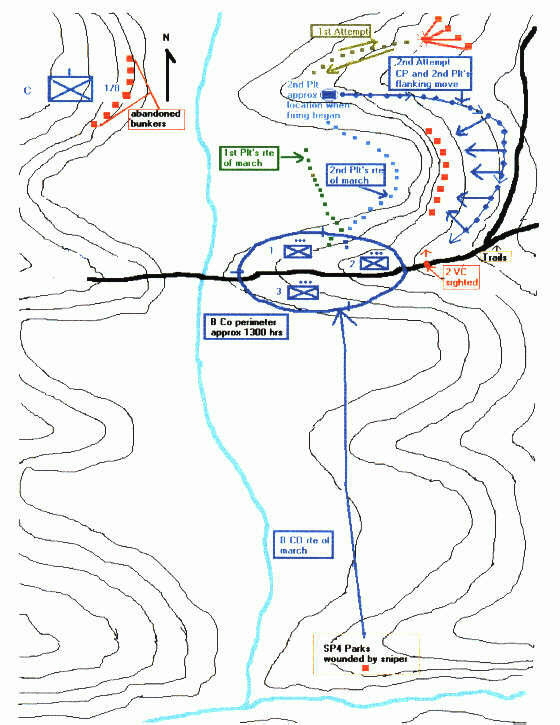
| SKETCH OF CRAZY HORSE BATTLE, (Col Bill McCarron) |
|
| A SHORT HISTORY OF
1965-1966 PRE VIETNAM Following the return to Japan, the 8th Regiment trained for winter warfare during the years of peaceful occupation, 1952-57. In August of 1957, the unit was transferred minus equipment and men to Korea where the 24th Infantry Division was redesignated as the 1st Cavalry Division. Returning to Korea, the 8th Cavalry assumed the position of watchful defender, deployed along the de-militarized zone. This deployment was continued from 1957 to the beginning of the Vietnam War. The new concepts which ultimately gave rise to the 1st Battalion, Airborne, 8th Cavalry , 1st Air Cavalry Division, Airmobile, are interwoven among the 8th Regiment's colorful and rich legacy. Recalling the elusive and dogged adversaries of the early frontier days and the tenacious natives of the Philippines, it is apparent that mobility was the key to waging successful operations against them. The cavalry provided the needed requirements. Faced with similar enemy in the jungles of Vietnam, a new type of cavalry was needed. VIETNAM PREPAREDNESS The 1st Cavalry was recalled from Korea in 1962, minus men and equipment, to subsequently be joined with the 11th Air Assault Division (Airmobile) to form the 1st Air Cavalry Division, Airmobile, on 3 July 1965. The Airmobile concept, hitherto an experiments, was achieving reality. This concept was soon to be tested and modified in the realities of combat in Vietnam. While the division was undergoing final preparation at Fort Benning, Georgia, the President had decided to commit the division to ground combat. The 1st Battalion, 8th Cavalry became one of the eight battalions in the division. The Jumping Mustangs were attached to the 1st Brigade, which was picked to receive airborne training - thus the whole battalion became parachute qualified. Designed to free the infantry trooper and his logistical support from the iron grip of the terrain, the 8th Cavalry was a new extension of the mobile policy followed by the old cavalry in the frontier days. Although this marked the first time the 8th Cavalry had been on U. S. soil in twenty years, the troopers were destined to again depart for overseas assignment, one which would required the ultimate in modern warfare and airmobility. The tactics employed in Korea and World War II, were to be set aside in favor of mobility and striking power in order to deal with the counterinsurgency and guerrilla warfare. After President Johnson's declaration on 28 June 1965, the 8th Cavalry had eight weeks to prepare for deployment to Vietnam. After many hours of training in new weapons, new tactics and new methods of supply, the 8th Cavalry departed on the Navy transport GEIGER for Vietnam from Savanna, Georgia. The date was 20 August 1965. DEPLOYMENT Arriving on the coast in Vietnam at Qui Nhon, the 8th Cavalry moved by helicopter to the division base area North of An Khe in Binh Dinh Province. After preliminary skirmishes with Viet Cong forces which resulted in the capture of enemy equipment and rice, the 8th Cavalry participated in the Pleiku Operation, for which the 1st Cavalry Division received the Presidential Unit Citation. Involved in action around Plei Me, Duc Co, and the Ia Drang Valley, the 8th Cavalry also cleared Highway 19 to the West of An Khe. By the end of November, over 1,500 enemy had been officially listed as KIA and over 600 weapons had been captured. The remainder of the year was spent in conducting operations around An Khe with the with the technique of combat air assaulting, rappelling and ground coordination being perfected. In addition to the Presidential Unit Citation, SP4 Raymond Ortiz won the Distinguished Service Cross in the Ia Drang valley action. Already at this stage, the success of the air mobile concept as evidenced by the Pleiku Campaign, proved the 8th Cavalry was on the right track. At every turn, airmobility had stymied enemy plans and coordination. The campaigns in the years that follow illustrated the battalion's ability to meet the challenges of wear, terrain and the enemy. 1966 The first year in Vietnam saw the battalion operate in sweeps while perfecting the techniques of cordon and search and clear operations. Operating from an interlocking system of landing zones, the line companies were covered by supporting elements, notably aerial rocket artillery and conventional tube artillery. The names for these battalion sized operations, designed to clear enemy strongholds and disperse enemy troops, harked back to the frontier days, as the 8th Cavalry was again chasing an elusive enemy. The year 1966 was one of learning and adapting. During the course of the year, the 1st Battalion, Airborne, 8th Cavalry, killed more than 430 Viet Cong and captured over 100 enemy. They destroyed and/or captured over fifty tons of rice and equipment. |
| The beginning of the
year opened with the 8th Cavalry conducting operations around An Khe
and eventually pushing to the Cambodian Border. Conducting Operation
JIM BOWIE later in the Spring, the battalion learned a costly lesson
in Viet Cong booby traps as 85 Sky Troopers were wounded, stepping
on pungi stakes, trip wires tied to grenades and other ingenious
devices. 20 May 1966 began with fighting erupting on all fonts as
Operation CRAZY HORSE swept into full force. Although the enemy was
soon reduced to squad sized units or smaller, the Viet Cong fought
tenaciously. During the course of action in which B and C companies
were involved in a fierce battle, SP4 David Dolby of B company won
the units first Medal of Honor Medal in Vietnam. There were many
other awards won including a Distinguished Service Cross, by Capt
Roy Martin, Commander of B company. The results of the operation
confirmed that a fierce struggle had indeed been waged. 85 enemy
were killed and 22 captured. The battalion lost 12 men and had 54
wounded. After several days of rest, the battalion again was faced with a new challenge as their mission to go forward and relieve and element of the 101st Airborne Division. Accomplishing this mission, the battalion returned to LZ Eagle and fended off a ground attack by two North Vietnamese companies. Co B killed 97 enemy and captured a large quantity of weapons and ammunition. Even at this early date, the North Vietnamese were required to bolster local Viet Cong unit. This was to become an ever increasing occurrence as the battalion forced back the local Viet Cong and decimated their numbers. Results of the operation, called NATHAN HALE, were highly successful. A ratio of 24 to 1 was chalked up in killed. For this action, the battalion received its second Presidential Unit Citation, dated 21-22 June 1966, embroidered TRUNG LUONG, after the successful conclusion of a key battle in this operation. Proving the versatility and adaptability, the battalion had fought the enemy in various types of terrain and weather. Late in the year, the battalion moved to the China Sea Coast in OPERATION IRVING, eventually pushing a defeated enemy into the sea or into the hands of other units. On 17 November 1966, the battalion in conjunctions with the Second Battalion, 8th Cavalry celebrated the Centennial Anniversary of the 8th Cavalry. During the waning days of the year, the battalion companies engaged the enemy in various firefights within the II Corps area. On 30 December 1966, Co C captured an NVA captain who had been the training officer and Chief of Staff of the 22nd NVA Division. |
