 Adolph Hitler: Another democratically- elected head-of-state
|
The Chavez government has gone beyond the limits of an authoritarian democracy and has entered into the realm of totalitarian despotism. This article discusses some of the reasons supporting this statement. To establish the perspective from which we view the present national crisis, it is crucial that we begin to present the problems, the perspectives and the hopes the country had in 1998.
THE STARTING POINT
Lieutenant Colonel Hugo Chávez Frias won democratic elections in 1998 with 56.20% of the votes (Consejo Nacional Electoral), allowing him to become president of Venezuela. At that time, the nation was immersed in the many years of economic, social, and political deterioration. For this reason, the populace -despite the 36.24% abstention in the elections, meaning that only 35.91% of the electors voted for Chavez- placed their trust in him to begin the processes for long overdue changes.
Social Aspects. The fundamental problem of the Venezuelan nation was the enormous social debt that the dominant sectors of the country had contracted with the poor, which at that time made up 57.8% of Venezuelan homes (Proyecto Pobreza de la Universidad Católica Andrés Bello). The criminal negligence of the governments of last decades of 20th Century brought about this social debt. They did not instrument nor did they even design the most important and peremptory necessity of contemporary Venezuela: a national program to concentrate all national resources towards reducing the fast growing structural poverty and social exclusion.
Ethical Aspects. Over the last decades in Venezuelan, erosion of the ethical and moral values that make up the essence of a healthy society had begun. Corruption was not only expressed in kick backs, embezzlement, fraud and other forms of theft to the public treasury but it found in political "clientelism" its most dangerous expression. Fortunately, in 1998, thanks to the campaign that Chavez developed to this effect, a massive conviction and a rising obligation concerning the need to create a large scale civic project to eradicate the corrupt administration swept the country.
Governmental Aspects. By 1998, the chronic
inefficiency and dysfunction of the State system had become acute. This was
expressed in the growing hypertrophy of the bureaucratic apparatus; the
unpunished corrupt administration; the unwillingness of the traditional
political parties to reform the Constitution of the Republic; a halt in the
decentralization process; and a decline in such basic institutions as social
security, health, control over the banking system, and tax collection. A radical
government reform was needed to cover, among other things:
· Restoring
political sovereignty to its original owners, the citizens articulated in civil
society, by eradicating the political monopoly exercised by party leaders
associated with the "clique" and "tribes" of the private social and political
sectors.
· Complete restructuring of the justice administration system, which
in the last decades, had become one of the most corrupt and inefficient in the
world
· Creating a balanced fiscal policy, which would emphasize investment
instead of government expenditures putting emphasis on the needs of the nation's
poor such as health, education, environment, and housing.
· Reducing
bureaucracy to its lowest possible expression. The Venezuelan bureaucracy was at
that time the largest in the world in terms of its population.
·
Restructuring government administrative processes to give them the highest
possible level of efficacy and efficiency.
· Eradicating administrative
corruption, which has been a determining factor for the decrease in the transfer
of wealth to the most impoverished social sectors in the last two decades.
·
Strengthening the political decentralization process by increasing the transfer
of functions and resources to local and regional administrative levels.
Economic Aspects. Faced with the collapse of
the productive apparatus unleashed by a banking crisis of gigantic proportions,
due to the drop in public and private investment, by elevated inflationary
rates, by unstable and permanently eroded currency, and by an impressive capital
flight, drastic measures were needed to reactivate the economy. Among them, the
following were announced in 1998:
· Creation of a trustworthy, transparent,
and efficient institutional framework.
· Drastic reduction in inflationary
rates.
· Stabilization of the currency by eradicating the practice of
covering the fiscal deficits through devaluating the Venezuelan currency. This
regressive practice generated a loss of purchasing power in the most
impoverished sectors, which made fresh money available fresh money for the
national treasury but, at the same time, further aggravated problems of income
distribution and increased poverty.
· Reverting capital flight, by creating a
stimulus for capital transferred out of the country to return.
· Applying a
policy which would stimulate private national and foreign investment that would
emphasize creating small and medium size businesses and the generating
employment.
· Developing an ample discussion, in a national context, about
the need to improve the fiscal income that PDVSA (the Venezuelan state owned oil
company) contributes to the country without neglecting the needed investment in
the oil industry.
THE ECONOMIC AND SOCIAL RESULTS OF FOUR YEARS OF CHAVEZ GOVERNMENT
Chavez has governed for four years under favorable financial conditions. During this period, the Venezuelan State received more than 120 billion dollars, equivalent to five times the foreign debt and which is the greatest four-year income that any government on record has received.
Economic Aspects. For the first time in the
nation's history, a petroleum bonanza was not reflected in the growth of other
sectors of the economy, or in the reinvestment in the petroleum industry. The
lack of proper stimulus for investment, the mistaken foreign exchange policy,
the lack of legal security and respect for property rights as well as a climate
of economic instability caused capital flight, which the Central Bank (BCV)
estimates to be more than 24 billion dollars. The gigantic resources were
squandered on improvised programs that did not leave a permanent print either on
the productive apparatus or on the quality of life as revealed by the following
data concerning the national reality at the end of the year 2002:
· Per
capita Gross National Product, in constant 1984 Bolivars decreased in 15% with
respect to 1998 (According to the Central Bank)
· Today 67.8% of Venezuelan
homes live below the poverty line (According to the Universidad Católica Andrés
Bello, Poverty Study)
· In 2002, the contraction of the Venezuelan economy
---before December's national strike---- was calculated as 7% of the Gross
National Product, and that year's capital flight was 11 billion dollars
(According to CEPAL. The president of the Venezuelan Central Bank backs these
figures, El Nacional, December 28, 2002).
· Direct foreign non-petroleum
investment, fell from 2,947 million dollars annually in 1998, to 456 million
dollars (data from SIEX, Finance Ministry), meaning that investments today are
15% what they were at the beginning of the Chavez government.
· The total
direct foreign investment (petroleum and non-petroleum) fell from 4,262 million
dollars in 1998, to 456 million dollars in 2002, which translates today in 10.2%
of what they were in the year Chavez was elected (SIEX data)
· The inflation
index controlled in 2001, until it was reduced to 12.3% in 2002, jumped again to
31.20%, two percentage points above the figure it was in 1988 (According to
Central Bank projections)
· Large sums were misspent on poorly designed
programs such as the Orinoco, Apure Axis and the Bolivar 2000 Plan, which were
even more poorly controlled. As a result, they produced no public or private
long term investment, nor stable employment or any sort wealth.
·
Approximately 6,200 manufacturing firms have gone bankrupt in the last four
years (According to the Federation of Chambers of Commerce and Industry Board of
Directors Technical Committee) due to the hostile institutional environment
towards private sector development (legal insecurity, the promulgation of laws
that threaten the economic rights established in the Constitution, agrarian and
urban land squatting, elevated interests rates provoked by the mistaken
macroeconomic policy, incremented red tape clogs official procedures and
facilitates corruption.)
· Capital drain from the giant public oil company,
PDVSA. Over 15,000 million dollars marked for reinvestment were removed by the
government. In the last few years, before the current general strike our
petroleum lost 15% of its traditional markets.
In summary, the economic policy of these four years has produced very negative results that translate in a decrease in the per capita Internal Product, in further deindustrialization, in lowered levels and rates of investment, capital flight, higher country risk and the loss of the competitive edge of the national production in national and international markets. The situation has deteriorated so much that Venezuela would need seven years with an annual growth of 4% to return to 1998 economic levels.
Social Aspects. Even though the government
announces that its political project favors the poor and oppose the "oligarchs"
, results reveal that the poor are poorer today and that social inequalities
have grown when compared to 1998 figures. Some data which confirms this
statement are:
· According to estimates from the Andres Bello Catholic
University (Poverty Study) the percent of homes at the poverty level grew 10
percent between 1998 and 2002 (from 57.8% to 67.8%)
· The open unemployment
rate increased from 11.4% in 1998 to more than 16% in 2002 (According to the
National Statistical Institute and the Workers Documentation Center -CENDA-
official figures place that year's unemployment rate at more than 22% while
DATANÁLYSIS places it at 18%)
· No serious national education work program
has been implemented
· The number of informal workers has been increasing
dramatically. At present, it is estimated to be more than 52% of the employed
(According to the National Statistics Institute). That is, under Chavez the
growth of informal economy (street vendors or "buhonerización") in Venezuela has
accelerated.
· According to official figures 68% of the labor force (adding
52% of the informal workers and 16% of unemployed) has no type of social
security and for 32% which make up the formal sector, there is no reliable
system of social security.
- Public hospitals and dispensaries, the only available medical care for the most impoverished sectors, has collapsed for lack of public investment.
- The package of fiscal and monetary measures issued in February 2002, was basically neo-liberal. Any government which calls itself popular and leftist is duty bound to impose tribute with even greater force on the rich, thus proportionally freeing taxes to the even poorer sectors. This leftist duty was completely disregarded. A fiscal policy, even farther to right than the current U.S. Republican Party, was designed to cover the fiscal deficit. The package of measures increased the value added tax rate, which punished equally all members of the oligarchy as well as all members of the poorest social stratus. And, as a “revolutionary innovation” two other traditional mechanisms of the most conservative Latin American governments were applied. They are devaluation and inflation. These are regressive disguised taxes, which strike with greater fury the poorer sectors. In 1998), the dollar was valued at 546.55 Bolivares; in January 2003 it increased 277% reaching 1,515.oo Bolivares (Banco Central de Venezuela). We have already shown that the inflationary rate grew during the Chavez administration.
- Sixteen social programs, such day care centers, school uniform distribution, and school cafeterias, were eliminated. It is worth comparing this measure of a leftist government with the document/program of the Venezuelan Confederation of Industry (July 20, 2001). In this document, their goal for 2002 was opening 500,000 day care centers. (This same “oligarchy” run association also proposed free breakfasts to primary schools and a program of compensatory diet for low-income families.) - Despite the strong macro-economic adjustment program implemented in 2002, no compensatory program for the lower income classes was designed or executed. This political practice surpasses in excess all the neo-liberal practices implemented in Latin America during the last decade of the past century and clearly reflects the true contempt Chavez has for the social classes he says he favors.
- UNESCO recommends an investment of 1% of the national budget in cultural programs. The cultural allotment is only 0.03%, the lowest since the creation of the National Cultural Council (CONAC; data from the CONAC’s budget office) And, much worse, by the end of 2002, only allotments for six months of the annual budget had been delivered to the cultural offices, thus reducing the amount to a ridiculous 0.015% - Under these difficult circumstances, the luxurious central government expenditure has increased considerably. The totally superfluous purchase of two new presidential planes, which cost more that 85 million dollars, is an affront to the impoverished country.
In summary, judging by the results, the Chavez government combines the worst of economic populism with so-called rightist economic principles. To express it in the president’s language, his government is wildly neo-liberal for its negative effects on the most depressed and poor sectors of Venezuelan society. Finally, it should be mentioned that our president recently decided, under conditions which violate our public bidding norms, to willfully adjudicate our gas deposits located in the Orinoco Delta to large foreign transnationals in a deal full of one-sided conditions against Venezuela (The transnationals will pay the nation 10% of what PDVSA had estimated). This is a clear example of Chavez’s lie concerning his “anti-imperialist” stand: the granting of these immense concessions, were signed just at the same time when the government accused the top executives of PDVSA of “treason to the nation” under the accusation –not substantiated by any proof- that they intended to sell to foreign companies part of our petroleum wealth.
Results of Four Years of Chavez Government in the Political and Institutional
In the eighteen months after Chavez assumed office, he subjected the country to five plebiscites (referenda and elections) and in each one he was victorious. According to his own version, the objective behind these perpetual elections was reforming the institutional framework in such a way that he would be given enough authority to definitively attack the two most important problems of Venezuela: the social and the economic. Soon, the citizens, however, realized that President Chavez’s only interests were political and that he was not capable, or interested, in social or economic development, as was demonstrated earlier in this paper.
Political Aspects. The political action which Chavez promotes has the following characteristics: -Disqualification of all citizens who think differently than the official doctrine. Social and ethnic resentment is manipulated to create and justify hate towards others. A political climate framed in the formula of the pro-Nazi social scientist, Karl Schmitt: “The political system is defined in terms of the contradiction, friend/enemy.” Using this totalitarian criteria, this discourse has been polarized to levels completely foreign to traditional Venezuelan culture. Chavez’s propaganda promotes the return to Bolivar’s “decree of war to the death”, which was obsolete one-hundred years ago, but that still lives in the dark realms of Chavez’s nostalgia. Over the last five years, in the never ending election campaigns, listening to the Lieutenant Colonel talk about “frying the heads of his political enemies” became common place. Faithful to Schmitt’s ideology, the “patriot”/“oligarch” contradiction was artificially created under the slogan, “Those who are not with me are with my enemies.” The opposition would be composed of traitors to the nation, coupsters, fascists, terrorists, agents of the CIA, or common delinquents.
- Inability to tolerate within the Venezuelan nation the expression of legitimate plural interests, sometimes contradictory, appropriate to a modern society with a vigorous civil society and to a valid democracy.
- Rejection of all past institutions, according to a vision of a history which completely deforms the results of our scientific historiography. M. Caballero, the historian, observes, “…the intent to falsify history is characteristic of all totalitarian regimes of any persuasion.” Our militaristic19th Century is represented as a model: one-hundred years of incessant civil wars and general destruction, executed by feudal military chieftans that converted the prosperous Venezuela at the end of colonial times into one of the poorest countries in Latin America. In addition, this deformed vision is blinded to the profound positive results of our 20th Century when the institutions of a modern state and modern society were created: the separate and autonomous public powers, universal and secret suffrage, the Rule of Law, literacy for the majority of the population, sanitary institutions that tripled our life expectancy, communication infrastructure, the development of industrial sector (in particular the petroleum industry), an outstanding national cultural, scientific and technological development, the creation of a vigorous civil society (one of the most capable in Latin America), a network of mass communication and lastly, the irreversible conquest of a national democratic conscience.
- Systematic lying as government policy. A government under whose mandate the number of poor has exponentially grown, presents itself internationally and nationally as the only régime in our history whose main function has been to fight poverty. A ruler who has carried out two bloody totalitarian-type attempted coups against the State and who, empowered as the country’s President, celebrated the anniversary of the 1992 February 4 coup with a military parade, accuses millions of members of the civil society of being coupsters because their peaceful marches protesting against their government for its lack of democracy are conspiracies destined to unleash a coup d’etat. - Belief in a historic mission that emerges not from individual will but from the will of God, from the Nation’s history, from an abstract concept called the People or according to others, Dialectical Materialism.
- Absence of an explicit doctrine, such as that which exists in Islamic fundamentalism and in Leninism. In the Chavez government, no public program exists where the Official Revolutionary Process is defined . It is strictly a personal project whose doctrine comes from the words and fancy of its leader.
The sum of these six characteristics: intolerance against the pluralism of interests, dissidence considered a crime, rejection of the past institutions, lying as State policy, the conviction of a historic mission that does not allow discussion and the national project based on the will of one person appears to be dangerously close to a totalitarian political project, and more particularly, the Nazi project.
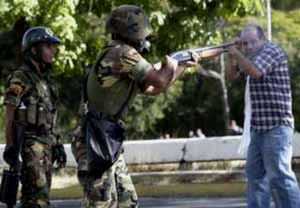
This suspicion was aggravated by the more recent events. In effect, during the first weeks of December, a series of unequivocal signs made clear that Chavez was on the verge of imposing a policy that appeared not only divergent to democratic practices, but stood in open contradiction to democracy. The violence, applied without any provocation whatsoever, by the National Guard in the Plaza de la Meritocracia (Meritocracy Plaza in front of PDVSA headquarters) with tanks armed with heavy machine guns, shots with rubber bullets, and tear gas against a reduced group of peaceful demonstrators, contrasts enormously with the total absence of this same armed body to the twenty vandalistic attacks on television and radio stations, which lasted many hours and which occurred simultaneously in several cities around the country. History registers moments in which violent paramilitary bands act with impunity while the forces of public order repress those who pacifically oppose the armed civilian groups. This is very similar to what happened in Germany in the wake of Hitler’s rise to power. A policy of intimidation, destined to break the oppositions fighting spirit in face of the complacent looking on by the forces of order. The coldly calculated massacre of the Plaza of Altamira and the bloody ambush of January 3, were the straws that broke the camels back. From that moment on, the great majority that opposed the current government were convinced that the institutional and democratic struggle must take extreme measures through the mobilization of the masses in the streets in order to impede a situation without precedence in the history of the republic because of the many indications that a totalitarian project would be imposed on Venezuela.
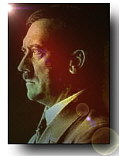
The tremendous disproportion between the dozens of crimes attributed to Chavez and the dozens of millions of assassinations ordered by Hitler must be placed in perspective. Hitler’s huge crime occurred much after establishing the totalitarian dictatorship. It is important to note that the violence that led to the birth of this genocide state is closely related in quality and magnitude to the violence propagated by the Bolivarian circles, the paramilitary branch of the “officialists ” in Venezuela. If the homicides perpetrated by the Nazi S.A. and S.S. in 1932, whose objective was exclusively to terrorize the majority that opposed the creation of a totalitarian regime, were compared to the assassinations attributed to Chavez as of 2002, the number would be proportionately fewer. (Germany had a 40 million electorate). In addition, according to official statistics from Hitler’s opposition, when the backbone of democratic Germany was already broken and Nazi dictatorship ruled, the famous 1933 purge and massacre of the socialist Nazis produced only 410 deaths.
Institutional Aspects.
The majority who had cried out for a drastic reduction in Venezuelan bureaucracy placed great hope in the Chavez victory. The number of our public employees had grown through the traditional political parties’ practice of clientelism. Chavez had no obligation to these political parties and the political country was sure that he would take the necessary painful measures to debureaucratize Venezuelan society. These are the results after four years of government:
- Far from reducing the national bureaucratic weight, it has increased 5%
- No restructuring or rationalization of public administrative processes has been introduced. On the contrary, except for countable exceptions, the new administrative “officers” seem expressly recruited out of a lumpen that groups the least qualified, the least hard working, the most sectarian, the least honest and the most servile of our society. The unskillful management of these big shots, together with administrative corruption, produced the amazing result that this government could waste in four years and with little government investment in public works worthy of mention, an amount of fiscal resources that could have paid the entire foreign debt five times over.
- Administration of justice has dropped to alarming levels. Nine months after the April massacre, the Truth Commission which would independently investigate the facts, has not been created. President Chavez has pending –and blocked- 28 trials for legal and constitutional violations.
- Rule of Law crumbled with Chavez’s public declaration ordering the heads of military garrisons to disregard the decisions and the sentences of the courts.
- The government has not sentenced anyone for embezzlement nor is anyone imprisoned awaiting sentencing; this includes those crimes committed in previous governments. The very same President Chavez, so little given to self criticism recognized this serious weakness in this regime. In mid 2002, he stated “… I recognize that not much has been done to combat corruption … there are structural problems that impede measuring the efficiency of government …by the number of prisoners in the jails.” In conclusion, all that was preached in Chavez’s election campaign against corruption did not have the least political will.
- Still, two years after labor union elections, the national government does not recognize the Central Labor Union board, which handed over a severe loss to the government’s candidates. Discussions of expired union collective contracts are paralyzed.
- The same attitude of institutional non-recognition has been maintained with the autonomous universities, which are the axis of higher education in the country. At the beginning of the Chavez government, the Universidad Central de Venezuela’s autonomy was attempted to be violated with the same procedure with which the Metropolitan police’s autonomy was broken, by a small group of “tomistas” (those who take over by force a public institution) protected by a state security body with the intent of “revolutionary capturing” the house of study. Just as in the police case, the civil society reacted against this antidemocratic practice and the “tomistas” were thrown out. Recently, Chavez violating university autonomy and acting against the Budget Law, ordered the suspension of transfers the Universidad Central de Venezuela and the Universidad de Los Andes. Evidently, Chavez has decided to intervene in all the independent institutions that do not obediently adhere to his autocratic dispositions.
- The same threat hangs over the mass media. This has been preceded by physical attacks on the studios of some audiovisual media, harassment and personal attacks against journalists, and permanent threats to the owners of news media. This physical and moral violence is always modeled by the classic scheme developed by Hitler in 1932: it is executed by para-military and para-police groups constituted by professionals in violence who are rigorously trained. Each time their misdeeds are carried out, there are official declarations that these acts “were carried out by unknown citizens that acted in reaction to contra-revolutionary provocations”. Those groups of terrorists act under the protection of legal security groups, which ignore the victims’ calls for protection against their violence.
- The process of decentralization is designed to bring government closer to the citizens. Chavez has systematically opposed decentralization. His actions are implemented at two levels: a) Judicial. A packet of new laws curtailed (struck) the fiscal autonomy of decentralized entities; among them, the State Federal Income Law, the Special Economic Assignment Law, the Tax Transfer Law and the Macro Economic Stabilization Investment Fund Law. a)Administrative. Military garrisons, by-passing state and municipal government, administered resources destined for social works (Plan Bolivar 2000). Illegal measures have been taken that put the dependencies of the autonomous decentralized entities under the control of central government offices. An emblematic case was the Interior and Justice Ministry’s intervention in the Metropolitan Police. So crass was its usurpation that a court, traditionally attached to the Executive branch’s wishes, had to decree its illegitimacy.
- The current government has splintered the armed forces, which were created laboriously during the 20th Century and which has highly capable professionals. It has violated the principles of promotion by professional merit substituting it for loyalty to its leader, in agreement with the worst totalitarian style.
General Conclusion
A systematic project has been detected that would end the Rule of Law, dismantle and disarticulate the institutions of a plural and democratic society; destroy the national private productive apparatus; bring under the rule of the state worker and employer’s organizations; aggravate the problems of structural poverty; falsify Venezuelan history; disintegrate social programs destined to alleviate the needs of the impoverished; violate the free expression of thought; submit the educational system to the rule of one state ideology; fracture the professional Armed Forces and concede nonrenewable natural resource concessions to foreign businesses.
The Chavez project is not like any socialist utopia. Its objective is a society whose economy would be fed by foreign investment. A society where workers are prohibited from negotiating their union contracts with their employers, where there is no right to strike and as such, they are forced to accept the minimum wage –what Marx used to call the brutal appropriation of the workers surplus value. A society where public protests against this exploitive regime are characterized as “treason to the nation”. A society where citizens have no participation in making fundamental decisions that mark their destiny and their history. A society where public denouncement of vice constitutes a crime. No! The Chavez model is not socialist, it is based on the paradigm of governments of the extreme right in the social, economic, political and institutional. Its model is Jurassic capitalism as practiced in Cuba and as it is described in this paragraph. This is the most antagonistic, the farthest possible from a democratic socialist humanism.
These are some of the reasons that there have been gigantic mobilizations of the civil society. We are fighting a definitive battle for the conservation of a plural democratic and free society. The slogan, “THERE IS NO RETURN” (NI UNO PASO ATRÁS) signifies in its most profound sense that we do not want to return to social injustices, to the misleading and non-operational policies that paved the way for the emergence of Hugo Chavez’s totalitarian project.