| The
Tamil Question ... very briefly |
||||||||||||||||||
|
||||||||||||||||||
| I
have been very consistent for over 2 decades in my views on the
so-called ‘Tamil Question’. The Western-dominated and English-educated elite continued to be in control after 450 years of colonial rule (particularly after 150 years of British rule) and independence in 1948. To be honest (yes, though I am myself a member of one of the minority communities involved, I must be impartial and honest), one aspect involved was that persons from the Tamil and Christian communities were over-represented in the top places (of the armed forces, of the administration etc ... not so much because of favouritism but because they probably had worked hard -- sociological research into minorities the world over has shown that such is quite a normal phenomenon -- and benefited from the educational system).
As was therefore to be expected, there was in Sri Lanka a national revivalist movement when the Sinhala-Buddhist community tried to re-assert itself. The movement reached a peak in the late 50s. They wanted their rightful place in the affairs of the country. There is no denying that when the Tamil and Christian minorities began to lose the privileged place they had some excesses did occur due to actions of the revivalist movement.
Similar things have of course happened in other places. As I have lived 11 years in Belgium I can draw a parallel with for example the ‘Walen Buiten’ movement of the (Dutch speaking) Flemish against the (French speaking) Waloons. Yes, the pendulum swung too much to one side ... and it took many years for some sort of equilibrium to be reached.
Coming back to what concerns Sri Lanka --- If one reads the newspapers of the West of the late fifties and the early sixties, there would be enough stories that the Christians were being persecuted. But particularly with the reformist trends of the 2nd Vatican Council it began to dawn on the Christian community that while they had a lot of power earlier, they had to accept that that was not the normal situation, that they had to be a minority --- and yet part and parcel of the Sri Lankan community. The Tamil political leaders were not ready for any accommodation of the type. In fact a different trend had started way back in the 1930s asking for 50% of power to that minority (of about 13% in reality even if all Sri Lankan Tamils of all castes are counted ... but leaving aside the 5% or so of Indian Tamils who were frowned upon by the High Caste Tamils of Jaffna). Even a very positive national consensus to build representation on the basis of territorial boundaries instead of communal distinctions was unfortunately rejected by Tamil leaders and that reasonable and sane recommendation has always been interpreted by them as ‘communal’ whereas it was a just and fair element of solution. And so it has continued to be said that the Tamils are exploited and the Sinhalese are the exploiters. But they have continued to forget what has happened since then with the pendulum moving slowly but surely away from the relative extreme of the late fifties.
Recently (July 14) when Sri Lankan Ace Cricketer Murali reached 700 test wickets the 'Associated Press' released a news item which had within it the phrase: "In a society bitterly divided along ethnic and religious lines and bruised by a two-decade-long separatist war ....". Even if one does not have access to the printed versions of news papers from around the world, it is really interesting to do a search on the web and see how so many just repeat the report parrot-wise & verbatim. ... More on the media further below ... If as is shown to the world, there is bitter division and genocide in Sri Lanka against the Tamils then the following would just not be possible: 54%
of the Tamils live outside the Northern area and 39% of Colombo is
Tamil… and we live happily together, and can sort out any more problems
that may exist.
For me, it is very clear that under-privilege and exploitation are not linked to religion or race. It cuts across these borders. (Even in my MA dissertation which was in demography, I was able to show through demographic data that a clear area of under-privilege started not in Jaffna but much lower and closer to Mannar and moved eastwards through Vavuniya and down through the ancient cities areas to Moneragala areas and down south thus putting the Tamils, the Sinhalese and the Moslems together amongst the underprivileged.) Those who have no access to power (be they Sinhalese, Tamils or Moslems…) are powerless. Elsewhere I have shown how powerless I sometimes am as a Sri Lankan. If I, being a person who commands respect and has so many connections etc, find that my rights as a citizen are not respected … then just imagine how powerless the ordinary citizen of the neglected regions of Sri Lanka is.
This is not the place to go into a detailed analysis of the so called ‘Tamil Question’. I am not a specialist in that either. But it is very clear that this is a case where international propaganda built over several decades through a well-oiled propaganda machine has contributed to many people of good will (particularly the humanists and the humanitarian persons in the developed countries whom we must respect for their honesty) have been led to forget the complexity of the situation and take a one-sided view. That persons with humanistic and humanitarian tendencies in the developed world have been exploited can be seen through the illustration that follows. They have been led to believe that their looking at problems in a certain way and favouring whom they see as the underdog is really the best thing to do. I remember being invited to the university in Namur (Belgium) to make a presentation in the early 80s on the then situation in Sri Lanka. Someone from the audience posed a question about the Sri Lankan system of admission to the national universities saying that it was discriminatory towards the Tamil community. I went into a detailed explanation of the situation that existed from independence etc and showed how the privileged classes from Colombo and Jaffna (and to a lesser degree from Kandy) managed to win places in the coveted fields of Medicine, Engineering etc. Then, having stated that I did not expect a perfect system to be in place as yet, I explained the system that existed then and the rationale. At the end of it I posed the question to the audience: “When you compare what we have now, with what existed for many years after independence, could you tell me what is less elitist and more egalitarian and socialist?”. All agreed that the newer system was in the correct direction, and was proactive and affirmative. This shows that the well-intentioned people from the developed countries who may have been misled are ready to listen if facts are explained to them. Perhaps you will permit me to relate one more story and a few more facts ... In 1982, the Belgian national TV broadcast a film shot in Sri Lanka. It was entitled "Any time is tea time behalve voor de Tamils" (the last half meaning "except for the Tamils"). It was wonderful propaganda ... The exploited estate workers were shown ... and in the minds of the viewers that became the image of the typical Tamil person and how such person lived and was treated. I wrote several letters and protested saying that if the title was "Any time is tea time behalve voor d'arbeider" (except for the worker) I was fully in agreement. The worker, whether Tamil or Sinhala received the same wage. And the audience would not have known that some of the big tea estates were owned by Tamil Businessmen and Politicians living lives of luxury. But the example illustrates how the propaganda machine was working ... When we were studying sociology I remember such processes being referred to as "glissage" (French for something like "slipping & shifting") ... where the exploited Estate Worker became "the typical Tamil".
It is interesting also to go into other information that appears in the media. There is for instance a typical figure of 60,000-65,000 killed which appears in most of the International Media (AFP, AP, BBC etc.) with regard to the northern conflict. It is noted that Reuters has recently started stating "two-decades of civil war in which nearly 70,000 people have been killed since 1983". While I have used in "Reflection 2" an estimate of "around 26000" for the numbers killed in the Southern Conflict during the period 1987-1990 as stated in that same section there are officials who claim that about 65000 were killed or disappeared during the southern conflict. And strangely the pro-LTTE website Tamil Nation at http://www.tamilnation.org/refugees/95USCourt2.htm refers to and quotes a US court case [JUDGMENT OF UNITED STATES DISTRICT COURT FOR THE DISTRICT OF NEW JERSEY Civ. No. 95-1922 (DRD)] which in turn quotes reports from reputed international agencies as follows: Superimposed upon the
Sinhalese-Tamil ethnic strife was the April 1971 insurrection of the
Maoist Sinhalese youth movement, the Janatha Vimukthi Peramuna ("JVP")
or People's Liberation Front. It took the government two weeks of heavy
fighting to suppress the revolt, during which between 1,200 and 8,000
people were killed and 16,000 imprisoned. Thereafter, the JVP continued
an armed struggle against the government which was not fully suppressed
until 1990.
Disappearances and extra-judicial
executions have been reported with increasing frequency since mid1983.
In addition, in the late 70s opposition groups engaged in armed
struggle to establish a separate Tamil State. From July 1987, armed
opposition escalated in the Sinhala majority areas of southern Sri
Lanka and were particularly numerous towards the latter half of 1989.
In addition, the Prevention of Terrorism Act and Emergency Powers
Regulations gives power to police and armed forces to arrest and detain
suspects without any democratic accountability. ... Reports were
received of people who have been taken and their bodies later
discovered often burned and mutilated. Other people were taken into
custody and disappeared after release from custody. In many cases,
people have disappeared without any trace. Families seeking information
about their relatives from the police station receive no information
and are still waiting to hear. ... Various estimates we have received,
suggest that at least 60000 people disappeared in the South of Sri
Lanka since 1987. This represents about one in every 250 of the
population.
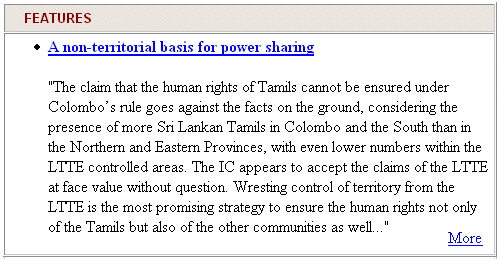
Now the question is this ... The southern rebellions of 1971 and 1987-90 have been seen as super-imposed on the northern ! In such a context it is possible that the figure of 60000 referring to the killings in the south is being used as killings connected with the North! Once again a matter of convenient 'glissage' which helps the propaganda campaign ? Over to the Sri Lankan Academics and Researchers ... who do so many studies for their own promotions or for money from donor agencies ... but do not usually grapple with issues that matter! Yes, the effect of several decades of propaganda, and of lobbying etc continued. Most of the developed countries are telling Sri Lanka and its government: “Negotiate with the LTTE”. But is that what they tell the Afghan government, or the Iraqi government or Israel? They did not say anything similar when particularly during the 2nd southern rebellion of Sri Lanka several thousands of youth Sinhalese rebels from a southern group were eliminated. (It is a pity that many persons in the west who speak about the northern rebellion unfortunately do not even know about the two rebellions in the south!) When a little thing happens in Sri Lanka, world powers, agencies and movements are quite sharp in showing that the end does not justify the means … but they seem to forget that the same principle should apply for example when western powers arm the Sunnis in Iraq to fight al-Qaeda. A recent feature in one of the national newspapers drew attention to double standards involved (http://www.island.lk/2007/07/09/features1.html). The same national newspaper in its edition of 31st July 2007 referred to the fact that the IC (international community) is misled and that it is not in giving in to the LTTE that human rights of the Tamils and of the others can be respected. In addition to saying “Negotiate” … "Allow us free access to rebel areas and provide security and transport"... they are now saying “No aid, unless you re-start the peace process and negotiate with the LTTE”. But of course the powerful
nations do not link conditions such as those for collaboration with
Israel ... even though they try sanctions in the case of Iran and
North Korea etc. Some tried such tactics with Mahathir Mohamad of Malaysia and we know
what his reaction was. When ethnic and religious conflicts erupt in
India there are no conditions either. They are powerful but Sri Lanka
is small and 'beggars are not choosers' and others are trying to
decide Sri Lanka's fate!
Let other Tamil leaders to speak. I think it is for Tamils persons themselves to show how complex the so called “Tamil Question” is. I will take just one example: Prof. Hoole (a respected Tamil and a good friend of mine) who was appointed Vice-Chancellor of the University of Jaffna could not assume duties and finally had to leave the country together with his family because of death threats from the LTTE. During the Munk Centre lecture at the University of Toronto on Saturday 21, April 2007 it took courage for him to speak, among other things, of communalism also among the Tamils and to highlight the dominance by the high caste Vellala. " In further evidence of Tamil
Communalism we note that Tamil intellectual leadership by the Vellahla
caste that orchestrates this Jaffna-centric Caste-Hindu Nazism (Tamil
Sangam of NY even today carries an article on its web-site describing
Roman Catholics as low caste). Incidentally the Vellahlas shout
from
the West while many Roman Catholic Tamils die fighting for the LTTE. If
you take any Tamil leader, you will find the he is highly likely to be
Vellahla, Hindu and from Jaffna and he would say that we are all united
and have no problems. The rest will remain silent because of what this
vicious crown can do to them for not falling in line ..."
|
||||||||||||||||||
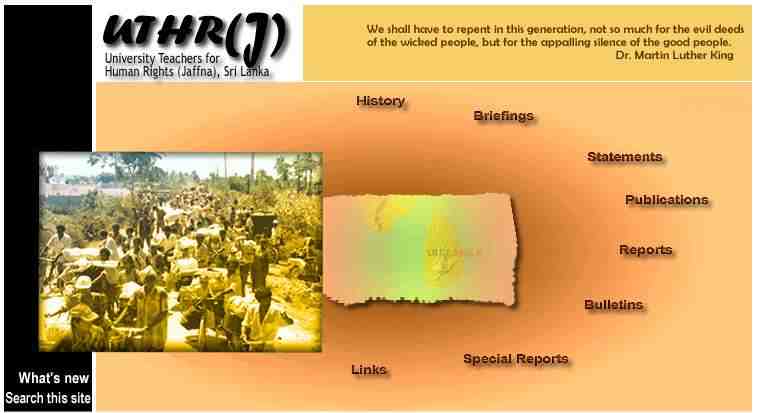
| It can be useful to just have a
look at alternative analytical and critical yet positive views among
the Tamil community. The University Teachers for Human Rights (Jaffna)
cannot operate from Jaffna because of death threats against them. But
it is worth visiting their website (www.uthr.org/index.html)
which they
maintain despite many difficulties. The picture below shows a graphic
of their home page. It certainly is a site worth visiting. |
||||||||||||||||||
 |
||||||||||||||||||
There is much more. The chasing away of all the non-Tamils (Moslems and Sinhalese) from the north, and the murder of those who tried to stay on was never called 'genocide' but the word is used as describing what the government does. Let us forget the many thousands of innocent civilians killed by the LTTE but think of their eliminating scores of Tamil leaders who were moderate and had a different point of view such as Alfred Duraiappah (the Mayor of Jaffna), Appapillai Amirthalingam (the leader of the Tamil United Liberation Front), Dr Neelan Thiruchelvam (eminent constitutional lawyer), and Lakshman Kadirgamar (then the much respected Foreign Minister of Sri Lanka). But there is no need to go on. This article (www.tamilnewsweb.com/Central chronicle_11jan07.htm) shows what an independent Tamil website has to say about the need for the LTTE to keep the conflict going without finding a solution for otherwise that economy (estimated at 500 million US dollars a year) will collapse. So the LTTE is not ready for a consensual solution. Then why force Sri Lanka to negotiate … is it because the western powers have a vested interest or are afraid of what the world’s second most vicious terrorist organization can do in their own lands? On 23 July Reuters reported that the internationally well known Jane's Intelligence Review in its August issue was carrying information ... which any impartial observer can see is a confirmation of the earlier info. |
||||||||||||||||||
| Mr Kadiragamar (Sri Lankan
Foreign Minister) was killed by the LTTE. A
few paragraphs above one notes the names of some of the other Tamil
leaders who dared to have different views and were eliminated by the
LTTE. Douglas Devananda, Minister in the current Sri Lankan Government and leader of the 'The Eelam People’s Revolutionary Liberation Front (EPRLF)' has escaped many attempts on his life while many of his party members have been killed. (See statement published at a Tamil website... see especially the appeal to the international community in the last para.) V Anandasangaree, leader of the Tamil United Liberation Front (TULF) is under death threat too. He is a respected and mature leader. Here is what he had to say on 26th June 2007. |
||||||||||||||||||
| So, then ... what ? What I would tell my friends (particularly my foreign friends) is … Let us be honest and accept that this is a highly complex situation. We appreciate your good will ... your humanistic concerns. But you need to reflect on whether you are being misled and exploited. First of all, let us try to leave stereotypes out. The Sinhalese and the Buddhists are not genocidal or murderers. They are not chauvinistic or communal either. Only a handful among them are. The Tamils are not terrorists. Only a few among them are. The vast majority of Sri Lankans (irrespective of religion, race etc) are wonderful people. Those of you who have visited Sri Lanka would have discovered what the typical Sri Lankan is. The typical tourist does not however easily discover who the real underdogs of Sri Lanka are. Sri Lankans usually do not display their problems. They hide such behind a smile. But the real underdog in the Sri Lankan situation is the ordinary powerless citizen ...irrespective of whether such person is Sinhala, Tamil, Moslem or other. I have lived among Tamil Estate workers for years and know what struggles they go through even though there has been some improvement in the last decade or so. I have personally worked with the powerless Tamil people of Colombo ... for example the cattle-mart community in Dematagoda. Such poverty and powerlessness however affects also the Sinhalese and other communities in the slums of Colombo or in the fringes of the city or in the remote villages. Their lot is not improving. Yes, I went through a major health crisis in 2006 and the cost of 6 weeks of care and surgery etc (leaving aside continuing costs for tests, drugs etc) permitting me to be alive today was over 15 months of a senior lecturer's salary! I had the connections and so many were ready to help me. But what are the options available to an ordinary powerless connection-less Sri Lankan falling ill in that manner ... often it is to accept the inevitable! Systematic changes are required within the Sri Lankan system to respect and protect the rights of all these. Given that, as for the current so-called "National Question", the best way to simplify it is to force the Sri Lankan government to work for a solution that is fair to all citizens (elsewhere I show how the rights of the ordinary citizens are being violated and the innocent have to die on Sri Lankan roads or at the hands of thugs), and fair to the Tamil community which has so many leaders who are ready to join hands with others and negotiate. But unfortunately what stands in the way is the LTTE. Let us see the reality … examine it … be intelligent and rational and not keep on saying that the Government and the LTTE are the two parties between whom negotiations should take place. Yes, the LTTE too can be part of the Tamil representation if they give up arms, and stop the killing, extortion, child recruitment etc. Well, if they are not ready to do such, the government and the international community should work together for a different solution. A minority (of Sinhalese, Tamils, Moslems etc) floats in riches and pleasures and they are the ones linked to power whether political, economic, or of the mafia. The real underdogs ... the ordinary people (irrespective of race and religion) of this land are suffering and go from bad to worse. It is their future we must be concerned about. What we need is a Sri Lanka that is more democratic and inclusive, where the rights of the simplest are respected. But of course 'beggars are not choosers'. Sri Lanka is a small country and its precious resources are being used up for a meaningless war. Is the war justified? Who is responsible? Which is the way forward? Some of what is above will hopefully provide indications of the orientation needed ... not only by the Government of Sri Lanka and its people ... but also by the 'International Community' which (probably in good will, and due to lobbying by the Tamil Diaspora and bombardment by a biased media) created conditions in which the LTTE became stronger and stronger. Some of the recent arrests of LTTE kingpins in USA, UK and Australia are perhaps eye-openers. It is also interesting to note that there are dissenting voices in Norway which is the "centre" of the Peace Process ('Peace Industry' specialist?). Can we work together at least now ... not for a country that the LTTE wants ... but for a Sri Lanka that is more democratic and inclusive, where the rights of the simplest are respected and protected ? postscript: On 11th July, Sri Lanka Armed Forces captured "Thoppigala" the last major camp of the LTTE in the Eastern Province. Did the international media report it? How did they do it? Did they report it as a "liberation"? Did they give the details of what was found? Did they report on the civilians who had been held prisoners and who surrendered to the Armed Forces? If not why? And within Sri Lanka who belittled the achievement? Which groups kept silent about it? There is for example a well-known Moslem Leader / Politician who said in parliament after the recent events in the East that the "Tamil People" are being made to "feel conquered". I have yet to meet a Sri Lankan who wants to conquer the Tamils. The problem is with "LTTE terrorists" and not with the Tamil people. These are all indications of the games that different people are trying to play. So, what this politician says can be true only if one thinks that "LTTE" equals "Tamils" in which case it is difficult to imagine how the State and the People permit 39% of Colombo's population which is Tamil to live peacefully and safe amongst the rest. As a person not linked to any political party, and tries to be impartial but committed to issues and values, (and also one not prone to easily accepting conspiracy theories) ... I cannot but hypothesise that there can easily be behind all this a political conspiracy. One is not interested in the "ordinary people" but one wants to grab power "does not matter how". The slightly more "populist" trends within the country are anathema to such people ... and to foreign groups and powers who fear they will not be able to "play the same games" if the populists capture power and so keep pumping money into the country for the purpose of furthering their own agendas by discrediting populist leaders. (Their local agents in some NGOs and organisations too play the game of telling the world what their principals would "like" them to say.) And so all some of our political leaders (among others) are keen on highlighting are the weak points of persons ... and not really of the system (supported by proposed structural and permanent solutions). And unfortunately (while hopefully being a committed Christian) I have to be honest enough to admit that many Christian Leaders (as well as some of the political/politicised Buddhist Monks) are (wittingly or unwittingly) part of the conspiracy (perhaps by not understanding the reality that is beyond what is apparent).
Further, sociological analysis leads one to hypothesise that other factors too may be at play. When President Premadasa was moving towards becoming the Prime Minister and later President it was very clear that there was behind many things a clash between the "Colombo Elite" culture and the "Rural Masses". I believe that similar forces too are at work even today. I certainly am not trying to defend everything the current government is doing. My views are clearly presented in the "reflections" section. I think that the waste of the people's money through commissions some obtain on various projects (& which international organisations give) and by way of the number of Ministries, of Government Ministers, and of perks offered to them is a terrible sin crying for vengeance.(We need to remember that politics is a big business. People spend a lot of money to become elected representatives / members of parliament. And so once they are in, they try to concentrate on making several times the amounts they spent. And so the need is for a reform of the electoral system introduced in 1978 when the present Opposition was in power saying we would have the best Constitution in the World, better than that of France or USA!) But as I said in 'Reflections 2' let the political parties come together and end corruption and waste in a firm structured manner reducing the risk of such continuing to occur also when others come to power. The rights -- not only of those who have access to the media and to international bodies that shout -- but of the people as a whole and the weaakest in particular have to be protected. But one cannot solve all problems at once. As happened in Northern Ireland and other places steps must be brought to limit the impact of the terrorist problem (which compounds the problems referred to earlier) and move towards a political solution (not the one Tigers are demanding with the gun but) that is just and fair to all peoples of Sri Lanka. Even with regard to the latter one notes a good sign in that the "All Party Representative Conference" has been functioning for some months now trying to build a consensus.
I have always been of the view that the merger of the Northern and Eastern Provinces is against the Constitution as language, race, religion etc cannot be reasons for decision-making. (Further, I do not think India or the US will re-mark the boundaries of their States. There are certain facts we accept from history as 'given'..) Another reason is that the East is not the North ...The East is very special. It is in reality a microcosm of Sri Lanka as home equally to Sinhala, Tamil and Moslem peoples. That should retain that identity and be a model for the rest of Sri Lanka. The merger referred to was forced on the country through the Indo-SriLanka Agreement of 29 July 1987. But there was a clause that the people would decide the future by a referendum that was to have been held on or before 31 December 1988. That was never held. It is interesting to look at a few points raised in the national weekly 'Sunday Times' editorial of 15th July. Yes, why is the "International Community" silent? My honest view is that everything possible should be done to hold a fair and peaceful election in the Eastern Province. Let all those commissions, observers etc who came from abroad and all local groups who monitored earlier elections in the country (and helped change Sri Lanka's 'election culture' to become relatively fair and free) get involved to ensure that the election be non-violent, peaceful and not rigged. It is not enough to let violence and the use of force to impose themselves ... and to issue a report afterwards to condemn such. If needed, the armed forces must be given power to "shoot to kill" anyone who tries to use violence at election time. Let the foreign observers oversee this. And let religious leaders be there on the spot at election booths ... ready even to die (after all that is what they preach)... in order to protect the freedom of the people to choose their leaders and their future. Further ... elections must go ahead in spite of any violence that will occur. One tactic of the terrorists will be create some initial violence and get their agents to shout for postponement of elections. Such is and will be part of another strategy, another game, which must be defeated. That will be the real test for democracy in the East. Yes, let the people of the East (not the politicians in Colombo, nor politicians and armed groups in the East with their own agendas) ... decide their leaders and their future freely. Let Sri Lankans and the International Community come together to ensure such a step forward. That is the best all can do (in addition to ensuring that the benefits of the Development Effort that is being launched really reaches the ordinary people) ... to help the people of the East who have suffered too much ... and by clearly getting the message across to the terrorists that terrorism will not win help also the whole of Sri Lanka who too have suffered too much over nearly 3 decades.
But, of course, the LTTE, though beaten, has declared war. It has given a clear signal that it will prevent free elections by killing the Chief Secretary of the Eastern Province on 16th July. Those who helped create the LTTE and the international community, international media, and the international non-governmental organisations etc etc (in varying ways and degrees) contributed to the LTTE gaining such power so as to become the world's 2nd most powerful terrorist group have the responsibility to tell the LTTE ... "
Stop or you will be damned".
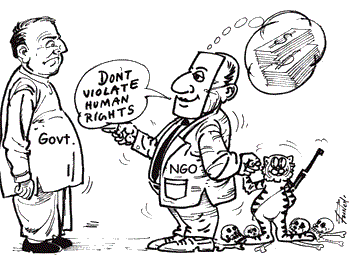
But if one forgets the international community, even some of our power-hungry local political leaders don't have a backbone to do that ... and what they do will only further support the agenda not of the people but of the LTTE ... . A sarcastic cartoon in the national weekly http://www.sundayobserver.lk/2007/07/22/fea03.asp sums it all up very well. I am afraid that the campaigns for human rights are all on behalf of those who have access to the media. I have shown in the other sections on 'reflections' that the rights of many thousands of ordinary people are being violated all the time ... and that they die, or carry the burdens imposed, or suffer in silence simply because they are powerless. A minority (of Sinhalese, Tamils, Moslems etc) floats in riches and pleasures and they are the ones linked to power whether political, economic, or of the mafia. The real underdogs ... the ordinary people (irrespective of race and religion) of this land are suffering and go from bad to worse. It is their future we must be concerned about. My fear is that through some of the current campaigns (human rights, peace, etc.) we may ignore the real reforms needed and may effect some changes that will perpetuate the system of power and privilege. Yes, on the whole, we Sri Lankans (of all races, religions etc.) are humane, hospitable, peace-loving and conciliatory ... to all peoples (of the other races and religions) ... It is only with extremists and terrorists that we do not agree. Yes, Tiger Terrorism can be defeated if the kind of power-hungry conspiracies are left aside. Much has already happened since independence for assuring the rights of the Tamil People. But even more important, a democratic and inclusive society (where disparities are not there or are at least within acceptable range, and) where the rights of the weakest (whether they be Tamil or Moslem or Sinhalese ... for those are the really exploited) are well protected can be built. Que Sera, Sera ?... Irrespective of the people, what they want they will somehow-or-other get ? ... Make offers that one cannot refuse? Or what? ... |
||||||||||||||||||