Reflections 2007 - Part 2
Charles' key interests for reflection have been ...
- Higher Education
- Behavioural Issues in society ...wwith a slant for 'road behaviour'
- Politics & current events ... more limited than earlier
especially after the health crisis
Whatever it is Charles is a person known to many and one who has some clout etc. If he can do nothing (or very little) about these (e.g. citizenship issue regarding son and daughter, right to fair use of the access road to his house) ... and if the threat of death is what is offered him instead, what can a powerless ordinary citizen do about asserting one's rights?
Given the crisis that Sri Lanka is facing on the ethnic front, if Charles was Tamil ... these could have been well exploited as a case of (what some call) the “Sinhala-Buddhist State” not protecting the rights of a Tamil person? Yes, the violence and chaos in the south and the terrorism in the north are connected. In fact it is possible to hypothesise that the causality is from the latter to the former. Of course to those who assume that terrorism (a.k.a. liberation struggle) in the north is justified, the causality will appear reversed!
The Tamil Question
Charles' views on that matter are rather complex anyway … click here for a summary!
These problems in society did not crop up just yesterday or last year ...
They grew and got built up over time ...
It is also noted that in the section on 'primitive blogs' (available from the main menu) Charles presented extracts from his traditional annual Christmas letters etc to show that these issues about values, human rights, corruption, destruction of the ethos of a people etc are topics that Charles has been highlighting for nearly two decades (and in fact even more as the article 'Youth in Rebellion' on the first post-independence southern rebellion published in 1971 referred to similar issues).
One can be happy that with regard to disturbing trends, there has been a reversal in the matter of vote-rigging and election-related violence. It is a fact that the religious leaders did not shout from the rooftops ... but a few civic organisations took the lead and received the support of international organisations such as the European Community.
Charles notes that now in 2006 and 2007 many persons are actively shouting about human rights etc. These persons include religious leaders, civic leaders, occasionally academic leaders, various NGOs and INGOs. Some of them have grouped themselves into organisations that have very high sounding names preceded by the word "National" and which would appeal well to foreign donors. This activism with regard to human rights etc is a happy sign. But Charles notes a clear distinction between how these people reacted during the 2nd southern youth rebellion and their relative silence then (when according to estimates over 26000 were killed), and the involvement now on the northern rebellion with a different set of leaders in power.
(Note:
Even though Charles has used an estimate of 26000 above, even now in
June 2007 a senior minister in the government has stated that during
the southern conflict over 3000 UNP supporters were killed by the JVP
and that over 60,000 JVPers and those alleged to be supporting or
connected were killed by the authorities or groups supporting them.
However there is a magical figure of 60,000 or 65,000 which appears in
most foreign news reports concerning Sri Lanka Lanka's northern
conflict. From where do these figures come? Who in Sri Lanka does an analysis of the
critical academic type using appropriate and developed techniques of news
reports and their content? The 'Tamil Question' link above takes one to a section that
has a little more
on this.)
It is extremely clear that even with regard to the current conflict the press conferences, public statements etc are mostly about deaths on the side of one party involved in the conflict. Further, there is clear evidence that a lot of foreign money is being pumped into various connected programmes, studies, publications and activities.(The note available in the section 'primitive blogs' and passed on to friends on the night of the last Presidential Election in November 2005 before the results were announced tried to show two different trends among the then two main candidates .. one of whom is now the President and the other the Leader of the Opposition. There are reasons to suspect that antipathies that some showed with regard to one or the other are the same today and that ideological preferences may explain much rather than real concern for the ordinary citizen!)
Unfortunately there are reasons to question the honesty and hidden motives of these leaders. When the whole system was being eroded they played safe. The unbelievable number of innocents who are killed and maimed on the roads and the families that have to pay the price and suffer, and the number who are harmed and killed due to thuggery, violence and abuse of power etc -- which are clear indications of the destruction of the ethos of a people that took place over a period of three decades or so -- do not appear to be connected with human rights and a matter of concern to these persons who shout only about the rights of some people. Further they seem to ignore history, and there is no mention at all in statements issued by these leaders referred to about the fact that the growth of corruption, abuse of power, violence etc has been part of a process that spanned over 3 decades ... and that particularly politicians of various colours who sometimes try to show themselves as "saints" are the "devils" who started and developed these unfortunate trends. We must say clearly that all leaders are responsible for the mess and thus have to work together to eliminate it.
Unfortunately, Sri Lanka suffers from not having a real opposition ... the supposed to be "Leader of the Opposition" seems only to be an opportunist (within the section on primitive blogs I have a note dated November 2005 where I compare the two main leaders of the country) who wants to make use of his status to travel around the world and criticise the government and not about trying to really change things for the benefit of the "People" here in Sri Lanka.
To take one illustration, it is now known that the Committee on Public Enterprises (COPE) and Public Accounts Committee (PAC) have reported to Parliament that the fraud that has taken place in 26 state enterprises, between years 2000 and 2006, amounts to Rs.15, 000 billion. The only people shouting that the persons behind these irregularities should be held responsible are the JVP (Janatha Vimukthi Peramuna - People's Liberation Front) showing clearly that they are the only people pushing for radical changes to break the unending cycle of corruption and abuse of power. Of course I respect the views of some people who hold reservations about what the JVP may do if they have a few years in power but I do not see the reasons why the JVP - which is now fully within the democratic political process - is anathema to political and religious leaders (and particularly those who shout for the LTTE)! To me they are a valid political force within the country ... representing the downtrodden rural masses. Further they certainly are not anti-Tamil but only anti-LTTE. To me they are a political force within the country to be reckoned with ... and the one's who are really playing the role of an opposition party.
And so a number of questions remain ...
Curse the darkness ... or start lighting a 'few' candles ...
Charles is convinced that (noting how China is changing people's behaviour on the roads etc. in view of the Olympics) if behavioural aspects of road behaviour are studied and such are changed through campaigns Sri Lanka can reach a precious goal ... that of beginning to re-establish the "value of respecting the other" ... and do something to fill the vacuum created through a gradual erosion process of three decades by an "open licence economy" which put money at the centre of everything and destroyed the ethos of a people.
He has many such studies in mind ... and (if one is ready to trust him that it is not studies that are needed but action) he has many concrete proposals ... (if anyone in responsibility is really keen to do something ... and not to announce big plans to change the world). Though unhappy that some things he had predicted years back have unfortunately happened with detriment to the people ...Charles is convinced that his sociology combined with a systems approach and a user-perspective derived from his work in computing has given him a capability to see problems "from a different angle" than typical.
Charles was amused when there was talk recently that the new harbour in the south is planned and designed for the next 100 years! Not even 30 years back, with the Mahaweli projects moving, we were told that Sri Lanka would be able to supply electrical power to India. Now less than 30 years afterwards one is talking of buying electricity from India. (People forget history ... and who even researches such aspects?)
Incidentally,
it is noted that Charles hates the announcement of big plans, laying of
foundation stones etc. For example with careers work at the university
... Charles' interest was to really do something and set up systems for
such to hopefully continue (subject to caveat below!). There was no
interest in big shows and publicity. Results (however hard one had to
work to achieve such within the system) was the concern. Thus, after
completion of 9 years of work (March 1998 to March 2007), only a simple
ceremony (held on 26th March 2007 and referred to in the Photostory
2007)
was agreed to by Charles.
True, graduates may prefer white-collar jobs. A recent poster appearing on the roads reads "Upadiyata Sarilana Rakiyawak" ('A job appropriate to the Degree') but having toiled within the University system Charles believes that policy should be "Hakiyawata Sarilana Rakiyawak" ('A job appropriate to capabilities'). The typical graduate may not like what Charles is saying ... and the University system may not like it either. This has been his fight for reform of Higher Education such that "A degree" would be an indicator of "high level of knowledge, skills and appropriate attitudes/values". That may be true in some exceptional programmes ... but it certainly is not the norm. That is the hard truth.
As hinted at elsewhere Charles thinks that the work he did (nearly paying for it with his life) in developing a Careers Service focussing on "employability" may be re-oriented towards "employment" because of political priorities and expediency with even academic leaders (some with their own goals) falling in line and imposing decisions!
In fact Charles thinks that even if the graduates may not like it and may prefer white-collar jobs ... at least 50% of those given jobs by the State could have been chanelled into being active agents of change in this regard. (Charles has the ideas on 'how to' if anyone is really keen ... once again not to announce plans but to do!)
Yes, light a few candles ...
but structural ones that will remain ...
Charles recalls for example that on the day the results of the 1977 election were announced when there was evidence (in Kolonnawa where he was working then) of thugs taking the law into their hands … that he telephoned the home of J.R.Jayawardene (then Prime Minister elect … later President) …yes, he recalls very well the answer he received.
He recalls how a few years later he sent to the President through an active member of the party a suggestion about allocating a time slot on national broadcasts (mainly radio then as television came later) for each of the parties represented in Parliament suggesting also the modalities for regulating and governing such etc. We talk today of State Media being partisan (they have always been that anyway whichever party was in power!) but it is structured democratic mechanisms that can start making a dent and Charles did think of the issue in 1978 and tried to do something.
20 years back in 1987 (on the occasion of the death of his friend, Fr Michael Rodrigo) Charles wrote to friends: "In 1977 we had terrible abuse of power and corruption. But call it the fabric of society or the ethos of life, yes, that was still there. One could hope that a new leader would come and could rebuild. ... But now in 1987, even that is gone and whether any leader, even with all good intentions, could ever rebuild society is doubtful".
About 10 years back Charles wrote an article entitled "Religious and Civic Leaders to the rescue" but no National Newspaper published it. The purpose was to sound a warning that what was happening (abuse of power, corruption, terror, thuggery etc.) was destroying society as such and that long term consequences would be horrific ... and that one had to act. Even more than in 1987, Charles was convinced that the base if Sri Lankan society was eroding.
Just about 4 years back ... in one of his usual "circular type letters to friends and acquaintances" he had commented that "Peace, when that come would be fine. But have we thought of what would happen to all those people whether on the government side or on the terrorist side who have got used to the power of arms? Have we planned rehabilitation programmes?" Yes, the reality is that with the ‘mafias’ active in the country (in addition of course to corrupt politicians, corrupt businessmen really behind such, the active ‘doers’ are very often deserters from the armed forces).
Charles can go on referring to various issues he has been reflecting on ... particularly in the context of what some religious leaders, NGOs and international bodies are saying about the violation of rights and human rights etc. Charles' has questions
1. Were you as vociferous or committed when other processes of erosion of values were going on? Having lived within countries which have “open economies” as I have said for many years now, what we have built up since 1977 is a “licence economy” where anything and everything is permitted and supported directly or at least indirectly. When danger signals were there that the ordinary people were being taken for a ride and were becoming victims of the system, did you shout from the rooftops?
2. When, to take just one example, the southern rebellion was raging during the period 1987-1990 and thousands of youth were being killed (wasn’t the estimate in the region of 26,000) by the government and other para-military forces … weren’t most religious leaders only about abortion or about the catching of fish in inland waters? Aren’t they able to say something about the role of the top political leader who is shouting now about human rights? (Incidentally, all international news services repeat that 60,000-65,000 persons have died from the ethnic conflict. See note earlier on this topic)
3. I ask again … Were you shouting from the rooftops when elections became a mere farce … or were you playing safe looking for privileges? What were you doing when society and societal values were being eroded ... even through what appeared as 'harmless nothing' such as the famous referendum of 1982. Did you group yourselves together and openly oppose the referendum of 1982 … or at least show the complexity of the issue, and the violation of ethics and morality given that it was the use of a facility of the new constitution to extend the life of a parliament elected according to the old, and which parliament would never have been elected according to the new constitution? (Yes, I can prove I did what I could even from faraway Belgium.) Would not the recent history of Sri Lanka been different if elections were held at the proper time without power being in the hands of a party leader who had an ‘immoral’ (because of the unethical referendum) overriding majority in parliament and also held undated letters of resignation of the members of parliament under him. …
4. The 1983 riots in Sri Lanka have been publicised internationally as an uprising of the Sinhalese against the Tamils. Was it so? It was in reality only a minority of the Sinhalese who were involved plus of course thugs and trouble makers. The house in which I live was then the property of a Tamil family, and yes, it was burnt down. But it was the Sinhala neighbours who hid the family and protected them. But leaving aside all that … are the do-gooders able to check back on the situation and say publicly who it was who really gave the order to create trouble?
5. What about the rights of the powerless people involved in incidents that are all too common such as parents (or often mothers) who give poison to their children and then drink it themselves (or jump into a river from a high bridge carrying the children, etc.) simply because she could not go on with life?
6. Yes, I appeal to all those who are shouting about rights today not to make scapegoats of just the current leaders but to say clearly and openly first of all that for about 3 decades we have been destroying the Sri Lankan society and that all political leaders past and present have to bear most of the blame for contributing to this, that that religious and civic leaders have to bear the blame for not having discerned what was happening and for not having done anything serious to stop the decay … and that we are paying the price … and secondly to agitate for fundamental and structural reforms which could at least start a process of change.
7. I am convinced that shouting about abuses etc is useless. Some of the politicians who are shouting about such were fully in such when they were in power. What we need is concrete action to bring about structural changes … and pressure being applied to have those done quickly. What about concrete action such as forcing the government and the opposition to take action jointly to curb corruption at political level ... not through transitional steps ... but through legislation binding (those in power who exploit and those in opposition who shout but would do the same thing if they were in power) reversal of which would require a two-third majority in the future? One simple thing not difficult to do if one wants would be to clearly specify and limit the number of ministries. I have many other ideas but this is not the place to go into details of such. (In the 'primitive blogs' section is an extract from a 1999 article by Dr Mevyn de Silva -- no, no, not the who got an honorary doctorate for 'something' -- that if India is to have political representatives equivalent to the rate we have they will need to have over 250,000!) The issue/problem is not just the number but the expenses incurred, the resources wasted, ... including the provision of security to so many which reduces the protection to the ordinary citizens.
8. And finally, how many innocent people are killed daily in Sri Lanka? How many die on the road due to lawlessness? As stated elsewhere, I was threatened with death simply because I wanted my rights to the access road to the house be respected? How many are killed simply because they are simple and powerless? Yes, we must defend the activists, journalists. We must make a fuss about disappearances, and about kidnapping of wealthy businessmen for ransom purposes. But one thing for sure is that all the people in such categories knew they were taking some risks … but the thousands of ordinary people who are killed in other ways are simple and innocent. As for me, both groups are equally important. We must shout for them all. They are paying the price with their lives on the one hand because of terrorism in the north, but on the other because over the past 3 decades or so the system has been becoming more and more corrupt …and on the whole religious and civic leaders either did not see the writing on the wall, or adopted a wait and see attitude, or preferred privileges for themselves. Some are shouting now … as if only the present set of leaders are responsible. But we know that some who try to talk about democracy, freedom etc have blood on their hands. Further we are not babies either. We do know about how foreign powers manipulate things within smaller nations through covert operations to bring to power those who are more open to their agendas. It is therefore useless to pretend that issues are that simple. (And of course I contend that the erosion and destruction of society has been further aggravated by the current conflict in many ways ... e.g. innocents getting mixed-up with terrorists ... and also due to the fact that the security forces and the Police in particular are so busy with the fight against terrorism and the protection of thousands of politicians and VIPs ... that the protection of the ordinary person appears not to be an important matter.)
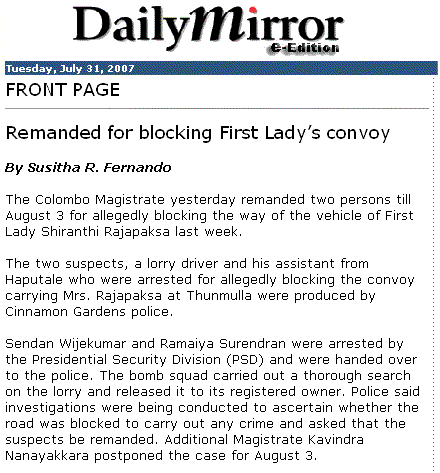 |
I certainly
respect the President and the First Lady but shocking things do happen
all the time. (See the news item
opposite.) And things like this happen everyday. What is even more shocking is that the media or groups that shout on Human Rights have not said anything about this. I agree that security must be provided but who is ready to analyse what happens on the roads when more than 100s of VVIPs rush around? Cannot a small mistake occur on the part of a motorist? Do they have to be locked up? Yes, these are very ordinary people who have no power to get the media and other groups to shout for them. |
9. As for me the final criterion in judging the various protests and campaigns (whether local or international and said to be concerning or related to Sri Lanka ) is whether the objective is really the welfare of the ordinary people of Sri Lanka (irrespective of their race, religion etc.) and whether such includes a component of concern for the most weak, exploited and powerless among them. What is noted currently is that (given that most such persons were silent during earlier periods) there are reasons to suspect that there are other agendas at work in the campaigns/statements on Sri Lanka. These are focussed for example on the current in such a way that historical reality is ignored and as if only the current set of leaders are responsible for the mess we are in. In such context, politicians who may not be in power (but who held power earlier and contributed much to Sri Lanka's destruction) are able to make use of such campaigns/statements to support their own petty agendas. Given the international lobbying that has got built up (referred to also in the section on the Tamil Question) it is possible to also hypothesise that some groups are stating things that external funding INGOs and groups like to hear. The words of John the Baptist "His winnowing-shovel is in His hand to clear out His threshing-floor, and to gather the wheat into His storehouse; but the chaff He will burn up in fire unquenchable" come to one's mind and one is reminded of the need to separate "the wheat from the chaff".
And finally, for now
... (i.e. June 2007)
 |
 |
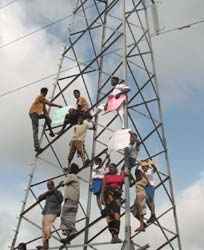
| Left: Why is that
men, women and children have to climb on to this pylon carrying
30,000volt electricity across their village to say "provide us access to a little electricity
in our homes so that our children can study in the night or watch a
little television" ? And just to stress the fact that
underprivilege and neglect is the lot of the powerless irrespective of
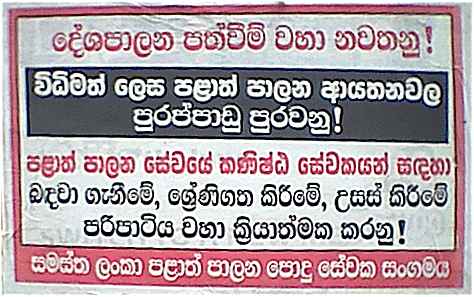
race, creed etc ...Yes, these are Sinhalese villagers ... Right: Here is a poster that appeared recently on walls around Sri Lankan roads. It calls for an end to political appointments and promotions. Will the politicians in Sri Lanka come together to make structural changes ... such that those shouting and protesting in the opposition too cannot (when they come to power eventually) go against the people ... |
|
More ...
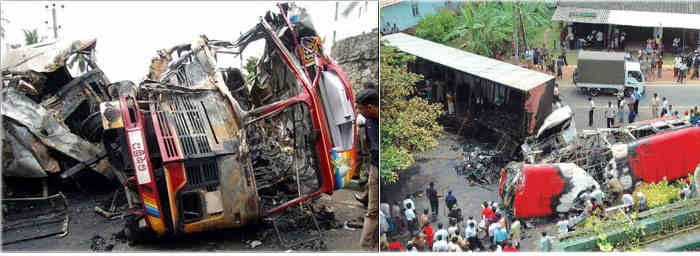
Let us take this accident when a container truck transporting beer hit a bus which then caught fire and where over 23 people died on the spot ... while many others are still suffering. One cannot ignore the families of all those who are affected who lost breadwinners etc and are paying the price still.
People who disappear and are being abducted etc need to be protected (even if that was not a concern during the southern rebellion of the late 80s ... and about which many foreigners are not even being made aware of). But these innocent people who die daily on our roads (and those who die all the time due to violence, thuggery and abuse of power) need to be protected too. Their right to life has to be respected. Who talks about them?
What is happening is clear indication that the system is crumbling with no one able to do anything about it. Let us not put the blame on the drivers ... the three-wheel drivers etc. I am a student of road behaviour and I have been observing executives also of the private sector and how they behave. There is enough of evidence that their value system has become "Let me get ahead ... it doesn't matter what happens to others"!
Even the driver of the container at the root cause of the tragedy referred to was part of the system. It was not his personal fault. He was pushed to work beyond limit without rest ... search for profit for the firm, irrespective of what happens to the citizen.
Yes, more than enough to reflect
on ...
Charles hopes he may have some time in the future
to put these & other things in more structured manner
in his memoirs.
Charles hopes he may have some time in the future
to put these & other things in more structured manner
in his memoirs.