
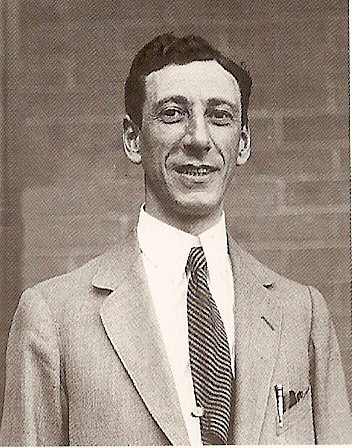
This article contains excerpts concerning the life and work of Charles Franklin from Harry Sucher's book "The Iron Redskin" (Haynes), which is the most authoritative history of the Indian marque. Sucher had the foresight to begin collecting materials for this book many years ago, when primary sources (e.g. ex-factory personnel) were still available.
The book is currently out of print, however copies are usually available second-hand through eBay or Amazon.com. It would be nice if an Indian club somewhere could negotiate with the copyright holders for a limited print run, as was done recently by the Ariel Owners Motorcycle Club in Britain for Peter Hartley's long-unavailable book "The Ariel Story".
Franklin promoted to Chief Engineer (again)
Now that the recent crisis of 1922-23 had been overcome, Colonel Hubbell resigned to enjoy his interrupted retirement, and Charles Franklin resumed full responsibility as Chief Engineer and Designer, which included overseeing certain aspects of production presided over by Theron L. Loose, who continued his duties as Plant Superintendent.
The two model ranges offered for 1925 consisted of the Scout and Chief, with the bulk of the production concentrated on the Scout. Sales of the Scout had been phenomenal for the times, and a number of new dealers were added to the company roster from enthusiasts who envisioned a new sales opportunity. Some former dealers, who had deserted the company during the difficult years, renegotiated their franchises, and by Spring Indian counted about 1,300 such outlets in the United States alone.
As the initial design of both models seemed adequate in both performance and dependability, they were continued with very minor changes for the ensuing season. The only exception was the addition of a Big Chief model of 74 cubic inches, otherwise identical to the original 61 inch model except for cylinder dimensions, and which was added to the line at the suggestion of many dealers who wanted the utmost in speed and power.
The Standard (Powerplus) model is dropped
The Standard was at long last dropped from the line, although it had enjoyed a loyal following from all corners of the globe since its first introduction in 1916. Now outmoded, the management decided that its modernization would be superfluous in view of the fact that the Chief had been planned to take its place.
While the Standard was basically a very sound machine, a few of its inherent weaknesses had never been entirely eliminated. The rear suspension system had been somewhat strengthened in the models produced between 1917 and 1920 by the addition of extra gussets in the spring brackets, although it still required frequent attention in keeping the bolts tight. The kickstart mechanism was another source of weakness, as the bracket that supported the crank was bolted to a long stud attached through the rear engine plate. This was prone to loosening and required frequent adjustment to keep the ratchet. in proper relationship to the standing pinion. The most serious fault was in the primary drive train, as under fierce acceleration the bolts securing the upper part of the gearbox housing would loosen, allowing the latter to twist, causing misalignment of the primary chain. This problem became more apparent with the fitting of the more powerful 74 cubic inch engine that was optional after 1920.
Generally speaking, however, the Standard had been a very satisfactory machine. It was powerful, reliable, and easy to maintain. Nearly 100,000 units were produced during its model life, including the War Department contracts, and it saw yeoman service allover the world.
[Page 2]