
Many of these models were still in use for two decades after production ceased, and numbers of sidecar outfits were seen in England up to the time of World War II. The author recalls two examples that were maintained as utility machines and were in daily use in 1939.
It was the Standard Powerplus engine that did much to establish Indian's reputation for ruggedness and longevity, and as a simple and uncomplicated design it inspired later designs by other makers.
Franklin tunes side-valve engines for racing
During the Spring of 1926, Charles Franklin perfected a racing version of the side valve Powerplus type twins, with special high compression cylinder heads, high lift cams, and twin carburetors, one for each cylinder. Four of these engines were built by the racing department, two being of 61 cubic inch displacement and two of 45 inches.
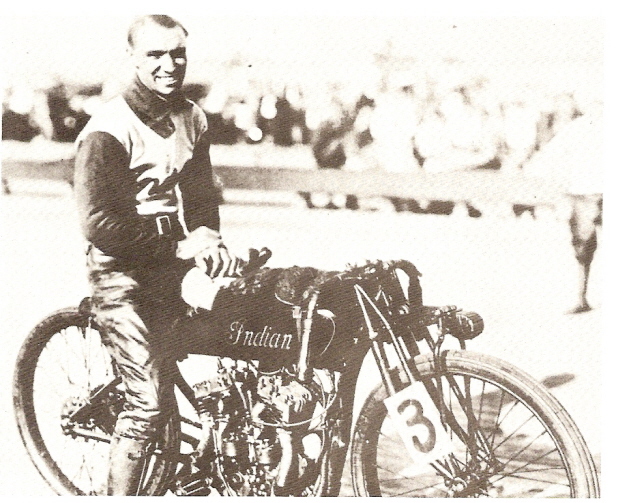
On August 21st at the Rockingham mile and a quarter oval at Salem, New Hampshire, Fredericks had already won two 25�mile races on one of the new 61 inch machines. Jim Davis had won the 20�mile National on a 45 inch model. At the half time of the race, Fredericks, with a terrific burst of speed, turned one flaming lap at 120.3mph for an all-time record that was never beaten on any board course.
It is significant to note that while most of Indian's and its competitor's racing records had, since 1911, been won on four and eight overhead valve specials, the ultimate marks were made on specially developed side valve machines. These results have remained as a lasting tribute to Franklin's engineering genius in the field of engine design.


General interest in board track racing declined from that time on, the two surviving courses being Rockingham and Altoona, which featured their last meetings during the 1928 season. The extreme danger to the riders and the deterioration of the tracks have both been mentioned as the reasons for board track racing demise. There was also less general interest due to the fact that during the latter years of the sport Indian was the only factory that supported it or fielded teams or machines.
[Page 3]