
During the early Spring, Indian's management decided to again enter the lightweight market. These plans were at once at variance with the policies already in force by the other big three factories, who were now manufacturing only big twins or, in the case of Excelsior, fours.
Surviving employees of the Engineering and Design department advanced a number of reasons for this decision. The continuing popularity of the Scout gave rise to the thought that a smaller and cheaper machine along Scout lines might have a similar appeal. Then there was the rumour throughout the trade that Cleveland was about to drop its two-stroke lightweight, in order to concentrate on a small four-cylinder machine recently developed for them by L.E. Fowler. There also may well have been the admonition of Richards lurking in the backs of their minds, concerning the necessity to offer machines more suited to novices and younger riders, who might be interested in a small type of motorcycle.
Another reason that has been cited for this new undertaking was the fact that the English motorcycle industry, whose products were now enjoying a soaring popularity both at home and abroad, was offering a vast range of light and medium weight machines, and that Indian might do well to attempt to compete in this market. There was also the fact that Indian's name still carried much magic on the English scene.
At any rate, Charles Franklin had been keeping in close touch with overseas developments, and had purchased several examples of some of the leading makes for evaluation at Springfield. He was particularly impressed with the newly-developed model K Velocette which was fitted with a 21 cubic inch overhead camshaft engine. This design represented the most advanced type of single cylinder motorcycle engine, as the use of bevel gear drive from the crankshaft to the valve gear was most efficient, obviated the clatter of the more usual push rods, and gave an extraordinary amount of power. After some experimentation, however, it was decided to finalize the design on the traditional Indian side valve type, as the overhead camshaft engine with its bevel gear drive was very costly to manufacture.
The result was a lightweight single cylinder machine which was named the Prince, and which was laid out along contemporary English lines. The solid frame was of the diamond pattern, the lower angles of which were formed by the engine plates. This type of frame came to be known as the 'Keystone' type in the United States. The front forks were of the English girder type, with a pair of tubes on either side forming a truss which was supported by a single barrel compression spring.
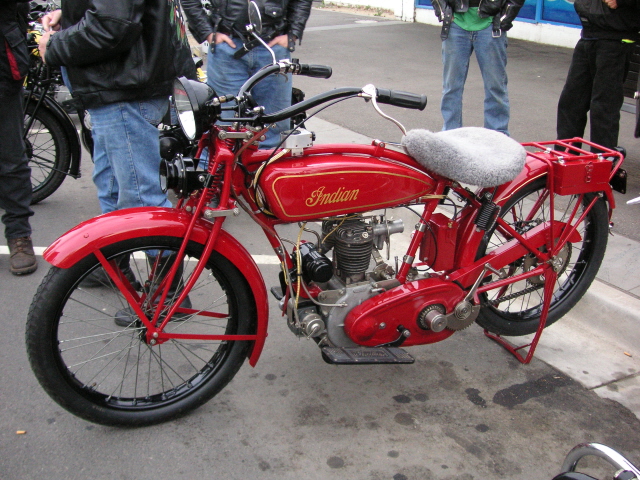
The single cylinder 21 inch cubic inch engine carried a single chain primary drive to a light pattern foot-operated clutch and three-speed hand change gearbox that was based on Hedstrom's 1915 design. The fuel tank was a somewhat ungainly wedge shaped affair that was clipped between the tank rails, and carried an oil reservoir for the total loss lubrication system of the engine.
The prototype machines were reported to have handled well, were easy to start, and had sufficient power to give a top speed of well over 50mph and to provide adequate hill climbing ability. After these tests were completed, the management gave the production staff orders to prepare for Prince manufacture in the Fall for the 1925 sales season.
[Page 4]