
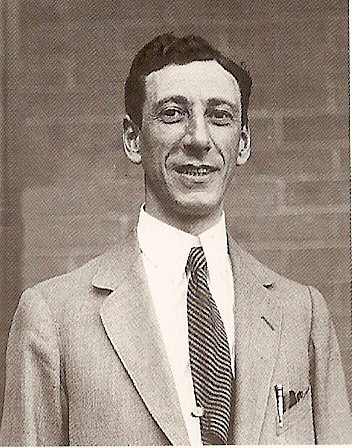
This article contains excerpts concerning the life and work of Charles Franklin from Harry Sucher's book "The Iron Redskin" (Haynes), which is the most authoritative history of the Indian marque. Sucher had the foresight to begin collecting materials for this book many years ago, when primary sources (e.g. ex-factory personnel) were still available.
The book is currently out of print, however copies are usually available second-hand through eBay or Amazon.com. It would be nice if an Indian club somewhere could negotiate with the copyright holders for a limited print run, as was done recently by the Ariel Owners Motorcycle Club in Britain for Peter Hartley's long-unavailable book "The Ariel Story".
Indian enters a factory team in the 1911 Isle of Man TT race
To consolidate Indian's leading position in the competition sphere, Hendee and Hedstrom decided to attempt an all-out effort to win the Isle of Man TT races, which were coming into their fifth season. In January, these plans were made known to Billy Wells, who responded with immediate enthusiasm and promised to engage the best available riders he could find in England to represent Indian. After some correspondence in the matter, Hedstrom stipulated that De Rosier would be one member of the team, with the balance of the riders selected by Wells. Additional interest was forthcoming in the TT by virtue of the fact that the organizers now planned to utilize the mountain circuit, which was 371/2 miles in distance and would entail five laps, for a total of 187 miles. Best of all, a twin cylinder class would comprise the Senior race, but with piston displacement limited to 585cc. The mountainous character of the course, now necessitating the ascent of Snaefell, would make almost mandatory the fitting of change speed gearboxes. The English trade press was jubilant that at long last the contest would be a good test for touring machines of substantial design.
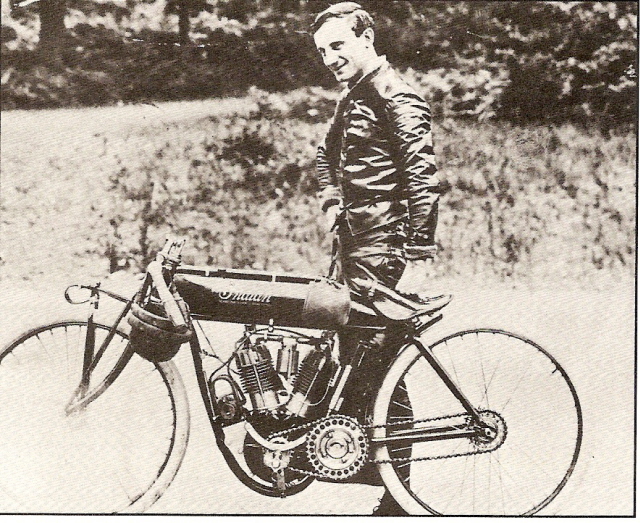
Hedstrom immediately set to work on the project, with the help of members of the racing staff, and six standard machines were modified for the event. The cylinders were sleeved to bring the displacement down to the required dimensions, other modifications including dropped handlebars and forward placed controls, so the riders could assume a crouched position.
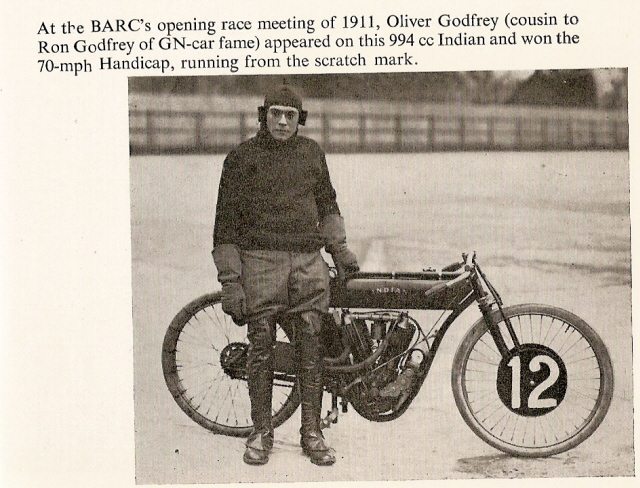
Hedstrom, De Rosier, and three mechanics set sail for England in June, well over a month before the races, to allow ample time for tuning the six machines and to enable the contestants to familarize themselves with the course. Wells selected Oliver Godfrey and A. J. Moorhouse, two promising young Indian enthusiasts and expert riders, along with a young Irishman from Dublin, Charles Bailey Franklin. Godfrey was later to become associated with a large motorcycle dealership in London. Moorhouse was to die tragically at Brooklands a year later, when his Indian went over the banking.
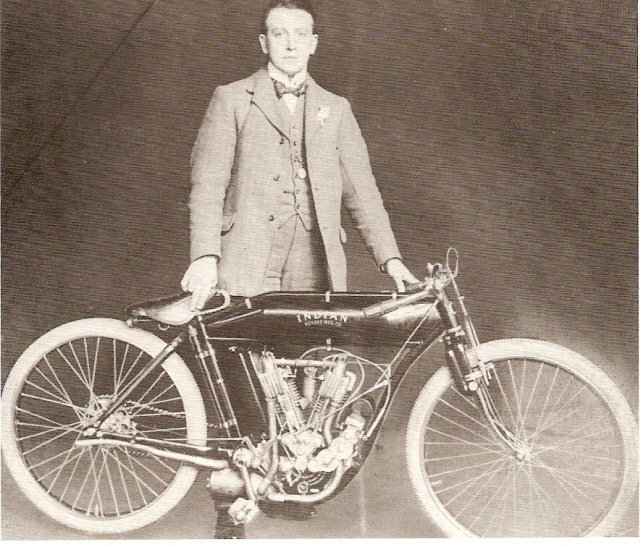
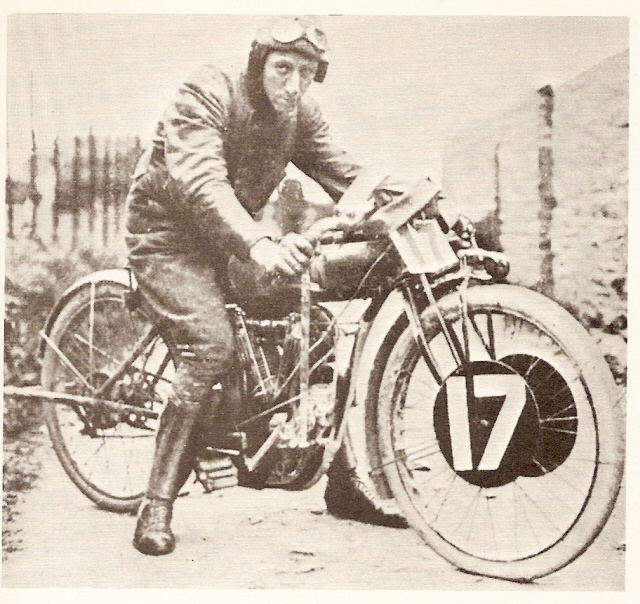
Franklin was born in Dublin in 1886 to parents of comfortable, middle class circumstances. After attending public school, where he showed interest in science and mathematics, he enrolled in the Dublin College of Science, where he majored in electrical engineering. Upon graduation in 1908, he secured a position in the engineering department of Dublin's municipal government. He became interested in motorcycling during the pioneer period and owned several early makes of machines. A keen student of motorcycle design, he became attracted to Indian in 1910, when Wells awarded a franchise to a Dublin dealer. He became a regular competitor in local club events, where his early competition successes and riding ability soon caught Wells' attention.
[Page 2]