
Indian sales for 1920 proved disappointing to the management. The only bright light on an otherwise dark horizon was the growing popularity of the Scout, particularly overseas. At home, interest in this machine was also encouraging and many dealers who had deserted the fold during the war, renewed their franchises.
Beset by numerous problems, the factory did not officially support the first postwar TT races. Billy Wells made his usual offer to aid private entries by Indian owners, but the only serious competitor was Reuben Harveyson, who did not place.
Sales volume for 1920 totalled $3,768,000.00 with only $68,000 reported as profit. The preferred shareholders continued to receive their 1 %% quarterly dividends. While the Scout had an encouragingly widened sales appeal and attracted many new converts to motorcycling, especially in the export field, it possessed a serious lack in its original form by not being fitted with electric lights. Franklin had apparently followed the current English custom of expecting night riders to furnish their own lighting in the form of proprietary acetylene units, which in those days appeared to offer more dependable illumination. This deficiency was corrected in the Fall of 1920 for the 1921 sales season, by fitting a Splitdorf generator and lighting system. This proved generally satisfactory, if careful attention was paid to care of the battery.
Dealer demand for a "bigger Scout"
What with the overwhelming enthusiasm for the Scout, many riders, dealers, and overseas agents began importuning the factory to design a larger, heavyweight V-twin along Scout lines, with more speed and power, which would have a special appeal for sidecar work. Many of the Indian executives seconded the idea, as the venerable Powerplus, now generally known as the 'Standard', still had the high and spindly old-fashioned look of prewar days, in common with the current big twin Harley and Excelsior models.
Franklin was therefore set to work designing an enlarged Scout type which was ultimately to be known as the Chief.
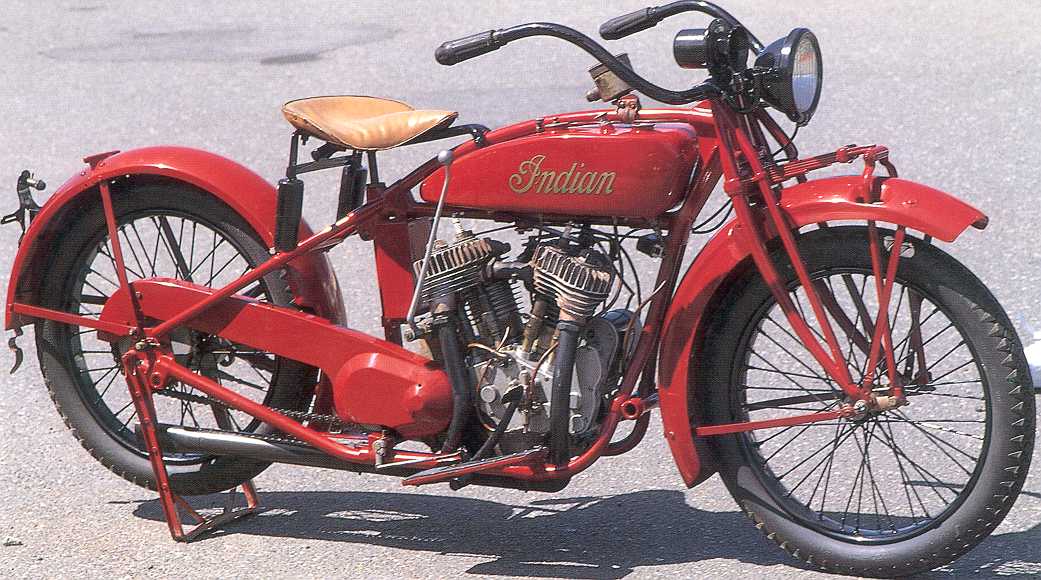
Some of the factory executives were opposed to the idea of launching a new model in the face of difficult times, especially as the present Standard model was a steady seller and had a wide following overseas. Butler and Richards were particularly adamant in their opposition, pointing out that sales efforts should be directed toward continuing attention to the very popular Scout, and citing the high costs involved in tooling up for the new model. Dealer pressure prevailed in the end and the soon-to-be-famous Chief was announced in the Fall of 1921.
The new heavyweight was in essence a slightly enlarged Scout, with a 61 cubic inch 42o V-twin engine, laid out with the now familiar helical gear drive and unit construction with the gearbox. The engine was basically similar to the Standard, except for the primary drive. In order to economize on manufacture, many Standard components were utilized, such as front forks and suspension system, wheel and brake assemblies, footboards and saddles. The principal new components were the frame, which was solid, like the Scout, new wider mudguards, and a pleasantly streamlined fuel tank, with integral oil reservoir for the total loss lubrication system. A separate generator and battery provided electric lighting as standard. The engine was sufficiently powerful to give a top speed of well over 90mph and gave good performance even when attached to a sidecar, the top speed then being over 70mph. In this latter guise it was a popular vehicle for bootleggers transporting illicit spirits, as the unpopular Prohibition Law had already been in effect for a year.
[Page 12]