
In order to better implement the new procedures, Weschler relieved Franklin of his duties as Chief Engineer and replaced him with Colonel Lindley D. Hubbell, who had just retired from the Army and had been in command of Springfield's Arsenal. While this was a technical demotion for Franklin, the change was much to his liking, as it left him free to direct all his efforts toward design matters, leaving production supervision to Hubbell.
Indian's final Isle of Man TT participation
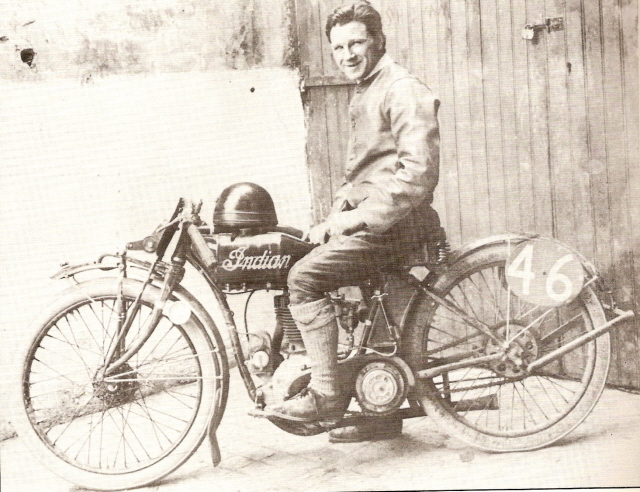
1923 marked the last year that Indian was represented in the TT races. Freddy Dixon, who had enthusiastically carried Indian's colors at Brooklands, had entered a special 500cc side valve factory special in 1922, but was forced to retire with engine trouble in the last lap, behind the winner, Alec Bennett. He entered the same machine in 1923, and managed third place, one minute behind the second place winner, C.M. Black, who was riding a Norton. Dixon's machine is still in existence and is owned by an Indian enthusiast in England, who is a member of the Vintage Motor Cycle Club. An identical machine, and thought to be the only other replica surviving, was once owned by Ted Hodgdon, who rescued it from a factory storage room after World War II. It now resides in the United States, where it is on view in a museum. A previously forgotten third replica was unearthed in another part of the factory by Ed Kretz, during the 1930's and was recently acquired by Russ Harmon, of Fullerton.
Indian strong in exports
Indian's position in the export market during this time was particularly strong, and, almost strange to relate, fully 50% of its production was still being sold overseas. Large quantities of machines, mostly Scouts, went to Australia and New Zealand. Indians were also popular in South America. At the Brazilian International Centennial Exposition, Indian was the only make to receive a gold medal for general mechanical excellence.
Indian's sporting successes overseas were no less impressive. Freddy Dixon won the Belgian Grand Prix on a 500cc side valve racing single. The Championship of Italy in both the 1,000 and 750cc classes was won on Chief and Scout models. The 1923 Argentine Tourist Trophy race was won by Antonio Gerli, riding a Super Chief.
US industry withdraws from participation in FIM
A final footnote to the close of 1923 was the ultimate withdrawal of the American motorcycling manufacturers from the international governing body of the sport, the Federation Internationaliste Motorcycliste. Billy Wells, who had held a seat on Indian's Board of Directors for some years, had been acting as a liaison representative between the American manufacturers and that body. In Indian's 1923 reorganization, he was not renominated to the Board, and for some reason the American Motorcycle Association did not see fit to appoint anyone else to continue in this post. As Indian was the only American manufacturer who had, up to that time, ever officially supported international racing, it appears that the others of the big three did not see fit to continue this representation. At any rate, motorcycle historians have generally agreed that this event marked the beginning of America's traditional isolation from international motorcycle sport.
Motorcycles relegated to minority status in US transportation market
While Indian's economic fortunes showed promise during the close of 1923, under Frank Weschler's capable management, both its future prospects of greatly enhanced production and sales were definitely limited, as were those of the other manufacturers who still survived on the domestic scene. The cheap, mass-produced, American light car, together with unlimited quantities of low cost fuel and lubricants, coupled with a general growing prospect of increasing economic prosperity, was now relegating the motorcycle to minority status in the transportation field.
[Back to Contents]