
Because they shared an interest in engineering, Franklin showed Butler his plans for a middleweight design which was a 37 c.i. 45" V-twin. It was a compact power plant with integral gearbox driving through helically cut gears rather than a primary chain, as was the current fashion.
In considering this design, Butler suggested, in order to make a more compact and lighter machine, that the original 60" wheelbase be reduced to 55" and the 22" wheels be reduced to 20" and that the frame be lowered. The essential feature, a strong cradle type frame which tied the whole structure together, was retained.
Butler at once took up the matter of introducing Franklin's model to Indian's board of directors who felt that departure from the 61 c.i. displacement Big Twin was poor marketing strategy although they were convinced of the newer model's technical excellence. Butler's insistence prevailed and the board ultimately approved the prototype development funding.
Franklin's efforts also included designing anew, lightweight model to replace the Model L, from which the Model O, a 15 c.i. horizontally opposed twin, came. This power plant was a miniaturization of that used in the English Douglas. Introduced in 1917, the Model O failed to attract a sufficient following probably because its lack of power provided mediocre performance although it was smooth running and easy to ride and control.
Two years later, Franklin introduced a 37 c.i. V-twin, now designated as the Scout, which proved to be an instant success. A middleweight machine that was easy to start and comfortable to ride with good handling, its 53-55 mph top speed was adequate for the needs of law enforcement and gave private owners sufficient performance in the sporting field.
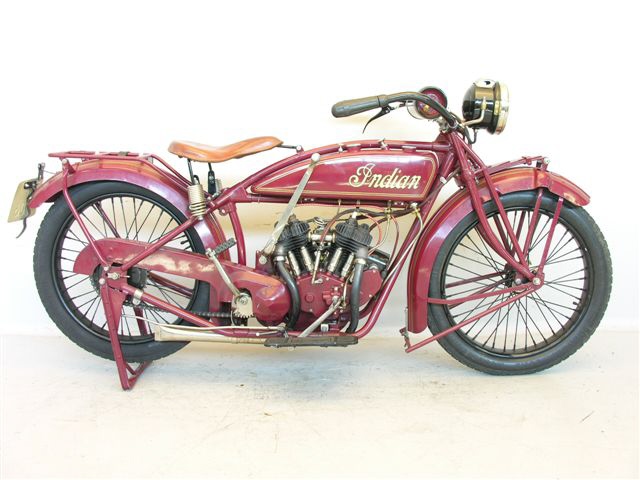
Known initially as the Model G, it was carried forward until 1927 with minor detail modification, with nearly 60,000 units sold. The popular motorcycle was credited with saving Indian from bankruptcy during the 1921-22 fiscal crisis.
Gustafson resigned from the company in 1921, the rumor being that he was somewhat miffed at Franklin's role in the Indian design. But he didn't go far, opening a concern adjacent to the company where he did speed tuning and sold aftermarket accessories for Indian enthusiasts. Gustafson's son, Charles Junior, remained with Indian for some years, managing the company's competition program.
[Page 6]