
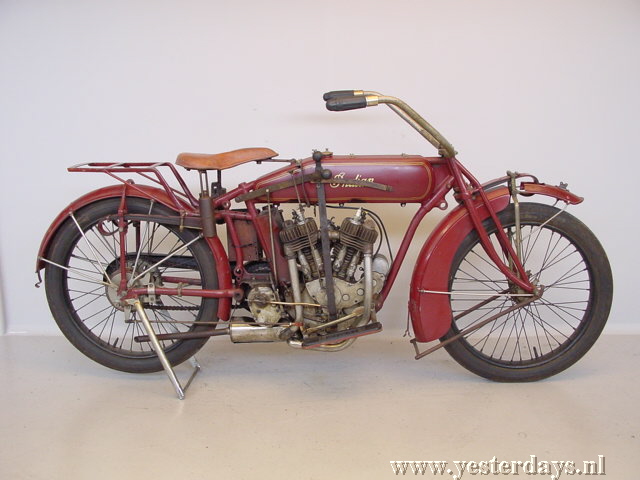
Also introduced in 1915 was a lightweight, two-stroke power machine, the Model L. The idea was to supply the lightweight utility market that had been largely vacated with the suspension of production of 85 percent of the U.S. motorcycle manufacturers caused by World War I.
That same year, Hendee advocated strengthening Indian's technical staff with the addition of some formally trained engineers. At the time none of the design section employees had ever been professionally trained.
Wells, as a company director, suggested that Franklin be hired as the Irishman's technical abilities, interest in practical motorcycling and competition experience made him familiar with the product.
Franklin, when presented with Wells' offer, was somewhat hesitant to relinquish a life-time tenure as a Dublin civil servant in a well paying position. A new, substantial export tax levied on foreign vehicles by his county government put Franklin's dealership at a disadvantage. He ultimately accepted Wells' offer, joining Indian in the summer of 1916 and arriving in the states that fall.
Franklin's first assignment was to try to improve the performance of the ill-fated Model L two-stroke lightweight, its power plant based on an earlier British effort produced by Union and originally designed by Gustafson. Attempting to improve the power output, Franklin altered the porting sequence, but the results were not satisfactory and the model was discontinued after a limited output had been assembled in 1917.
Franklin next collaborated with Gustafson on redefining the flowmetrics of the Powerplus engine Gustafson had designed, which proved to be superior to the former Hedstrom designs and also more economical to manufacture. The Powerplus or "standard" Indians still fit on Hedstrom's rear sprung frame and were carried with minor modifications until 1923 and also were assembled as the War Department machines from 1916-1918.
[Page 5]