
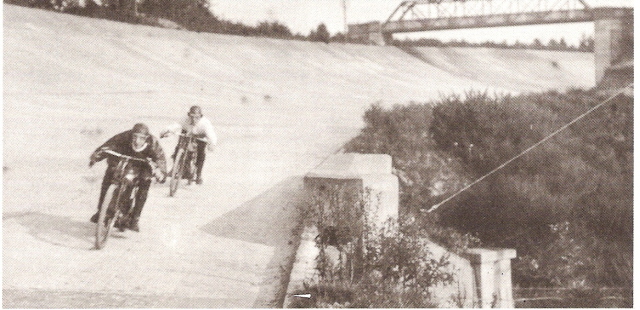
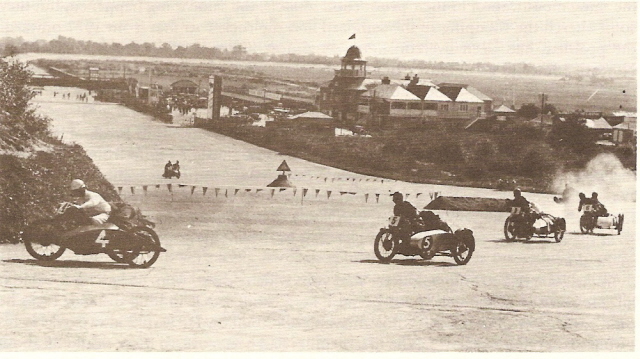
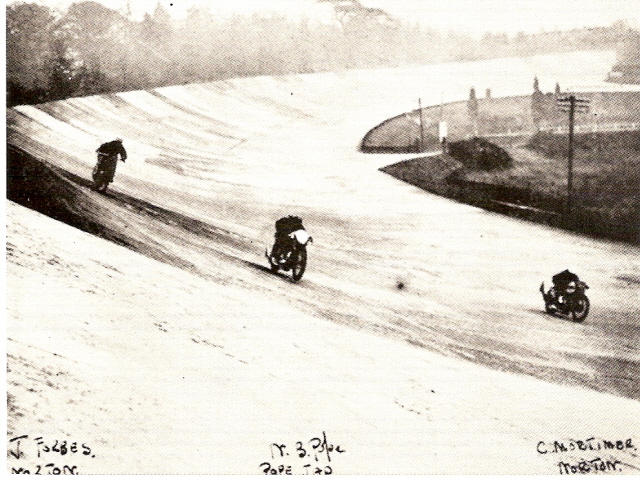
The temporary deviation had been caused by sudden exposure to a southwest wind on emerging from the shelter of the Members' Hill. The strength of the wind that day was relatively light, its effect much exaggerated by my own stupidity. It was a requirement of regulations that motorcycles should carry on each side a circular disc of 12in diameter, painted black and bearing the competitors number in bold white figures. A man with a brush and bucket of whitewash was posted in the Paddock for this particular duty. In my inexperience I had bolted my number-plates to the front-forks, with the result that even a moderate wind-pressure had produced a marked turning-moment on the front wheel assembly.
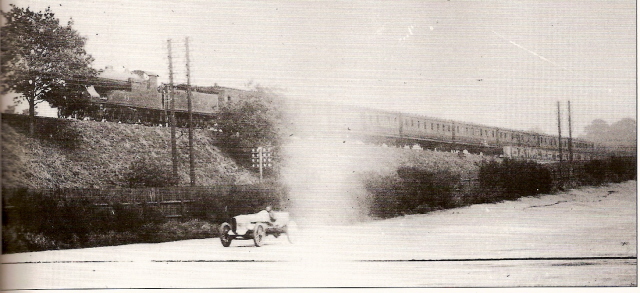
It may be added that when a really strong southwest wind was blowing the sudden impact could be a considerable hazard no matter where the number-plates might be situated; to the unwary even a racing-car was not immune.
The journey down the Railway Straight was not marked by any similarly untoward event; which was just as well because there was plenty to contend with. The motorcycles of those days depended upon the timely operation of a hand-pump for their lubrication; failure in its proper operation could result in engine seizure, causing in turn a serious skid or even the propulsion of the rider over the handlebars. At touring speeds one pumpful every ten miles would normally be sufficient; at racing speeds, very much more because so much oil was thrown out of the exhaust pipe.
Without experience, which might be bought dearly, it was difficult to decide how many pumpfuls should be given during each lap; too little would mean seizure, too much would oil up the sparking-plug. It was a difficult decision to take for quite a different reason: operation of the pump meant taking one hand off the handlebars. It was not too bad when the pump was fitted with a non-return valve and the plunger returned under the action of a spring; one hand was required for only a few seconds in one single operation. The more common case of a simple pump, worked in conjunction with a hand-operated two-way cock and requir�ing four consecutive operations extending over 20 seconds, could be a veritable nightmare. Hitting a bad bump with one hand off the handlebars was a combination of events to be avoided.
[Page 5]