
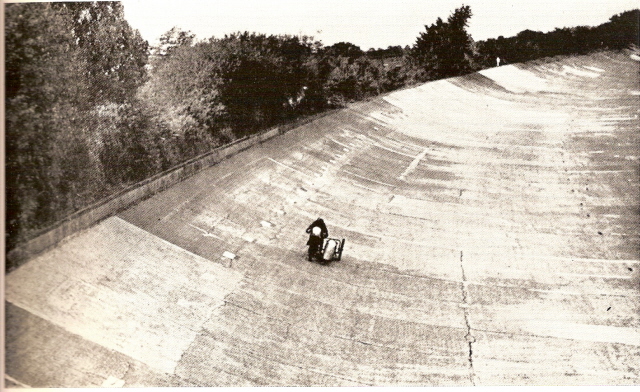
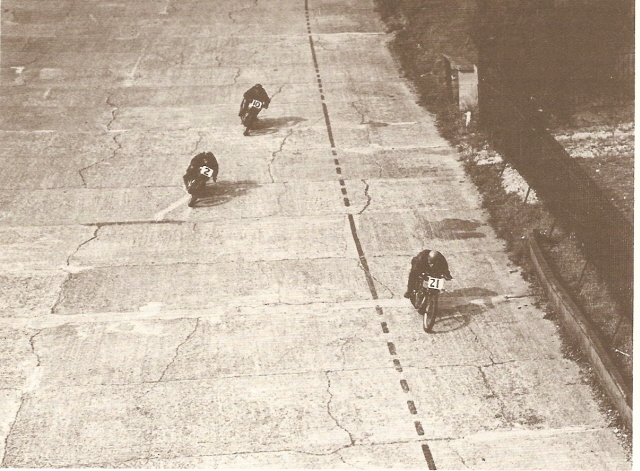
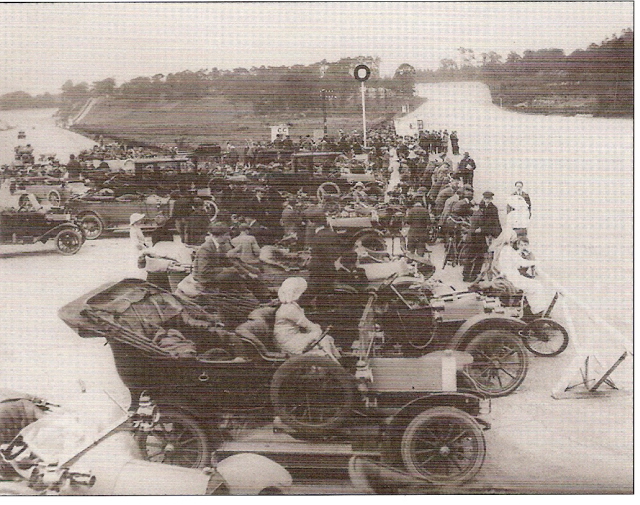

Being in line and usually close to the inner edge, one saw little ahead beyond the man immediately in front except on the Byfleet Banking, where it was possible to see across to a few riders curving off to the left. During the first lap I was overtaken by one or two whose get-away had been even slower than my own; it was only after a few more laps that the really fast machines came by after completing one more lap than myself. The race included several classes of engine ranging from 250cc to 1,000cc twins.
At about the ninth or tenth lap, apart from feeling tired, I had really settled down, but without warning there came a stunning blow on my back, my machine went into a skid and stopped almost abruptly. The driving-belt had broken and become wedged between the belt rim and a rear tubular member of the frame - it was this jamming which had caused the skid and allowed the free end of the belt to hit me in the back.
Not only had the belt broken, but one half of the fastener had become stuck in the groove of the engine pulley; in consequence, the spare belt entwined about my middle was useless. There was nothing to be done except to walk, pushing the machine all the way to the Fork.
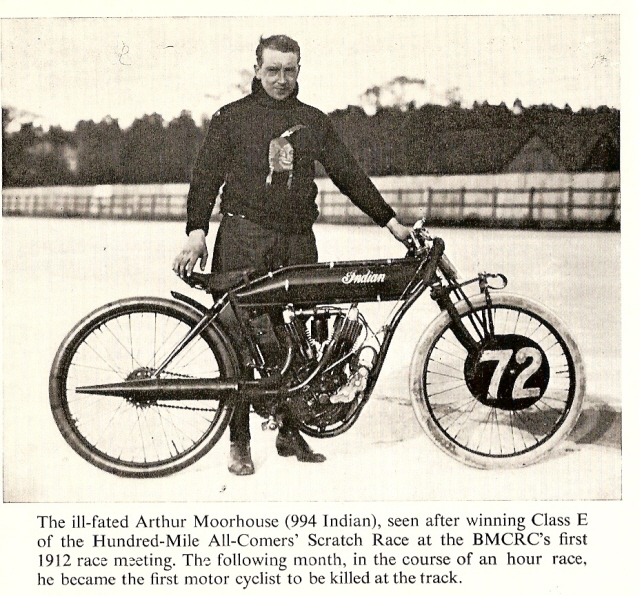
Far and away the fastest competitor was Arthur Moorhouse riding a 1,000cc Indian twin; with unfailing regularity he would pass about halfway up the banking although his speed was not more than about 75mph. In the course of this race he was to break the existing one-hour record. At the next meeting, the following month, he met his death along the Railway Straight by hitting a telegraph post in which remained the imprint made by the impact of his goggles. The cause was never established although it may be surmised: despite the fact that Indians were fitted with automatic mechanical lubrication of the engine, an automatic (single control) carburettor, its throttle operated (as in the case of ignition advance/retard) by twist-grips instead of awkward levers, Moorhouse was in the habit of riding with only one hand on the handlebars while he fiddled with something or other on his engine.
By the time the Fork had been reached, I was in company with a number of other unfortunates pushing their machines. The pushers were an assorted lot, two professionals and the rest amateurs, one little older than myself, all of them inspired by the indomitable spirit of Brooklands, the determination to try again and do better next time.
[Back to Contents]