
Although I had never been round the circuit before, the possibility of any surprises being in store never occurred to me, so intensely had the situation been imagined. The correct technique was believed to be simple enough - to get away smartly and make a bee-line for the inner edge of the track; the closer one got, the shorter the distance to be covered. The present race was for a 100 miles, the equivalent of 37 laps.
At last the flag dropped and immediately the scene was transformed. Three dozen young men were heaving their heavy machines forward and running as fast as they could go. In a very few seconds there was bedlam; first a few, one after another, and then the whole mass of engines burst into life. As the riders leapt into their saddles, motor-cycles swerved dangerously close to one another and for a few moments a number of collisions seemed inevitable. As my own engine sprang into life the competitor on the right swerved in front, missing my wheel by inches as he made towards the inside.
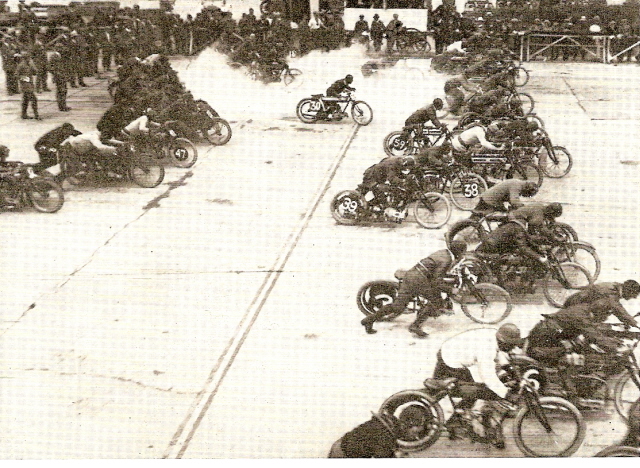
For my own part, once safely in the saddle all thought of the inside line vanished into thin air; it was one thing to know the correct procedure, it was another to carry it out. Quite apart from the fact that everybody displayed the same intention, my machine bucked about in the most unexpected manner and every effort was required to keep it on a straight course.
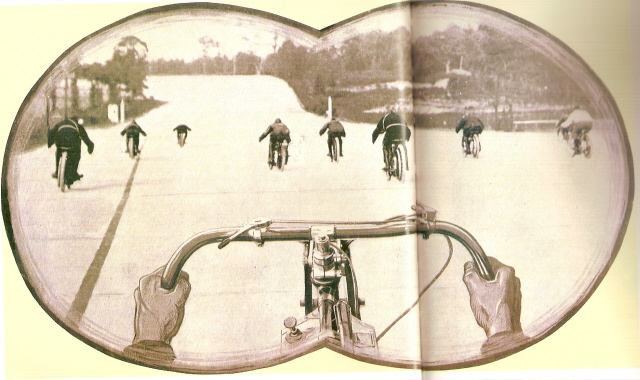
The difficulties were accentuated by the need to juggle with the pair of levers which controlled the carburettor. It was not simply a matter of opening the throttle. Motor-cycle carburettors possessed both a throttle lever and another lever which controlled the strength of the petrol/air mixture. Then there was the ignition advance-and-retard lever, this one situated on the side of the petrol tank about which my knees were tightly gripped, otherwise it would have been impossible to remove one hand from the handlebars.
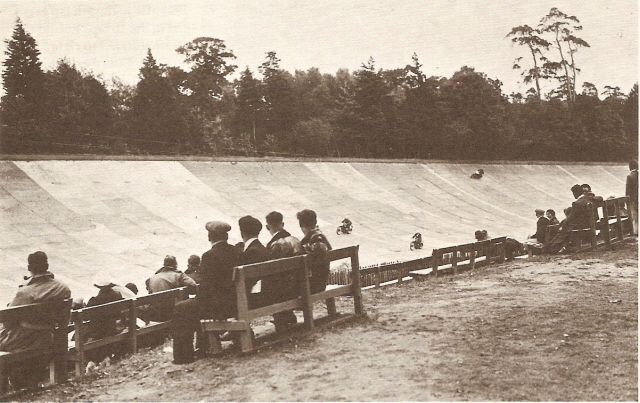
As we climbed the one in thirty incline towards the curve round the Members' Hill, most were doing about 50mph but varying our speeds sufficiently to space ourselves out: the inside edge was now becoming more accessible. Still much disconcerted to find the going so rough, I settled down to take things as they came. There was not long to wait. Sweeping round the long bend and under the Members' Bridge, all the time the way overshadowed by the high Members' Banking on the right and the hill on the left, I became aware of going downhill as the speed rose perceptibly.
[Page 4]