
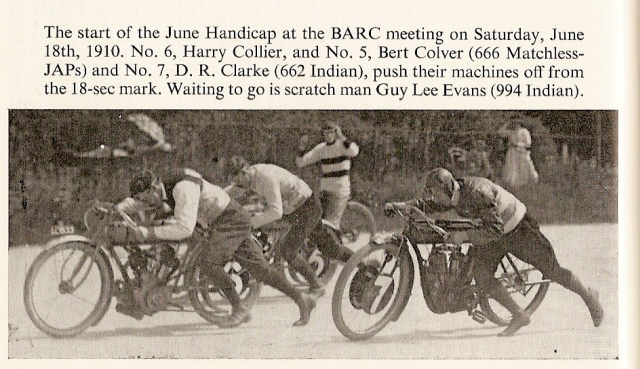
Just as Napier cars had threatened to dominate the field of car-racing so, over much the same period, Matchless motor-cycles were predominant in their own sphere. These machines were manufactured by the firm of Collier & Sons. It was the sons "C.R." and "H.A." who swept the board at the first motorcycle race meeting at Brooklands by winning at something over 70mph on their own make of machine. There was nothing surprising in this: they were used to winning races, from the boarded track at Canning Town to the Tourist Trophy Races in the Isle of Man.

Both were fearless riders and sound engineers into the bargain. They were also physically tough, as they had to be to survive the violent buffetings of machines completely devoid of any springing. "Spring Forks" for front wheels were already on the market, but these still young veterans of the board track (where they were not really necessary) would as yet have none of them, believing that they would result in too great a loss of transverse rigidity. Once again, Brooklands was to teach its lessons; sprung front-forks were very soon universal.
The number of starters in a Brooklands race might be as few as five or as many as 50; with the larger fields a simultaneous standing start provided an awe-inspiring spectacle to spectators and riders alike. Before 1914, clutches and gear-boxes were nearly unknown on motor-cycles, the rear wheel being driven directly by the engine through the medium of a rubber and canvas belt.
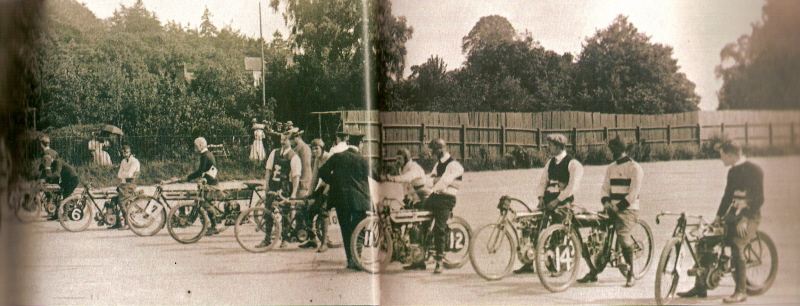
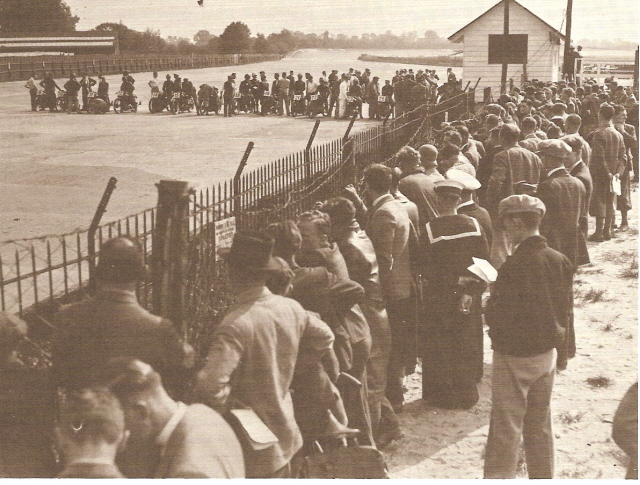
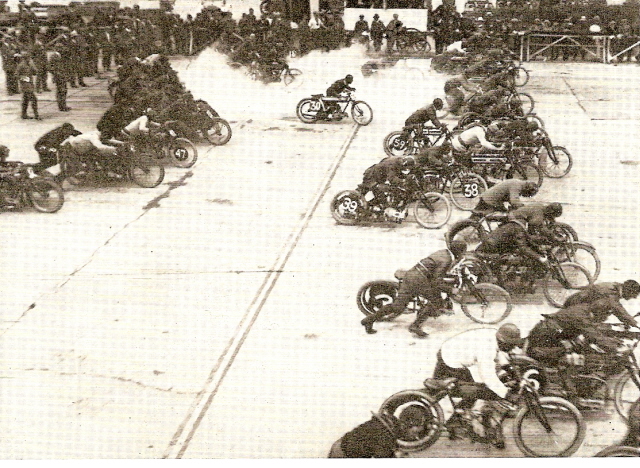
It was this mechanical austerity which compelled the rider to push and run along-side the machine with the exhaust valve lifted from its seating in order to reduce resistance from cylinder compression. When sufficient speed had been attained, the exhaust control lever would be released and, with luck, the engine would burst into life. At this point, and not a moment later (otherwise the handle-bars might be wrenched from his grasp), the rider would leap into the air and vault into the saddle. Failure of the engine to fire could reduce the rider to a stage of physical exhaustion. High compression-ratio, big valve-overlaps and large-bore chokes all combined to make starting more difficult and uncertain; yet all three were required for maximum speed.
[Page 3]