
Racing successes continued [for JAP], W. Hodgkinson winning the Essex Hill Climb held during April 1906, using 85 x 60mm and 85 x 76mm engines. A month later, D. G. Gilmour won the Auto-Cycle Club's Hill Climb at Blackdown House, riding a 6hp twin. J. Hancox finishing 9th on a similar mount. Meanwhile, preparations were again in hand for the International Cup Race, the 1906 event having been shifted to a course in Austria. A special racing engine was designed and built for C.B. Franklin's use, a 90� vee-twin with' square' bore and stroke measurements of 85mm. It was claimed that an engine of this arrangement would run very smoothly. Its distinctive feature was the length of the cylinders, the effect being accentuated because there were only five fins, and these around the non-detachable cylinder heads. On the domestic front, a twin cylinder JAP engine fitted with a multiple disc clutch attached directly to the mainshaft was announced towards the end of May.
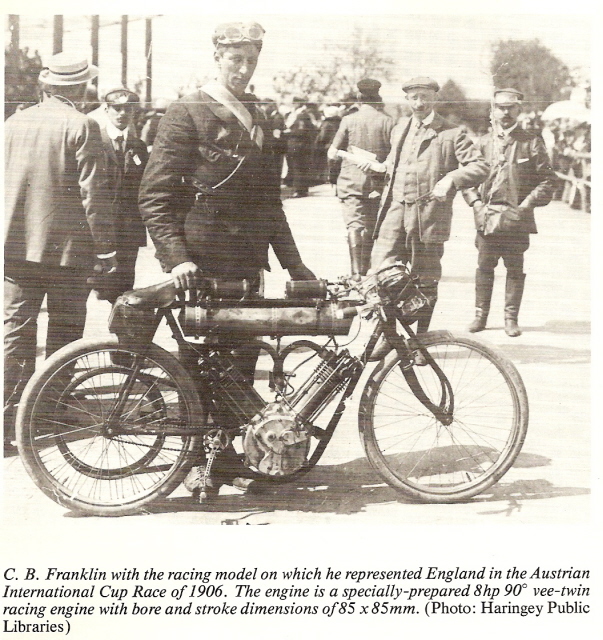
The 1906 Selection Trials for the International Cup Race were held in Knowsley Park, Liverpool, another venue where there was no speed limit and the roads could be closed without legal complications. The two Collier brothers and C. B. Franklin emerged victorious, although it is significant to note that on this occasion only four British manufacturers submitted entries. Two of them were soon out of the running when their riders were forced to retire.
In the Race itself, Harry Collier managed to take third place, although his placing subsequently carried little prestige. With the inevitable bending of the rules, followed by protests and counter-protests when the results were announced, the future for the continuation of this annual event looked anything but good. Fortunately, thoughts were diverted in other directions when the disgruntled British riders discussed the situation with the Marquis de Mouzilly de St. Mars on their way home by train. Very much an anglophile at heart, he had managed the British Team in the event, and he was able to contribute to the open discussion. As a direct result, plans were laid for a new Tourist Trophy Race to be staged in the Isle of Man during 1907, which eventually became a reality. From this simple discussion, the greatest road race in the world was conceived and the International Cup Races were quietly laid to rest.
[page 3]