
In the Single Cylinder race, Charlie Collier brought his Matchless JAP into 2nd place, after having to stop and change a plug when a misfire set in. Harry Collier ran out of petrol and Franklin struggled in to finish 6th. The JAP-engined runners in the Twin Cylinder Class fared almost as well. Harry Bashall took second place, a puncture having caused him to stop and effect a repair at the time when he was in the lead. Drury finished 6th and Bert Colver 9th, the latter having suffered the same fate as Harry Bashall when he was on his 7th lap. Only White failed to finish; the magneto drive bevel pinion had shed its teeth towards the end of the race, and put him out of the running.
An interesting feature of the 1909 TT machines ridden by the Collier brothers was the adoption of a Bosch magneto for the ignition system, in place of the usual battery and coil. It is claimed that this was the first appearance of the new vee-twin Bosch magneto in Britain, which may have given the riders an added advantage. Neither machine had spring forks or a spring frame, so that if a battery and coil system had been fitted, these components would have taken quite a hammering.
It was Charlie Collier who encountered misfortune on this occasion. Alleged to have the faster of the two machines, it was the belt drive that let him down. On the opening lap the belt fastner broke and in so doing caught in his rear brake, putting it permanently out of action and forcing his early retirement from the race. Many would have liked to see how he matched up to the challenge provided by Lee Evans, who was riding a 5hp Indian twin with a two-speed gear and all-chain drive. As it was, brother Harry had his work cut out to take the lead from Evans and win at an average speed of exactly 49mph.
It was the 1910 TT that again drew the attention of the capabilities of the JAP engine, for it was Charlie Collier who brought his Matchless JAP into first place at an average speed of 50.63mph. The field comprised no less than 83 riders, 12 of whom rode a machine fitted with a JAP engine, either a single or a twin. The expected challenge of the all-chain drive Indian failed to materialise and after the usual early incidents, Charlie found himself in the lead at the half-way stage, with brother Harry close behind. These positions remained unchanged by the time the race ended, although it was by no means a walk-over victory. Amongst the many famous names who had offered a challenge were Harry Martin, Noel Drury, H.H. Bowen, F.A. McNab and Harry Reed. The third member of the Matchless team, Bert Colver, finished tenth.
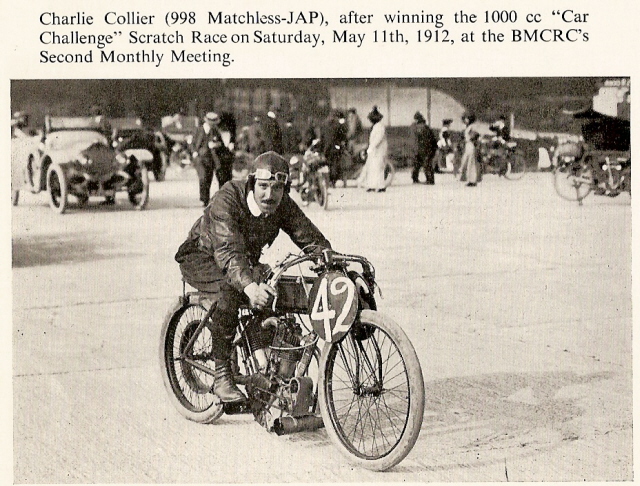
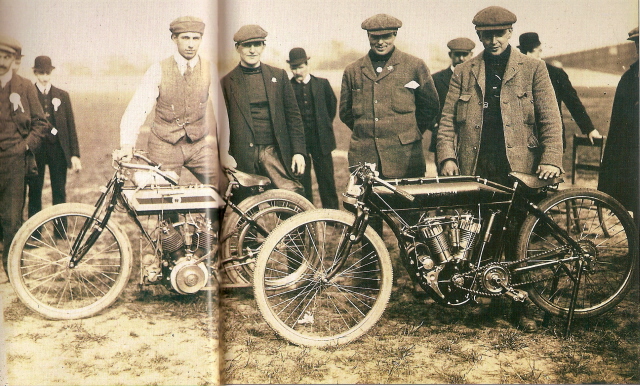
Soon after the TT it was the BMCRC 5th 1910 meeting at Brooklands that focussed attention on some of the JAP-powered entrants. During the Record Time Trial event, Charlie Collier set up a new Class E record for sidecars, taking the flying start mile at 80. 18mph and the flying kilometre at 78.45mph. Bert Colver took the flying kilometre in Class D (up to 750cc solo) with a 666cc Matchless JAP at 70.61mph, whilst S. A. M. Witham took the flying mile in the same class at 71. 72mph, riding a BAT JAP of similar capacity. Later, F.A. McNab won the up to 500cc July Junior Handicap on a 498cc Trump JAP, and Bert Colver the up to 1000cc July Senior Handicap on his 666cc Matchless JAP. It was McNab's second major success in less than a month, for at the end of June he had won the up-to-500cc Singles Class of the Brooklands 60-Lap TT Race, on the same machine. H. H. Bowen had finished second in the Multi-Cylinder Class on a 666cc BAT JAP twin, beaten only by Arthur Moorhouse on an Indian.
[Back to Contents]