
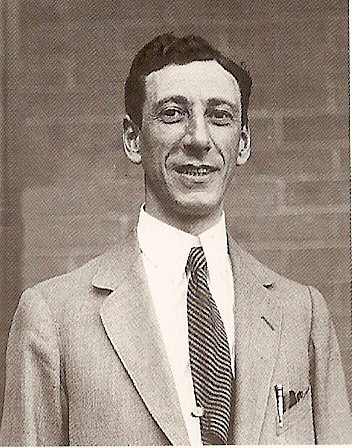
Before moving to Indian, Charles Franklin had already become one of the fore-most motorcycle racers of his age aboard machines powered with engines by John Alfred Prestwich, whose company JAP of London made power units for a range of British marques beginning with Triumph in 1902. Mention of "C.B. Franklin" crops up in Jeff Clew's book "JAP: The Vintage Years" (Haynes), a book which is long out of print and now considered "collectable" which means that second-hand copies are very expensive.
Highlights of the following quoted passages from this book are:
(i) that in 1906 JAP made a V-twin racer especially for use by Charles Franklin, so by this time he can already be considered a factory-supported rider;
(ii) that he was one of a group of British racers who in 1906 resolved to establish the Isle of Man TT races starting from 1907 (these races continue to this day); and
(iii) that by 1909 the main challenger to the racing success of JAP-powered racers in the TT and at newly-opened Brooklands was an all-chain-drive brand from across the Pond, called Indian. Franklin himself made the switch to riding Indians in 1910.
Racing was now beginning to take prominence in the motorcycle world, it having been recognised that racing successes made powerful advertising copy. In the early days, reliability had been the keynote in promoting sales, but as machines became more reliable as the result of continuing development and participation in competitions, it was racing that became the decisive factor in evaluating performance capabilities. Road races held on the Continent were beginning to attract British manufacturers and when France announced the running of the Coupe Internationale in 1904, around a 34 mile course near Dourdan, John Prestwich entered a rider by the name of W. Hodgkinson on a machine powered by one of his new ohv engines. Lagonda and Quadrant entered machines, too, yet sadly all three British machines failed to complete the race. Perhaps it was as well, for eventually the race was declared null and void. Certain' irregularities' had come to light and there had been many squabbles amongst those who took part.
In an attempt to improve the quality of the British entry for the 1905 event, the Auto-Cycle Club decided to hold selection trials in the Isle of Man. This was considered to be a suitable venue because a course had already been agreed over which the Gordon Bennett car race would be run during the month of May. It would be comparatively easy to extend the use of the course until May 31 st for the Selection Trials to be run, for the Island had its own government and it was still possible to close the roads for speed events. Furthermore, there was no rigorously enforced 20mph speed limit, as there was on the mainland.

Amongst those invited to take part were seven riders of JAP-powered machines, six of them using 76 x 95mm 6hp engines and one an 8hp engine. On this occasion, Hodgkinson was sponsored by Charles Jarrott, the celebrated racing motorist, the others having entered under their own names, comprising C. B. Franklin, O. L. Bickford, H.A. Collier, C. R. Collier, J. S. Campbell and H. Rignold. The Collier brothers rode Matchless machines of their own design and manufacture, whilst J. S. Campbell had an Ariel. Rignold, a former Lagonda rider, rode the machine fitted with the 8hp engine, make unrecorded.

[Page 2]