
In 1925 Paul Anderson rode one of Franklin's 750cc ohv twins, based on an Altoona model crankcase and Prince cylinders, in search of records at Arpajon, France. His two-way average over the flying kilometre was 120.91mph, which exceeded the existing official world motorcycle speed of 119.05mph, established by Bert LeVack on a Brough-JAP over the kilo distance. But Anderson's effort was never ratified because of suspicions about the timing gear after he had been clocked at an impossible 159.08mph in one direction on a mile run.


His return speed for the mile was 118.34mph, which gave an average of 135.71 mph when paired with the blatantly incorrect figure. Indian used the 135mph claim in advertisements, but a more realistic - and thoroughly laudable - achievement was Anderson's two-way average of 125mph established later at Sellick's Beach, Australia. Even more impressive, in my opinion, was a two-way average of 117mph on a 1300cc Altoona model, the fastest speed yet recorded on a side-valve motorcycle.
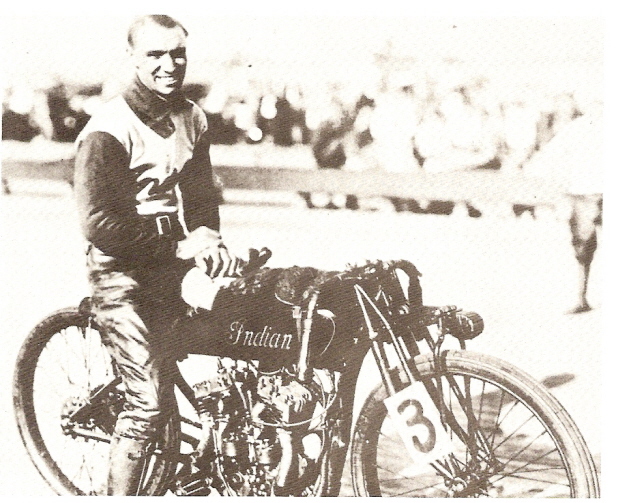
In 1926 and 1927, Indian built a total of 26 newly designed Franklin 750cc four-valve overhead twins for racing and hillclimbing. Ball bearings were used for both the crankshaft and camshafts, with roller bearings for the big-end and plain bearings for the little end. In 1928, These bikes won both 750cc and 1000cc national championships on the New Hampshire boards.
Having so seriously pursued overhead valve development, Franklin must have been surprised at the progress of his own side-valve trials, which had been conducted since 1916. Following up on the extensive pre-war inlet-over-exhaust research, he had continuously experimented with side-valve design along the same lines, aiming the combustion charge towards the valve cavity, thus raising compression and enhancing turbulence.
As an aside, it is interesting to compare Franklin's technique with that of Britain's Sir Harry Ricardo. The Franklin side-valve combustion chambers were never so radically shaped as Ricardo's. In Ricardo's side-valve engines there was but minimal unsloped chamber clearance over half of the piston, with the chamber roof then opening up dramatically into a scooped-out, almost hemispherical volume above the valves. Frank1in's engines had the sloped roof above the entire piston, with additional steeper sloping into the valve chamber.
Ricardo's approach seemed to offer better low- and mid-range performance for standard machines, while Franklin's technique produced maximum power for racing. However, the performance of the standard Indian 750cc Scout and 1200cc Chief models was not lacking, and by the late thirties Harley-Davidson side-valve design had tended to follow Franklin's evolution. Both the later generation Indian Sport Scouts and Harley-Davidson KR racers were also much less along the lines of Ricardo's initial Harley-Davidsons of the early thirties. Certainly, the entire process of side-valve combustion chamber design was one of trial and error, and both Franklin and Ricardo independently evolved successful techniques.
[page 5]