
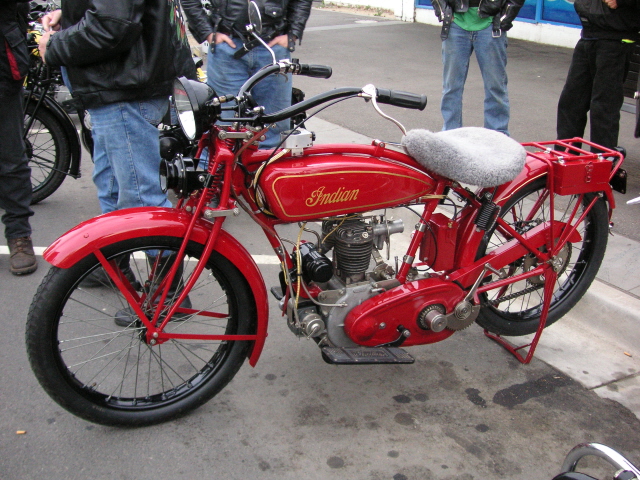
Franklin then designed an ohv version of the Prince, although this bike never enjoyed the sales success of the cheaper side-valve job. However, the ohv Prince earned its place in American racing folklore by winning its share of races against Harley-Davidson's 350cc 'peashooter'. During this same period, Franklin put together an overhead cam Prince, but Indian management decided not to produce this more expensive creation.
After ten years with Indian, Franklin probably felt stifled by the stagnation that had taken hold in American motorcycle manufacturing, when he considered the abundance of new designs that were continuously hitting the streets across the Atlantic. When he had entered Indian's employ, the Wigwam was one of the world leaders, not only in sales but in technology as well. However, cheap cars and restrictive tariffs had undone both the domestic and export opportunities for the company, with the result that Franklin would not again design a new road-going Indian.
In my opinion, Franklin was one of the world's greatest motorcycle engineers. You may wonder how the designer of only three roadster models can be accorded that accolade, but the answer is twofold. Franklin built arguably the fastest ohv motorcycles of his day, beating Britain and the Continent at their own game. Even more impressive was his uncanny continuous development of the side-valve engine, to the point that his machines frequently out-powered their ohv competition.
During the twenties, motorcycle engineering in Britain and Europe progressed along natural lines, especially in racing. Side valves slowly but surely gave way to overheads, while the more informed confidently and correctly predicted the rise of ohc designs in the near future. In contrast, in the United States indecision was the keynote, and that indecision was the direct result of Franklin's side-valve achievements. So it was, that Henderson and then Harley-Davidson switched from inlet-over-exhaust to side-valve designs in their road machines, converting the bulk of the American industry, in a tribute to Franklin's racing successes of the twenties.
When Franklin assumed leadership of the Indian racing department in 1919, he inherited the ancient ohv eight-valve twins and four-valve singles originally drawn up by Oscar Hedstrom in 1910. He at once set about improving the porting and cam action on these 1000cc and 500cc machines, which were turned over to the top Indian riders. Foremost among these was Gene Walker, who became practically unbeatable in mile dirt-track races over the next several years, defeating Harley-Davidson's newer ohv designs.
In 1926 Johnny Seymour rode Franklin-tuned eight-valve and four-valve Indians to new American speed records at Daytona Beach. These one-way runs were not internationallly recognized, but Seymour's achievement at more than 132mph should be compared in the offical two-way record of 119mph by Bert LeVack on a Brough-Superior. It's hard to believe that an ocean beach course with typical morning inward breezes would have an effective assisting component of greater than 13mph, so a conservative judgement would be that Franklin's 1000cc Indian was perhaps as fast as any other motorcycle in the world.


[page 4]