

Meanwhile, at Indian's factory in Springfield, Massachusetts, a most interesting development was coming to fruition in the engineering department. Whether under the influence of Franklin, or worked out independently by some combination of the talents of the Indian staff, the Indian inlet-over-exhaust racing singles were being equipped with a radically different cylinder head. The combustion chamber roof now sloped steeply towards the valve chamber, thus predating by five years the designs by Britain's Sir Harry Ricardo.
That Indian development arrived at the same conclusions as Ricardo should come as no great surprise, for Indian was then the world's largest selling motorcycle, and the company possessed an immense engineering capability. In any event, combustion chamber experiments at Indian in 1913 and 1914 were setting the stage for the near future, when a new generation of the iron redskins would clearly be established as the world's fastest side-valve motorcycles.
In 1915 Franklin was chosen as manager of the new Indian depot in Dublin. Upon his selection, Irish Cyclist and Motorcyclist commented: 'Franklin is more than a clever rider. He is a first class mechanic, and his ability to diagnose the cause of trouble in a motor bicycle is almost uncanny. '
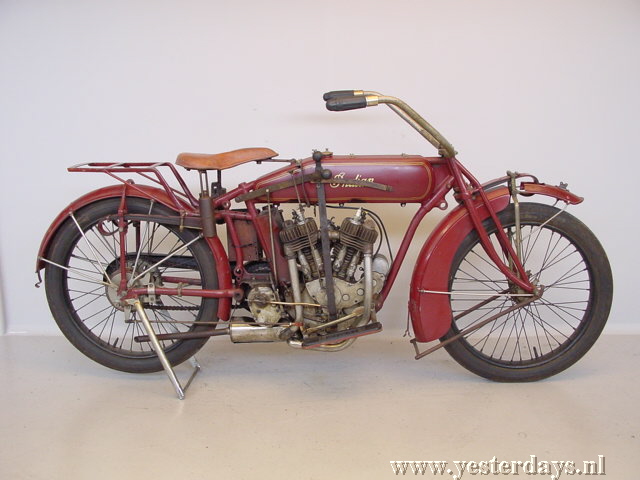
These were the days when Indian had annual sales approaching 30,000 units. When the Dublin depot was closed in 1916, Franklin set sail for the USA, where he entered Indian's engineering department, joining Charles Gustafson senior and son Charles junior. By this time, co-founder and chief engineer Oscar Hedstrom had left the company, whereupon the Gustafsons had replaced Hedstrom's famous inlet-over�exhaust models with side-valve designs. Franklin soon became the dominant force in the Indian engineering department, and with management approval spearheaded the design of a motorcycle which was ultimately to change the course of the American industry.
That machine was the 600cc Indian Scout, which debuted in the autumn of 1919 as a 1920 model. The Scout was a bold breakaway from past practice, being a unified motorcycle concept as opposed to a collection of individually designed components. The powerplant consisted of a side-valve V-twin, connected to an integral three-speed sliding-gear transmission by a helical-gear drive train operating in a cast-aluminium oil bath.
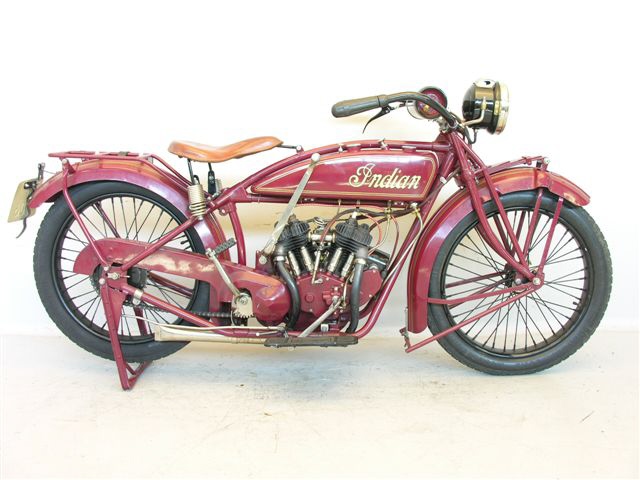
The engine/transmission unit was bolted into a double-loop cradle frame by two forward mounts on either side of the engine, and one aft mount on the bottom and in the middle of the gearbox. In contrast, other motorcycles of the day relied on an assortment of plates and bolts to link the engine and gearbox, and a single-row primary chain, over which a stamped metal covering kept out dust while permitting a steady drip of oil to soil any parking spot.
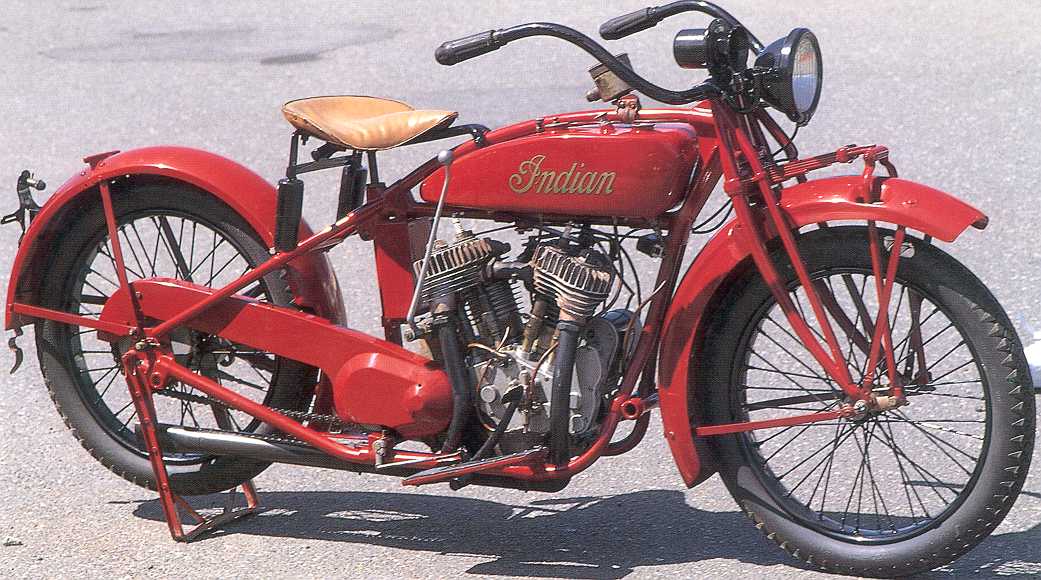
Instant public acceptance of the low-slung Scout meant that Franklin lost no time in designing a larger motorcycle along similar lines, as a replacement for the ageing and top heavy Powerplus V-twin. The new 1922 machine was named the Chief, clearly denoting it as the top of the Indian line, and advertisements and magazine articles described it as 'basically a big Scout'.
[page 3]