
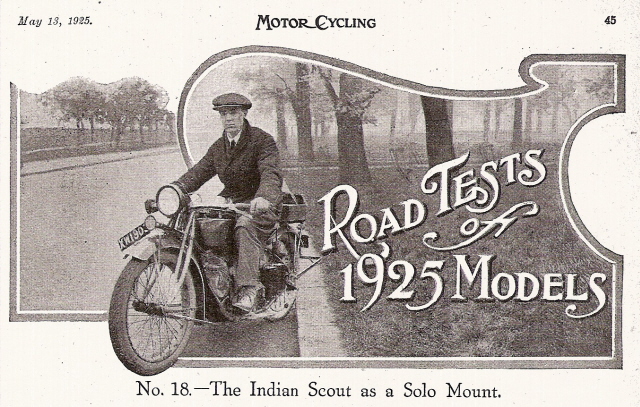
WHEN the Indian Scout and the writer left the wigwam in the Euston Road, conditions were dead against us. Not having ridden a twist-grip-controlled machine for five or six years, the terrific acceleration of which our mount was obviously capable was not so welcome as it might have been to a man surrounded by traffic on a wet road, who knew himself capable of turning the grip the wrong way at any moment. Moreover, foot-control clutches are in the minority, and there can be no denial that, to the chicken-hearted on asphalt, two feet on the ground at once are a comfort.
The journey down Regent Street at the hour of the day when the last of the leisured suburban shoppers are fighting the first of the business folk for a place in the buses was mildly exciting. But by the time the quieter Haymarket was reached, and it became possible to take the eyes off a vehicle in front, confidence returned. Upon arriving at Westminster Bridge the controls came as naturally as the conventional arrange�ment.
Controls Inspire Confidence.
This question of control is an important one. There are hundreds of people who feel they must have a hand-control clutch. With distinct leanings in this direction ourselves, we are glad to be able to record that the Indian system leaves nothing to be desired; and as soon as one has become accustomed to it the change from orthodox English practice is in many ways preferable. On greasy roads with a bumpy surface, for instance, the feeling that one can maintain a firm grip of the handlebars while having the throttle under extremely delicate control, is conducive to confidence.
Incidentally the throttle is controlled by the left-hand grip, while the right hand looks after the spark. This latter control is most useful in hill-climbing, and permits of a very efficient magneto setting on the level. Indeed, it is not too much to say that the exceptional acceleration characteristic of all Indian models owes something to the fine control of the ignition.
The bore and stroke of the twin engine are respectively 69 mm. and 77 mm., the capacity being 596 c.c. The cylinder heads are detachable and the gaskets are a sound job deserving of the sincerest form of flattery. The fuel passes through a Schebler carburetter, while the Splitdorf magneto, which gives a healthy spark at 40 r.p.m., assuredly has something to do with the easy starting.
[page 2]