

 User's Guide

3. Structural Overview
The information in this section is intended to give a brief overview of the structure of the CenDoc schema. For more detailed information on the elements and how to use them, refer to section 4.
| 3.1 | <cl:doc> Element Structure | ||
The CenDoc structure is based on a book model, and uses the <cl:doc> element at the top level to represent the individual book or volume. This structure is referred to as the document because we typically capture our content starting with the <cl:doc> element. The structure inside of <cl:doc> is made up of document-level metadata stored in the <cl:doc-meta> tag. Also we have elements that allow us to capture structural, presentational, and descriptive metadata. Finally and most important, there are elements to capture front matter, body matter and back matter content.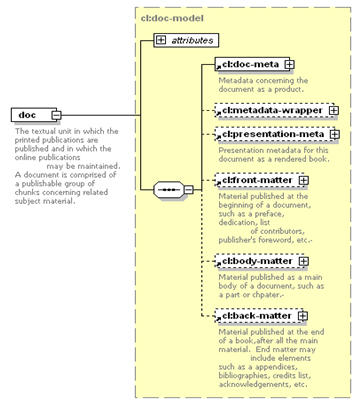  | |||
| 3.2 | <cl:doc-meta> Element Structural Overview | ||
| The <cl:doc-meta> element is used to capture metadata at the publication level. This element is a wrapper for the child elements used to capture the publication’s title (<cl:title>), sub-title (<cl:subtitle>), author (<cl:creator>), other persons involved in content creation (<cl:contributor>), the ISBN (<cl:isbn>), date of publication (<cl:pub-date>), copyright year (<cl:copyright-year>), edition (<cl:edition>), among other publication specific level elements. | |||
| 3.3. | <cl:metadata-wrapper> Element Structural Overview | ||
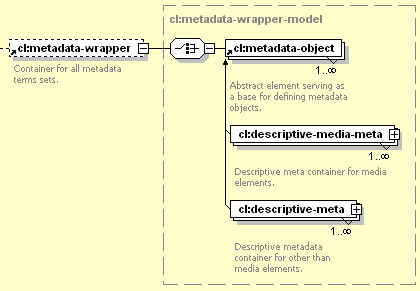
The <cl:metadata-wrapper> contains three child elements used to capture metadata information about the content. It is an optional element but, if used, it has three required child elements: <cl:metadata-object>, <cl:descriptive-media-meta> and <cl:descriptive-meta>.
<cl:metadata-object> is intended for internal use and wouldn't need to be populated by a conversion vendor.
<cl:descriptive-media-meta> is used to capture media metadata.
<cl:descriptive-meta> is used to capture what is referred to as "descriptive metadata" for use with Cengage Learning‘s Atlas vocabulary system. The <cl:metadata-wrapper> structure is used in several locations throughout the CenDoc schema, including:
| |||
| 3.4 | <cl:presentation-meta> Element Structural Overview | ||
<cl:presentation-meta> is structured to capture any special design requirements of the book that schema hierarchy, semantic element name or <cl:descriptive-meta> cannot further define. This element only occurs at the top-level of CenDoc schema and the overall purpose of <cl:presentation meta> is to capture the design exceptions which is not able to be differentiated with the functions of the schema. See the Design Application Decision Tree.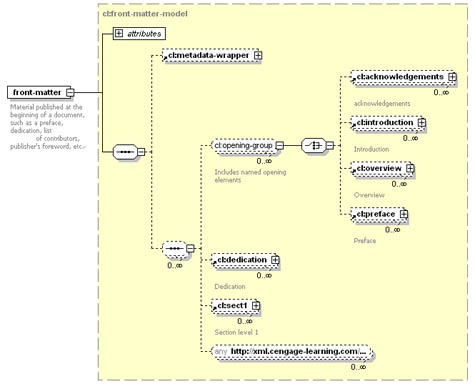 For more information, refer to <cl:presentation-meta> element.
 |
 For more information on <cl:descriptive-meta>, refer to
 © Cengage , Inc., 2008