| 2. The Proposed Hybrid System The hybrid system combines the thermoelectric cooling device with a collector/storage tank as schematically shown in Fig1. The absorbed heat from the refrigerated space is supplied to the collector/storage tank by a heat exchanger. In addition to waste heat, gains from solar radiation are earned by exposing the collector/storage to the sun. The title angle of the storage tank was set equal to Bangkok?s latitude (14o). 2.1 Heat Exchangers Two types of heat exchanger have to be used. Air-solid heat sink on the cold side of TE modules and water-solid heat sink on the hot side of TE modules. Design calculations are rather complex [10] and depend, mainly, on characteristics of TE modules. Based on commonly used techniques, two heat exchangers were designed as shown in Fig. 2. 2.2 Collector/Storage Tank For simplicity of design of the collector/storage tank, the following assumptions were made: 1. The storage tank is designed for a three people household, each uses 35 liters of water per day, (storage tank capacity is 105 liters). The mean required hot water temperature Tf is about 38 C. 2. Calculations are made based on daily average data, namely: 2.1 Incident solar radiation on horizontal surface 17.5 MJ/(m2d) [11] 2.2 Ambient air temperature 30 C 2.3 Initial water temperature 27 C 2.4 Average surface temperature of the collector/storage 50 C 2.5 Average wind velocity in Bangkok 1.5 m/s [12] 2.6 Lateral and back heat losses from the tank are neglected (the tank is well insulated) |
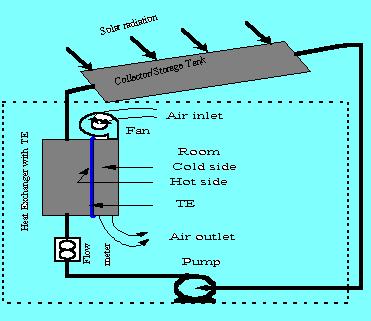 |
| Fig. 1 Schematic view of the proposed hybrid system |
 |