
Finally, under design consideration used in this study, the optimum conditions for operating the hot water production and cooling as well are: 100 VDC, water flow rate of 15 L/min and air velocity at 2.5 m/. The corresponding highest Coefficient of performance of hybrid system is about 3.12.

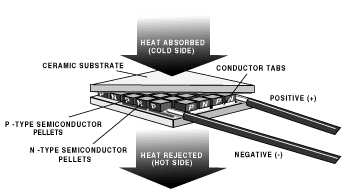

From the past to the present, the world has been high developed continuously. Human invents plenty of facilities for themselves, and everyone knows that the most important factor in invention is energy. Nowadays, the temperature of the world is changing continuously this is due to the increasing of carbon dioxide and chloroflurocarbons (CFC) resulting of the development of technology. The energy we use today for driving air-conditioning and producing hot water is too high and trend to increase every year.
In 1834, the thermoelectric (TE) heat pump phenomenon was discovered by Peltier and in 1909, Altenkirch [1] presented a theory of TE power generation and TE refrigeration. During the last two decades, TE industry development has been extremely fast. TE modules cost continues to decrease substantially. Consequently, TE applications have received increased attention despite the low coefficient of performance which varies between 0.25-0.6 [2,3]. TE cooling/heating systems are used for many applications [4-7]. TE cooling/heating units are of small size, silent, have no moving parts. Moreover, it is very simple to control the rate of cooling/heating by adjustment of the current [8]. The TE cooling system consists of two major subsystems, namely, the photovoltaic electric supply and the thermoelectric modules [9]. This research is aimed to investigate the production of domestic hot water by combining solar energy with waste heat from a thermoelectric air-conditioning. The proposed concept is very suitable for hot countries such Thailand as we have abundant sun?s ray which also creates a need for air-conditioning.

