 |
 |
 |
 |
 |
 |
 |
 |
 |
 |
 |
 |
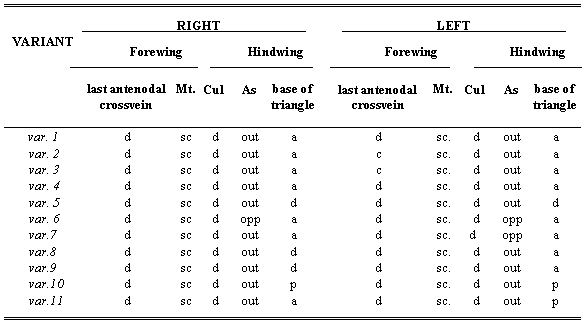 |
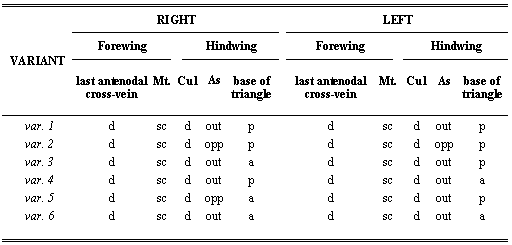
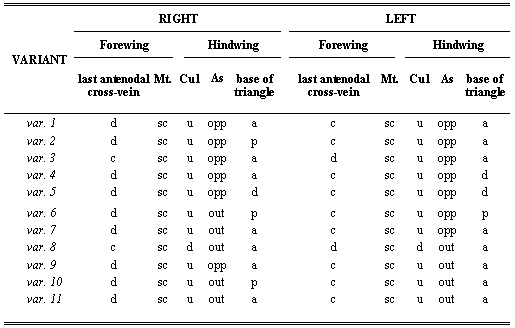
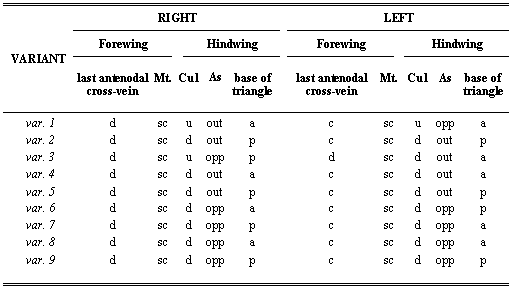
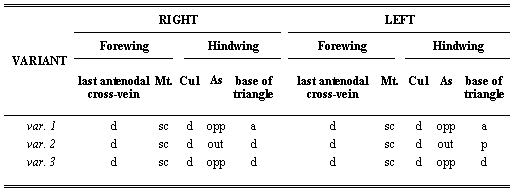
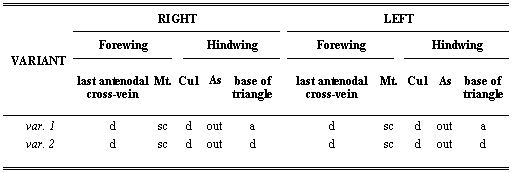
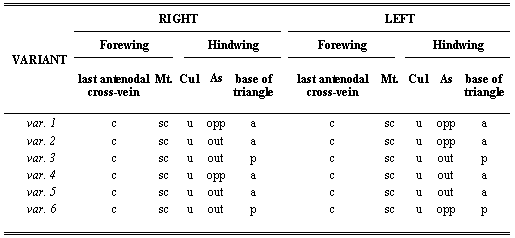
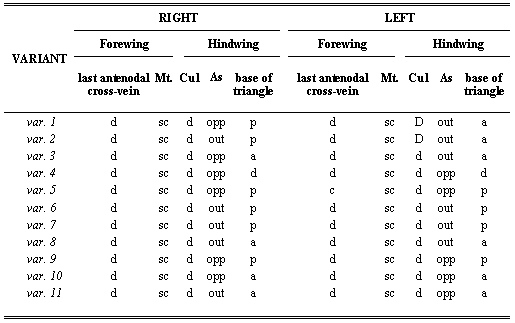
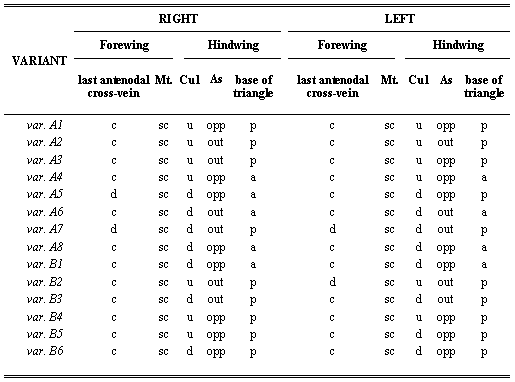
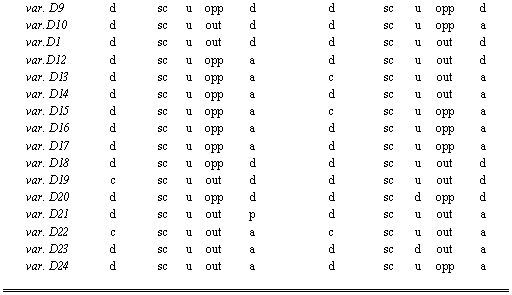
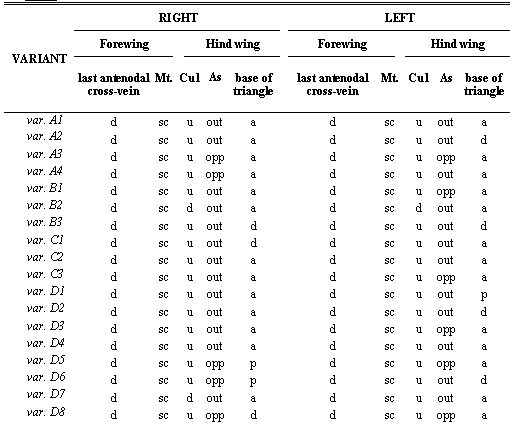
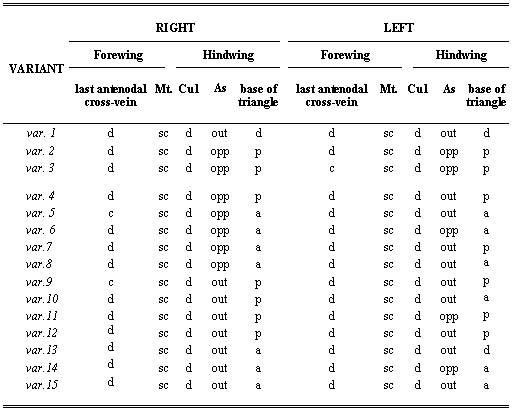
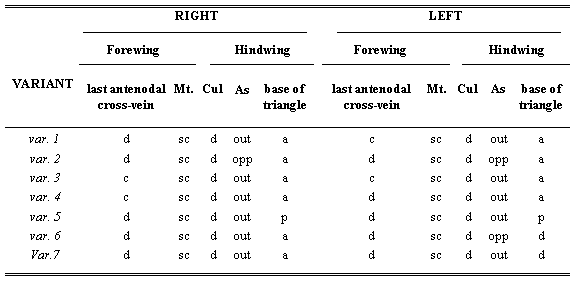
| RESULTS AND DISCUSSION Of the 594 individuals collected, 16 known species were identified and 13 unknowns were observed. The following are the descriptions of the different species: Neurothermis terminata terminata (Fig.2) General Description: Members of this species are easily distinguished by the network of strongly reticulated cross-veins in the triangles of both of its wings; both thorax and abdomen tainted uniformly with red brown; wings dominantly colored with red-brown with colored area terminating squarely at the stigma; base of hindwing smoothly curved; wing apices well rounded; posterior margin of prothorax well elevated with long erect hairs at its base. Head: Vertex larger than the occiput; median cleft in front present; frons nonmetallic; lobes of eyes scarcely touching. Wings: [Forewing] Number of cross-veins in the triangle 5-20 ; number of cells in the subtriangle 3-25 ; extra bridge cross-veins 1-5; number of cell rows within the discoidal field 2-8; number of antenodal cross-veins 10-18; number of forewing postnodal cross-veins 8-19; upper side of triangle less than twice the length of the inner side; triangle in forewing and hindwing different in size and shape; distance from triangle to arculus in forewing and hindwing different; outer side of triangle straight; Rs vein running in a smooth curve; Rs vein unforked; number of rows subtended by the radial planate greater than 1; number of paranal cells before the subtriangle 6; number of intermedian cross-vein greater than or equal to 4; number of cross-veins under stigma less than three; stigma thin; nodus located halfway between the base and the tip of the wing; two rows of cells between M1 and M2 beginning to appear just before the stigma; stigma thin (about three times as long as wide). [Hindwing] number of cross-veins in the triangle 1-4 ; number of cubitoanal cross-veins 1-4; number of antenodal crossveins 8-14; number of postnodal cross-veins 9-15; anal loop foot-shaped and entire; anal foot not flat; toe in anal loop well developed; ankle cells present; midrib entire and angled; veins M4 and Cu1 strongly divergent; number of cross-veins under stigma less than or equal to three; arculus nearer to the second antenodal cross-vein; supratriangle uncrossed; stigma thin (about three times as long as wide). Eleven variants were observed on account of their differences in five major characters of the anisopteran wing (Table 1). Nearly all of the variants have their distal antenodal crossveins incomplete except for variants 2 and 3 which have continuous distal antenodal crossveins in their left forewing. Variant 6 is unique because its vein As is situated opposite the anal crossing. Variant 7 however has a combination of the types of vein As - one opposite and one beyond the anal crossing. All of the variants have their vein Mt. running in a smooth curve and their vein Cu1 arising from the hindmost angle of the hindwing triangle. All the other variants differ in the location of the base their hindwing triangle. Table 1. Qualitative characters in the fore- and hindwings used to describe the different variants of N. terminata terminata. Distribution: variant 1- Gabunan, Gimbalonan of Rogongon, Iligan City, Mabua and Mainit, Surigao del Sur; MSU-IIT, Noria of Iligan City; variant 2 - Mainit, Surigao del Sur; variant 3 - MSU-IIT, Iligan City; variant 4 - Mantigue Islet, Camiguin; variant 5 - Noria and Pala-o of Iligan City; variant 6 - MSU-IIT, Iligan City; variant 7 - Gabunan, Gimbalonan of Rogongon, Iligan City; variant 8 - Gabunan, Rogongon, Iligan City; variant 9 - MSU-IIT, Iligan City; variant 10 - Mainit, Surigao del Sur; variant 11- MSU-IIT, Iligan City. Neurothemis pallata (Fig. 2) General Description: Members of this species are similar in appearance to N. terminata terminata except that the red brown area in both wings are abbreviated in the hind-wing on posterior side (just after it reaches the stigma) and rounded externally; posterior margin of prothorax elevated and with long erect hairs; apices of both wings rounded. Head: Vertex larger than the occiput; median cleft in front present; frons nonmetallic; lobes of the eyes scarcely touching. Wings: [Forewing] Number of cross-veins in the triangle 7-20 ; number of cells in the subtriangle 13-34; extra bridge cross-veins 0-5; number of cell rows within the discoidal field 6-10; number of antenodal cross-veins 12-22; number of postnodal cross-veins 11-15; upper side of forewing triangle less than twice the length of the inners side; triangle in forewing different from triangle in the hindwing; distance from triangle to arculus in forewing and hindwing different; outer side of forewing triangle straight; vein Rs smoothly curved and not branching; number of rows subtended by the radial planate greater than one; number of paranal cells before subtriangle 6; number of intermedian cross-vein number of intermedian cross-vein greater than four; number of cross-vein under stigma less than three; supratriangle not crossed; nodus midway between base and apex of forewing; two rows of cells between M1 and M2 starts at the point before the pterostigma; ; stigma thin (about three times as long as wide). [Hindwing] number of crossveins in the triangle 1-4; number of cubitoanal cross-veins 1-3; number of antenodal crossveins 12-16; number of postnodal cross-veins 11-16; anal loop foot-shaped and closed with well developed toe; ankle cells present; midrib angled and entire; veins M4 and Cu1 strongly divergent; number of crossvein under stigma less than or equal to three; upper end of arculus nearer to the second antenodal cross-vein ; stigma thin (about three times as long as wide). Seven variants were identified based on individual differences in three out of the five major wing characters (Table 2). Variant 3 is unique in having a complete distal antenodal crossvein in both the left and the right forewing. Variant 1 on the other hand has only its left distal antenodal crossvein complete. Variant 2 differs from the rest in having a vein As arising opposite the anal crossing of both its left and right hindwing. Variant 6 on the other hand has its vein As arising opposite and beyond the anal crossing in its left and right hindwing respectively. The base of the triangle of all the variants varies considerably. However, all the variants have their vein Mt. running in a smooth curve and their vein Cu1 arising from the hindmost angle of the hindwing triangle. Table 2. Qualitative characters in the fore- and hindwings used to describe the different variants of N. palliata. Distribution: variant 1 - Mt. Gabunan, Rogongon, Iligan City; variant 2 - Mantigue Islet, Camiguin; variant 3 - Noria, Pala-o of Iligan City; variant 4 - Gimbalonan of Rogongon, Iligan City; variant 5 - Mt. Gabunan, Rogongon, Iligan City; variant 6 - Mantigue Islet, Camiguin; variant 7 - Mt. Gabunan of Rogongon, Iligan City, Mantigue Islet, Camiguin, MSU-IIT, Iligan City, Tawagon of Rogongon, Iligan City. Trithemis aurora (Fig.2) General Description: Members of this elfin species of dragonflies have both its thorax and abdomen redbrown in color; thorax characteristically striped with black; both fore and hindwings appear smokey translucent; basal part of the hindwing tainted with dark brown; Posterior margin of prothorax well elevated and filed with long erect hairs; wing apex not rounded slightly pointy; Borders of discoidal field strongly converging at wing margins; discoidal cell of fore-wing broader, with its coastal side 0.5 the length of basal; two rows of cells above radial planate; no supplementary nervure; IR2 between R2 and R3; A2 smooth; stigma reddish, short with two crossveins below; frons red dorsally. Fifteen variants observed. Head: Vertex larger than the occiput; median cleft in front present; frons metallic in color; lobes of the eyes rarely in contact. Wings: [Forewing] Number of cross-veins in the triangle 1-3; number of cells in the subtriangle 3-5; extra bridge cross-veins 0; number of cell rows within the discoidal field 2-4; number of antenodal cross-veins 13-17; number of postnodal cross-veins 9-16; upper side of triangle less than twice the length of the inner side; triangle in forewing and hindwing dissimilar in size and shape; triangle not equal in distance from the arculus in fore and hindwing; outer side of forewing triangle straight, Rs vein smoothly curved and unforked; number of rows subtended by the radial planate greater than 1; number of paranal cells before subtriangle 6; number of cross-veins under stigma less than 3; nodus located midway between the base and the wing apex; two rows of cells between M1 and M2 appear just before the stigma; stigma thin (about three times as long as wide). [Hindwing] number of cross-veins in the triangle 0-1; number of cubitoanal cross-veins 1-2; number of antenodal cross-veins 9-12; number of postnodal cross-veins 10-14; anal loop characteristically foot-shaped; anal foot rugged and not flat; toe in anal foot well developed; ankle cells present in the anal loop; midrib entire and angled; veins M4 and Cu1 divergent; number of intermedian cross-vein less than 4; number of cross-veins under stigma less than 3; arculus nearer to the second antenodal cross-vein; supratriangle neatly crossed; stigma thin (about three times as long as wide). All of the individuals belonging to this group of species were further classified into 15 variants on account of the individual differences in three out of the five major wing characters (Table 3). Typical to all variants of this species of dragonflies is the possession of a smoothly curved vein Mt. and a Cu1 that arises from the hindmost angle of the hindwing triangle. Nearly all of the variants have a discontinuous distal antenodal crossvein except for variants 3, 5 and 9. The left and right wings of this species of dragonflies show considerable variation in the location of the base of their hindwing triangle with respect to the arculus and the origin of their vein As. Table 3. Qualitative characters in the fore- and hindwings used to describe the different variants of T. aurora. Distribution: variant 1-Gimbalonan of Rogongon, Iligan City; variant 2- Mesaledeng of Rogongon, Iligan City; variant 3- Mesaledeng, of Rogongon, Iligan City; variant 4- Gimbalonan, of Rogongon, Iligan City; variant 5- Purok Bayanihan, of Rogongon, Iligan City ; variant 6- Mt. Gabunan and Gimbalonan of Rogongon, Iligan City; variant 7- Mt. Gabunan of Rogongon, Iligan City; variant 8- Gimbalonan, of Rogongon, Iligan City; variant 9- Gimbalonan, of Rogongon, Iligan City; variant 10- Mesaledeng of Rogongon, Iligan City; variant 11- Gimbalonan and Mesaledeng of Rogongon, Iligan City; variant 12- Mt. Gabunan. Gibalonan, Mesaledeng and Purok Bayanihan of Rogongon, Iligan City; variant 13- Purok Bayanihan of Rogongon, Iligan City; variant 14- Mt. Gabunan, Gimbalonan and Purok Bayanihan of Rogongon, Iligan City; variant 15- Gimbalonan and Mesaledeng of Rogongon, Iligan City Diplacodes trivialis (Fig.2) General Description: Members of this species of dragonflies are relatively small; the range of colors that characterize this group includes the following - blue, green, yellow and orange brown; these group of dragonflies can be tainted with one or more color combinations; thoracic segments with dark stripes; posterior margin of prothorax well elevated; wing apex rounded; prothoracic lobe large and fringed with long erect hairs. Head: Vertex larger when compared to the occiput; median cleft in front present; frons nonmetallic dorsally; eyes contiguous for a short distance. Wings: [Forewing] Number of cross-veins in the triangle 0-3; number of cells in the subtriangle 0-3; extra bridge cross-veins 0-3; number of cell rows within the discoidal field 0-4; number of antenodal cross-veins 6-9; number of forewing postnodal cross-veins 5-8; upper side of triangle less than twice the length of the inner side; triangle in fore and hindwing dissimilar in shape; triangle nearer arculus in hindwing than in forewing; costal side of triangle straight; Rs vein smoothly curved and unforked; number of rows subtended by the radial planate greater than 1; number of paranal cells before subtriangle 5; subtriangle with 3 cells; number of intermedian cross-vein less than 4; number of cross-veins under stigma less than three; nodus located midway between the base and the wing apex; two row of cells between M1 nad M2 beginning before the stigma; stigma thick (length about twice as long as the width) [Hindwing] number of cross-veins in the triangle 0-1; number of cubitoanal cross-veins 1-2; number of antenodal crossveins 5-7; number of postnodal cross-veins 5-8; anal loop footshaped and entire; toe in anal foot well developed; anal foot not flat; ankle cells absent; midrib entire and angled; discoidal cell entire; veins M4 and Cu1 divergent; number of cross-veins under stigma less than three; arculus nearer to first antenodal cross-vein; supratriangle uncrossed; stigma thick. A total of 32 variants belonging to four groups were identified based on the observed differences in four out of the five major qualitative characters of the anisopteran wing (Table 4). Group A have thoracic segments alternately colored with yellow and blue which is further marked with dark stripes. This group has yellow abdominal segments. Group B have yellow brown thorax and abdomen. Group C have yellow green thorax and abdomen. Group D on the other hand have both of its thorax and abdomen colored with blue. All of the variants have incomplete distal antenodal crossvein except for variants 13, 15 19 and 22 of the D group which exhibits a continuous antenodal crossvein in one or both of its forewings. Having a smoothly curved vein Mt. is an equivalent phenomenon in all of the variants identified. Nearly all of the variants have their vein Cu1arising from the outer side of the hind wing triangle except for variants D20 and D23, which has their vein Cu1 arising from the hindmost angle of the hind wing triangle. Table 4. Qualitative characters in the fore- and hindwings used to describe the different variants of D. triviales. Distribution: variant A1 - MSU-IIT, Tipanoy, Mantigue Island; variant A2 - Tipanoy; variant A3 - Luyong, Mantigue Island; variant B1 - Mantigue Island, MSU-IIT; variant B2 - MSU-IIT, Mantigue Island, Mabua of Surigao del Sur; variant B3 - MSU-IIT; variant C1 - Mantigue Island; variant C2 - MSU-IIT; Mabua, Surigao del Sur; Luyong, Mantigue Island; variant C3 - Mabua, Surigao del Sur, MSU-IIT; variant D1-MSU-IIT, Iligan City; variant D2- Luyong, MSU-IIT and Tipanoy of Iligan City; variant D3- MSU-IIT and Tipanoy of Iligan City ; variant D4-Camiguin, Gabunan, Gingoog, Maigo, MSU-IIT, Tipanoy; variant D5, D6, D7, D8, D9-MSU-IIT; variant D10-Maigo, MSU-IIT; variant D11-Gimbalonan, Gingoog, MSU-IIT; variant D12-, D13, D15- MSU-IIT; variant D14-Camiguin, MSU-IIT and Tipanoy; variant D16-Camiguin and Maigo; variant D17-Camiguin, Gingoog, Luyong, Maigo, MSU-IIT; variant D18-Camiguin and Gabunan; variant D19-Tawagon; Trithemis sp.(Fig.2) General Description: Members of this species of dragonflies have red brown thorax and abdomen; dark thoracic markings absent; prothorax fringed with long erect hairs; posterior margin of prothorax well elevated; wing apices slightly pointy (Fig.6) Head: Vertex larger when compared to the occiput; median cleft in front present; frons nonmetallic; lobes of the eyes scarcely touching. Wings: [Forewing] Number of cross-veins in the triangle 1-2; number of cells in the subtriangle 3-4; extra bridge cross-veins 0; number of cell rows within the discoidal field 2-3; number of antenodal cross-veins 11-19; number of postnodal cross-veins 8-14; upper side of triangle less than twice the length of the inner side; triangle in fore and hindwing dissimilar in size and shape; triangle nearer to arculus in hindwing than in forewing; costal side of triangle straight; vein Rs undulated but not forked; radial planate present and subtends 1-2 rows of cells; number of paranal cells before the subtriangle 6; number of intermedian cross-veins greater than 4; number of crossveins under stigma less than 3; nodus located halfway between the base and the apex of the forewing; two rows of cells between M1 and M2 begins to appear at the point before the stigma; stigma thin (about three times as long as wide); [Hindwing] number of cross-veins in the triangle 1-2; number of cubitoanal cross-veins 1; number of antenodal cross-veins 12-14; number of postnodal cross-veins 11-15; anal loop footshaped and entire; anal loop flat footed and open at some point; toe in anal foot well developed and complete; ankle cells present; midrib entire but angled near the middle; veins M4 and Cu1 divergent towards the margins of the wings; number of cross-veins under stigma less than 3; arculus nearer to second antenodal cross-vein; cross-veins in supratriangle present; stigma thin. Fourteen (14) variants were observed and classified into two groups (Table 5). Group A have smokey transparent wings while group B have wings tainted with brown; both have copper markings at the base of the hindwing; the former consists of eight (8) variants while the latter consists of six (6) variants. All of the variants have smoothly curved vein Mt. The distal antenodal crossveins of nearly all the variants are complete except for variants A5, A7 and B2. Variants 1, 4,5 and 8 of the A group and variants 1,4,5 and 6 of the B group have their vein As positioned opposite to the anal crossing. The rest of the variants have their vein As located beyond the anal crossing. It can also be observed that half of the variants in group A and in group B have their vein Cu1 arising from the outer side of the hindwing triangle while the other half have their vein Cu1 originating from the hindmost angle of the hindwing triangle. It can also be noticed that the bases of the hindwing triangle can occupy two positions relative to the arculus - one directly opposite the arculus and the other proximal. Table 5. Qualitative characters in the fore- and hindwings used to describe the different variants of Trithemis sp. Distribution: variant 1- All samples were from Gimbalonan, Rogongon of Iligan City Trithemis festiva (Fig.2) General Description: Members of this species of dragonflies are small; the three thoracic segments are uniformly colored with blue; abdomen blue in color; both wings except for the hindwing which is painted with dark brown markings at the base of the hindwing; posterior margin of prothorax not well elevated; base of hindwing not broadened; wing apices slightly pointy; This species were observed to have eleven (11) variants. Head: Vertex larger than the occiput; median cleft in front present; frons metallic; lobes of the eyes scarcely touching. Wings: [Forewing] Number of cross-veins in the triangle 1; number of cells in the subtriangle 3-4; extra bridge cross-veins 0-1; number of cell rows within the discoidal field 3-4; number of antenodal cross-veins 11-14; number of postnodal cross-veins 6-10; upper side of triangle less than twice the length of the inner side; triangle in fore and hindwing dissimilar in size and shape; triangle nearer to arculus in hindwing than in forewing; costal side of triangle straight; vein Rs undulated and not forked; radial planate present and subtends 1-2 rows of cells; number of paranal cells 5; nodus located midpoint between the base and apex of the forewing; stigma thin (about three times as long as wide); [Hindwing] number of cross-veins in the triangle 0-1; number of cubitoanal cross-veins 1-2; number of antenodal cross-veins 8-9; number of postnodal cross-veins 6-10; anal loop footshaped and jagged; anal loop not flat footed; toe in anal foot well developed and closed; no ankle cells present; midrib entire and angled; veins M4 and Cu1 diverging towards the margins of the wings; number of cross-veins under stigma less than 3; arculus nearer to first antenodal cross-vein; cross-veins in supratriangle absent; stigma thin. There were eleven variants identified from this group (Table 6) It can be noticed that nearly all of the variants have incomplete distal antenodal crossvein except for var. 5 which has its last antenodal crossvein continuous. Typical to all of the variants identified is a smoothly curved vein Mt. and a vein Cu1 originating from the hindmost angle of the hindwing triangle. The bases of the hindwing triangle of this species can occupy all of the three positions. Table 6. Qualitative characters in the fore- and hindwings used to describe the different variants of T. festiva. Distribution: variants 1 and 5- Purok Bayanihan; var. 2- Mesaledeng; variants 3, 4, 11 - Gabunan; var.6 - Luyong; var.7- Mesaledeng and Luyong; variants 8 and 10- Mt. Gabunan, Luyong, Tinago Falls and Mesaledeng; var.9- Mt. Gabunan, Gimbalonan, Luyong, Tawagon and Mesaledeng. Diplacina braueri (Fig.2) General Description: Members of this group have dark green thoracic segments; dark stripes in thorax absent; the abdomen is filled with black except for the second abdominal segment which is richly colored with red; the wings are generally clear except for the basal part of the hindwing which has dark brown coloration in it; prothorax fringed with long erect hairs; posterior margin of prothorax well elevated; base of hindwing not greatly broadened; wing apices well rounded; This group has six (6) variants (Fig.8). Head: Vertex larger than the occiput; median cleft in front present; frons nometallic; lobes of the eyes scarcely touching. Wings: [Forewing] Number of cross-veins in the triangle 1; number of cells in the subtriangle 2-3; extra bridge cross-veins 0; number of cell rows within the discoidal field 2; number of antenodal cross-veins 11-16; number of postnodal cross-veins 8-13; upper side of triangle less than twice the length of the inner side; triangles in fore and hindwing dissimilar in shape; triangle nearer to arculus in hindwing than in the forewing; costal side of triangle straight; vein Rs smoothly curved and unforked; radial planate present and subtends a row of cells; number of paranal cells before the subtriangle 6; number of intermedian crossveins greater than 4; number of cross-veins under stigma less than 3; nodus locted halfway between the base and apex of the forewing; two rows of cells between M1 and M2 starts before the stigma; stigma thin (about three times as long as wide). [Hindwing] number of cross-veins in the triangle 1; number of cubitoanal cross-veins 1; number of antenodal cross-veins 8-14; number of postnodal cross-veins 8-13; anal loop foot shaped and jagged; anal loop not flat shaped; toe in anal foot well developed; no ankle cells present; midrib entire but angled near the middle; veins M4 and Cu1 strongly convergent towards the margins of the wings; number of cross-veins under stigma less than 3; arculus nearer the second antenodal segment; supratriangle crossed; stigma thin. Six variants can be observed from this group (Table 7). It can be noticed that all the variants belonging to this species have complete distal antenodal crossvein, smoothly curved vein Mt. and vein Cu1 arising from the outer side of the hindwing triangle. Variants 3 and 6 differs from the other variants because the bases of their hindwing triangle are in the proximad position. Variants 3 and 5 have their vein As located beyond the anal crossing. Table 7. Qualitative characters in the fore- and hindwings used to describe the different variants of D. braueri. Distribution: var 1 - Camiguin and Luyong; var 2- Camiguin, Luyong, Mesaledeng; var 3- Mt. Gabunan, Mesaledeng and Purok Bayanihan; var 4 - Mt Gabunan; var 5- Luyong; var 6- Mesaledeng, San Juan. Potamarcha obscura (Fig.2) General Description: Members of this group have blue thoracic segments fairly marked with dark stripes; the abdominal segments blue in color; wings clear with no colored spots at the base of the hindwing; prothorax fringed with long erect hairs; posterior margin of prothorax well elevated; base of hindwing not greatly broadened; wing apices well rounded; This group was observed to have two (2) variants. Head: Vertex larger than the occiput; median cleft in front present; frons nonmetallic; lobes of the eyes scarcely touching. Wings: [Forewing] Number of crossveins in the triangle 1; number of cells in the subtriangle 3-6; extra bridge crossveins 3; number of cell rows within the discoidal field 3; number of antenodal crossveins 15-16; number of postnodal crossveins 11-14; upper side of forewing triangle less than twice the length of the inner side; triangle in fore and hindwing dissimilar in shape; distance from triangle to arculus in fore and hindwing not equal; costal side of triangle straight; vein Rs undulant but not forked; radial planate present and subtends 1-2 rows of cells; number of paranal cells before the subtriangle 7; number of intermedian crossveins greater than 4; number of crossveins under the stigma less than 3; nodus located beyond the midpoint; stigma thin (about three times as long as wide). [Hindwing] number of crossveins in the triangle 1; number of cubitoanal crossveins 1; number of antenodal crossveins 11-14; number of postnodal crossveins 11-16; anal loop footshaped and jagged; anal loop not flat footed; toe in anal loop well developed; ankle cells absent; midrib entire and distinct but angled near the middle; veins M1 and M2 strongly divergent towards the margins of the wing; number of crossveins under the stigma less than 3; arculus nearer to the second antedoal crossvein; supratriangle not crossed; two rows of cells between M1 and M2 arises just before the stigma; stigma thin. Only two variants were observed from this group, which differs only in the position of the bases of their hindwing triangle (Table 8). The first variant has its base located directly opposite one end of the arculus while the other has its base at the distad position. Table 8. Qualitative characters in the fore- and hindwings used to describe the different variants of P. obscura. Distribution: var.1 ?MSU-IIT, Tinago and Gabunan of Iligan City, Camiguin; var.2 - Gabunan and Purok Bayanihan of Rogongon, Iligan City. Ptholymis tillarga (Fig.2) General Description: The thoracic segments of the members of this group are red orange in color; thoracic markings absent; the abdominal segments red orange in coloration; the base of the hindwing marked by a dark brown spot;prothorax fringed with long erect hairs; posterior margin of prothorax well elevated; base of hindwing greatly broadened; apices of the wings slightly pointy; this group was observed to have three (3) variants. Head: Vertex larger than the occiput; median cleft in front present; frons nonmetallic; lobes of the eyes scarcely touching; Wings: [Forewing] Number of crossveins in the triangle 1; number of cells in the subtriangle 3; extra bridge crossveins 0; number of cell rows within the discoidal field 3; number of antenodal crossveins 8-12; number of postnodal crossveins 7-9; upper side of triangle less than twice the length of the inner side; riangle in fore and hindwing dissimilar in size and shape; triangle nearer to arculus in hindwing than in the forewing; costal side of the triangle straight; vein Rs undulant and unforked; radial planate present and subtends greater than one row of cells; number of paranal cells before the subtriangle 5; number of intermedian crossveins greater than 4; number of crossveins under stigma less than 3; nodus located halfway between the base and the apex of the forewing; two rows of cells between veins M1 and M2 starts before the stigma; stigma thin (about three times as long as wide). [Hindwing] number of crossveins in the triangle 0; number of cubitoanal crossveins 1; number of antenodal crossveins 8; number of postnodal crossveins 9-10; anal loop footshaped and jagged; anal loop flat footed and open at some point; toe in anal foot well developed and incomplete; ankle cells present; midrib entire and angled in the near middle; veins M4 and Cu1 strongly divergent towards the margins of the wings; number of crossveins under stigma less than 3; arculus near the first antenodal crossvein; no crosveins in the supratriangle present; stigma thin. Three variants were identified from this group of dragonflies (Table 9). As observed, variants 1 and 3 have vein As which are positioned directly below and opposite the anal crossing. Variant 2 on the other hand has a vein As positioned beyond the anal crossing. It can also be noticed that all of the three variants identified have their distal antenodal crossvein incomplete, vein Mt. smoothly curved and vein Cu1 originating from the hindmost angle of the hindwing triangle. Table 9. Qualitative characters in the fore- and hindwings used to describe the different variants of T. tillarga. Distribution: var 1- Camiguin, Luyong; var 2 - Tipanoy; var 3 - Camiguin Onycothemis sp. (Fig.2) General Description: Members of this group have the first thoracic segment blue in coloration; second and third nearly black; dark stripes in the thorax present; abdomen dark brown in color; wings generally clear; basal part of the hindwings dark brown in color; posterior margin of prothorax well elevated and and fringed with long erect hairs; base of hindwing greatly broadened; wing apices slightly pointy. Head: Vertex larger compared to the occiput; median cleft in front distinct; frons nonmetallic; lobes of the eyes scarcely touching. Wings: [Forewing] Number of crossveins in the triangle 1; number of cells in the subtriangle 3-4; extra bridge crossveins 0; number of cell rows within the discoidal field 3-4; number of antenodal crossveins 12-18; number of postnodal crossveins 8-18; upper side of triangle less than twice the length of the inner side; triangle in fore and hindwing dissimilar in shape; triangle nearer to arculus in hindwing then in the forewing; costal side of triangle straight; vein Rs undulant but not forked; radial planate present and subtends a row of cells; number of paranal cells before subtriangle 6; number of crossveins under stigma less than 3; nodus located halfway between the base and apex of the forewing; two rows of cells between M1 and M2 begins to appear just before the stigma; stigma thin (about three times as long as wide). [Hindwing] number of crossveins in the triangle 1-2; number of cubitoanal crossveins 1; number of antenodal crossveins 10-15; number of postnodal crossveins 12-17; anal loop footshaped and entire; anal foot not flat; toe in anal foot well developed; no ankle cells present; midrib entire and nearly straight; veins M4 and Cu1 strongly divergent towards the wing margins; number of intermedian crossveins greater than or equal to 4; number of crossveins under stigma less than 3; arculus nearer to the second antenodal crossvein; supratriangle crossed; stigma thin (about three times as long as wide). A total of nine variants were identified from this group (Table 10). Nearly all the variants have their distal antenodal crossveins discontinuous and continuous in the right and left side of the forewing respectively except for variant 3, which is strictly discontinuous in both sides of the forewing. It can also be noticed that all of the individuals collected have smoothly curved vein Mt. Variants 6 to 9 have vein As in both sides of the forewing positioned directly below and opposite the anal crossing. Variants 2, 4 and 5 on the other hand have vein As in both sides of the forewing positioned beyond the anal crossing. The bases of the hindwing triangles of all the variants occupy only two out of the three possible positions - proximad and opposite the hindwing arculus. Table 10. Qualitative characters in the fore- and hindwings used to describe the different variants of Onycothymis sp. Distribution: var, 4 and 7- Luyong, var 2 and 5 - Mt. Gabunan; var 3- Camiguin; var 6 - Luyong and Maigo; var 8-Gabunan, Luyong and Maigo; var 9- Gabunan, Luyong, Maigo and Sambwar. Orthetrum sabina (Fig.2) General Description: Thorax and abdomen greenish yellow with black marks; prothorax bright yellow; segment IV to VI with a broad oval dorsal black spot on basal one-third continued finely along mid-dorsal carina to join with very broad apical black rings on IV and V ; prothorax with a very large, erect notched posterior lobe fringed with long hairs; wing smoky transparent with slight marks at apices and borders of wings; basal part wings with yellow brown markings; pterostigma black with yellow-brown median, covers two cells; frons yellow, very deeply notched two form two triangular facets in front; males- genitalia with a mark of long hairs; females- ventral plate of segments VIII with a small convex notch the ends of which project slightly ventral wards; 9th ventral plate keel shaped basally and swollen at apex.wing apices slightly pointy. Head: Vertex larger when compared to the occiput; median cleft in front distinct; frons nonmetallic; eyes contiguous for a short distance. Wings: [Forewing] Number of crossveins in the triangle 1-2; number of cells in the subtriangle 2-3; extra bridge crossveins 0-1; number of cell rows within the discoidal field 2-4; number of antenodal crossveins 11-17; number of postnodal crossveins 9-13; upper side of triangle less than twice the length of the inner side; triangle in forewing dissimilar in size and shape to hindwing triangle; triangle nearer to arculus in hindwing than in forewing; costal side of triangle straight; vein Rs undulated but not forked; radial planate present and subtends more than one row of cells; number of paranal cells before subtriangle 6; number of crossveins under stigma less than 3; nodus located halfway between base and apex of forewing; two rows of cells between M1 and M2 beginning to appear just before the stigma; stigma thin (about three times as long as wide). [Hindwing] number of crossveins in the triangle 0-1; number of cubitoanal crossveins 1-2; number of antenodal crossveins 8-13; number of postnodal crossveins 9-14; anal loop footshaped and entire; anal foot flat; toe in anal foot well developed; no ankle cells present; midrib entire and angled; hindwing moderately broadened basally; veins Cu1 and M4 strongly divergent towards the wing margin; number of crossveins under stigma less than 3; arculus nearer to second antenodal crossvein; supratriangle crossed; stigma thin (about three times as long as wide). Eleven (11) variants were observed in this group on account of the observed differences in some of the major qualitative characters of the wings (Table 11). As observed, all of the variants identified have smoothly curved vein Mt. Variant 8 is unique from the rest in having a vein Cu1 originating from the hindmost angle of its hindwing triangle. Variants 2 and 10 have the bases of their triangle positioned at the P and A position in the right and left side of the hindwing respectively. Variant 6 on the other hand has its base appearing at the point between the base and arculus of the hindwing. All variants of this group of dragonflies collectively occupy all the three possible positions of the base of the triangle. Table 11. Qualitative characters in the fore- and hindwings used to describe the different variants of O. sabina. Distribution: var 1- Camiguin, Mt. Gabunan, Gimbalonan, GingoogLuyong, Mabua, Noria, San Francisco, Tawagon, Tipanoy; var 2- Camiguin; Camiguin and Mt. Gabunan; var 3- NSC Field; var 4- Camiguin and Mt. Gabunan; var 5- Camiguin; var 6- Camiguin, Mt. GabunanLuyong, Mabua, MSU-IIT, NSC Field, San Francisco; var 7- Gabunan, Luyong; var 8- Camiguin, Mt. Gabunan, Gingoog, San Francisco, Tipanoy, Tubod; var 9- Luyong; var 10- Camiguin, Mt. Gabunan, Gimbalonan, Gingoog, Luyong, Mabua, MSU-IIT, Noria, NSC Field; var 11- Camiguin. Pantala flavescens (Fig.2) General Description: Large dragonflies; thorax and abdomen yellow to yellow brown in color; wings generally smokey transparent; hindwings vary greatly broadened basally; entire basal area of hind-wings somewhat yellow; slightly swollen basal segments of abdomen with extra transverse carinae; prothorax fringed with long erect hairs; posterior margin of the prothorax well elevated; apices of the wings slightly pointy. Head: Vertex larger when compared to the occiput; median cleft in front present; frons nonmetallic; lobes of the eyes scarcely touching. Wings: [Forewing] Number of crossveins in the triangle 0-1; number of cells in the subtriangle 3-6; extra bridge crossveins 0-3; number of cell rows within the discoidal field 3-4; number of antenodal crossveins 11-16; number of postnodal crossveins 6-12; upper side of triangle less than twice the length of the inner side; triangle in fore and hindwing dissimilar in shape; triangle nearer to the arculus in hindwing than in the forewing; costal side of the triangle straight; vein Rs undulant and not forked; radial planate present and subtends 1-2 rows of cells; number of paranal cells before the subtriangle 6; vein M2 strongly wavy; stigma trapezoidal; number of intermedian crossveins more than 4; number of crossveins under the stigma less than 3; nodus located halfway between the base and apex of the forewing; two rows of cells between M1 and M2 appears just before the stigma; stigma thin (about three times as long as wide). [Hindwing] number of crossveins in the triangle 0-1; number of cubitoanal crossveins 1-2; number of antenodal crossveins 6-8; 11-14; number of postnodal crossveins 7-11; anal loop footshaped and jagged; anal foot not flat and not open; toe in anal foot well developed and complete; no ankle cells inside the anal loop; midrib entire and angled in the near middle; stigma trapezoidal; veins M4 and Cu1 divergent towards the margin of the wing; number of crossveins under the stigma less than 3; arculus nearer to the second antenodal crossvein; supratriangle crossed; stigma thin. The wing characters of variant 1 parallel that of variant 4 in the following manner: both variants have incomplete distal antenodal crossvein in both sides of the forewing, smoothly curved vein Mt., D positioned vein Cu1, and vein As positioned beyond the anal crossing. On the other hand, variants 3 and 6 both have their distal antenodal crossvein discontinuous, vein Mt. running in a smooth curve, vein Cu1 originating from the hindmost angle of the hindwing triangle, vein As arising from the point beyond the anal crossing, and the bases of their right hindwing triangle positioned opposite the arculus. Table 12. Qualitative characters in the fore- and hindwings used to describe the different variants of P. flavescens. BACK NEXT |