| Home Page Information
Benefits
Photo's
Price/Contact |
|
STORY FROM THE SOUTHLAND TIMES
By Mandy Gillies
FRIDAY, 22
FEBRUARY 2002
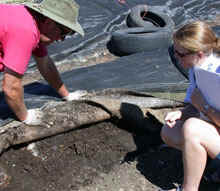
Central Wormworx owner Robbie Dick (Left) shows Environment Southland resource planner
Gretchen Johnston how a worm bed works in Cromwell yesterday.
The dairy effluent problem in Southland could be tackled in true waste management style
with tiger worms, an Environment Southland group heard yesterday.
Environment Southland councillor Ali Timms and resource planner Gretchen Johnston and
Southland dairy farmers Jeff McCandless (Riversdale) and Tracey Brown (Waikaka) visited
Central Wormworx in Cromwell.
The worm farm is the largest in the South Island with 36 windrows of worm beds at 30m long
producing up to 300 cubic metres of vermicast a year.
At any one time there could be 300 million worms at the Cromwell site. The worms can eat
twice their body weight in waste a day with 40 percent of their food intake returned as
vermicast.
They feed on reject fruit plus green and abattoir waste but also thrive on manure.
Wormworx owner Robbie Dick told the group this could be a solution for farmers to the
dairy effluent problem in Southland. The farm was already using effluent from Central
Otago company CromTrans Ltd which hoped to set up a permanent truck wash on the site this
year, producing 3.5 tonnes of manure a week that would be aged and fed to the worms.
"The worms would be busy working while the farmer is doing something else," Mr
Dick said. The idea would be for farmers to have their own worm beds on which they would
spread the effluent from the dairy shed and then use the vermicast as a fertiliser on the
paddocks, Mr Dick said.
This would eliminate the risk of toxic build-up in the soils, he said. Cr Timms said she
was interested in waste management because it seemed the way to go.
"I think it is a good idea but it is just getting the farmers who will take the time
to do it. There are some dairy farmers with a green bent who might be open to the
idea."
Environment Southland was also looking at establishing truck wash stations this year. Most
farmers did not stand their stock before transport so truck effluent was also a problem,
she said.
|
