Harpsichordist`s Holidays
Welcome to Atsuko`s
Website!
I am Japanese Harpsichordist who has lived in Washington DC area
from 2002 to 2005.
©Atsuko Watanabe
All right
reserved 2005
 Washington Early Music Festival 2005 WEMF 2004 Photo Album

 Concert Info
I am invited to Washington Early Music Festival 2006.
See you there!
Washington
Early Music Festival presents
The Virtuosos of Rome, Venice,
Ferarra and Naples
June
23rd 2006 at Noon
St.
Marks Episcopal Church
Capitol
Hill, Washington DC
Ms.
Ikeda will perform works for the keyboard instrument composed in four major
cultural centers in 17th century in Italy. The diversity of musical
stiles ranges from liturgical pieces written in the strict counterpoint to
dances written in the homophonic texture. The program also tracks their
influences beyond the Alps.
For
detailed information 
|
*********************
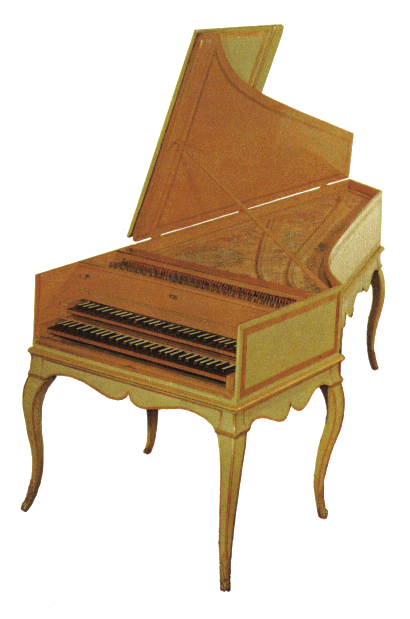
The first harpsichord was probably
built at the end of the 15th Century. One can see the shape of one carved on a
wood surface in a church in Minden, Germany around 1425.
The body of the harpsichord is constructing with many
woods, each with its own purpose and function. Cypress, poplar, pine, oak,
spruce, pearwood, holly, walnut and mahogany were all
employed. The strings were made of
iron in the treble and brass in the bass.
Unlike the instrument used today, most harpsichord were highly
decorated, with landscapes on the lids, birds and flowers on the soundboard,
and special decoration around the rose hole which held the makers mark
containing the builder’s initials.
Do you know why harpsichords are so highly decorated? Before I answer this, I would like to
explain a little about the historical background of the instrument. Harpsichords were the “house instrument”
during the Baroque period from 1600 to 1750. During this
period many famous composers flourished, as J.S. Bach, Handel and Vivaldi to name but a few.
It was a period of monarchy and aristocracy. Noblemen
could show their power and social status with impressive architecture,
collections of fine arts, and their own dedicated band of musicians to play
music for the nobility as social occasions required. Harpsichords would convey social status,
and no expense would be spared to engage the finest craftsmen to construct
these instruments and artists to embellish and decorate them. Many late instruments bear the owners
coat-of-arms and other identifying insignia.
Louis XIV (the sun king) was especially lavish in his
endeavors. In addition to building
a palace in Versailles, he assembled a troupe of musicians unequalled throughout
Europe. His string ensemble “the twenty-four Violinists” were well known. Musical ensembles were divided into
groups with one to perform church music, another for drawing room or chamber
music, and one for the field for equestrian adventures and other sporting
events.
In the same period, aristocrats within the
Holy Roman Empire emulated Louis XIV.
They build castles that imitated Versailles, and musically emulated his
musical entourage. As the Holy Roman
Empire was an aggregate of small dominions, the demand and supply of
harpsichords constantly increased throughout this period.
Harpsichords were commonly employed wherever music was played
during this time as a solo instrument, in a small group of different
instruments (an ensemble), or in small orchestras. Even today, major orchestras include a
harpsichord for the continuo part when baroque pieces are played.
Why were harpsichords used in orchestras? There are many reasons, but three will
suffice.
First – The baroque period was a significant period for
the development of a new musical style.
In an earlier period the Renaissance (1450-1600), in musical chronology,
music was written in “polyphonic” style.
Polyphony is the interweaving of several melodic lines. This might be described as “horizontal”
music. In the later period called Classic (1730-1820), music was written in a
style known as “homophonic”.
Homophony exists with one melodic line dominates the others, which take
no part in the melody, but adds to it by augmenting harmony. This is described as “vertical” music.
Music developed from polyphony to homophony during the
baroque period. The form called
“figured bass” or “basso continuo” dominated every kind of ensemble music. The harpsichordist played the bass-line with
his left hand. This would counter the main melody. With the right hand, they played the
chords, which were written in figures below or above the notes of the
bass-line. Only a continuo instrument such as the harpsichord can effect this
composition. Thus the keyboard
instrument can sound both the “horizontal” and the “vertical” elements at the
same time. For this reason, the
harpsichord held an important place in the playing of baroque music.
Secondly – During this period, composers and conductors were
usually one and the same person.
Most of these were also harpsichord or keyboard players. A composer then,
would sit or stand in the middle of an orchestra, and conduct and accompany
from the harpsichord. This had an
additional advantage as it permitted the orchestra to learn the pieces quickly
as the composer/harpsichordist could play a melodic line and the orchestra
could then “flesh it out”.
Thirdly – Most monarchs of small and mid-sized dominions
could not afford to support a large musical entourage. However, to emulate the great monarchs
such as the King of France, they found the harpsichord produced a lot of
musical sound – as complex chordal structures and
intricate melodic lines could be produce with ten fingers and many strings, and
this could make up for a lack of string or other players, and curry favor with
their noble patrons.
©Atsuko Watanabe
All right
reserved 2003-2005
Also visit http://www.bartleby.com/65/ha/harpsich.html
Please E-mail me!