 |
|
|
|
|
|
|
|
|
|
|
|
|
|
|
|
|
|
|
|
|
|
|
|
|
|
|
|
|
|
History of Fashion & Dress |
|
|
|
Week 4: 16th Century Europe |
|
|
|
Lesson Instructions:
�choose a film you can rent, watch & review. Write a review of the film you saw addressing all of the following topics:
1. The basic story
2. The style of the film
3. The extent to which the costumes in the film supported the story
4. The extent to which the costumes appeared to conform to real images from the past
5. Why you thought the costumes were successful or unsuccessful overall |
|
|
|
Ever After |
|
|
|
 |
|
|
|
|
It is probably safe to say that �everyone� is familiar with the story of Cinderella. Ever After is not the fairy tale you read to your children�or perhaps, the one I read to my children. Actually, Ever After is not the Brother�s Grimm fairy tale, either. You can read their rather grim (pun intended) version at the Brothers Grimm original Cinderella text: Or check out other of the many versions of the story at http://www.nationalgeographic.com/grimm/index2.html or:http://www.pitt.edu/~dash/type0510a.html or http://www.ucalgary.ca/~dkbrown/cinderella.html |
|
|
|
|
|
|
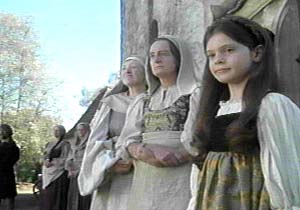
Andy Tennant�s version of the classic Cinderella story is set in Renaissance France, but is full of so many fun twists & turns, that even knowledge of the familiar story does not spoil the movie. �Cinderella� is Danielle de Barbarac, the daughter of a wealthy widower. The story begins when Danielle is 8 years old, & her father brings home the requisite wicked stepmother with her 2 daughters. Very shortly after this, her father suffers a fatal heart attack. Ten years later & true to the Cinderella story, Danielle is seen being treated as a servant by her stepmother & stepsisters. But this �Cinderella� is not passive, helpless or defeated in spite of her circumstances. Danielle is independent, intelligent & quick-thinking, ready to laugh & play as well as managing to work hard to keep up the manor home. Indeed, it is Danielle�s personality, so full of joie de vivre, that makes this Cinderella an enjoyable experience. |
|
|
|
 |
|
From meeting the prince�by pelting him with apples-- as he appropriates her father�s horse, to defying the sumptuary laws to go to the king dressed as a courtier in order to buy back an old family retainer (who was sold by the wicked stepmother), Danielle�s courage & personality are established. The prince has his own growth experiences as he rescues Leonardo da Vinci from bandits/Gypsies & gets to know Danielle, now masquerading as Comtesse Nicole de Lancret (her mother�s name.) |
|
|
|
|
|
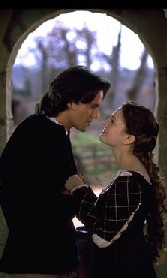
A series pf adventures/misadventures all add to the growth of the film & the characters in it. There are any number of scenes that present tension & expectation, making the story difficult to summarize succinctly but a delight to watch. Of course the course of true love does not run smoothly, especially the night of the ball. Danielle is locked in the storeroom; is rescued, dressed & sent to the ball, not by a fairy godmother, but by Leonardo da Vinci. And once at the ball, & with the prince, Danielle/Nicole is exposed by her step-mother. Again, it is the wisdom of Leonardo that persuades the prince to seek out his love & rescue her & marry her so they can live happily ever after. I liked what actress Drew Barrymore said about Danielle: �[she didn�t sit] around and wish for what she wanted, and it magically came to her. In this version, it's really her brains and the fact that she's well-read that make [Danielle] win in the end.� And of the prince: "The Prince is not a person you meet at the ball who is a complete mystery up until then and a complete mystery after... This is a real, living, breathing, interesting young man who's very heroic in his own way ." |
|
|
|
Ever After is a fairy tale. The setting is the Renaissance, in France. Historical figures are characters in the story: Leonardo da Vinci, King Francis & Prince Henry. It doesn�t pay to dig too deeper than that. For example, the written story version of the script is dated 1502-1512. A quick check of history shows that while Leonardo did go to the court of Francis I�in 1516. King Francis I was crowned king in 1515 & his son Henry was born in 1519, about a month before Leonardo da Vinci died. It was King Francis I who founded the University of France & provided academic freedom as well as free courses at Fountainbleau. And Prince Henry was actually married to Catherine de Medici. |
|
|
|
 |
|
|
 |
|
|
|
|
|
|
|
|
|
|
If you really start digging for historical anomalies, there are plenty.
� A high-born woman would never lift her skirts & run, showing off her legs;
� Would the King & Queen be sleeping in the same bed?
� On the subject of beds, in one scene, Marguerite throws herself backwards on the bed & it is obvious that �bed & board� were one & the same. The bed had no give at all. This in an era of featherbeds & rope springs. In reality, Marguerite should have sunk into the featherbed so as to be practically invisible in the bedding. Rope bed springs sagged terribly. This I know as I own one, & many nights I was rolled to the middle of the bed, like a hammock, until my father had a board cut to support the mattress!
� Then, too, how did Danielle get into the courtier�s dress without the help of a maid? The back of the dress was laced up, as seen in a later scene.
� If Rodmilla wished to appear rich, as is suggested, would they have opened their own doors at the manor house?
� At one point, Queen Marie advises her son Henry to consider his choice of wife carefully as �divorce is only done in England.� Did she forget that Eleanor of Aquitaine was divorced from King Louis of France at least 300 years earlier?
� And the undergarments Danielle wore in the scene where she scaled the heights were like nothing I�ve ever seen in any study of clothing. Her undergarment is a cross between a chemise & pantalets, with drawstrings at the ankles no less! A woman/girl would never appear in public in just her undergarments, unless she was being publicly punished.
� I also want to know when Danielle had time to learn how to wield a sword. She said that her father was an excellent swordsman & he had taught her, but he died when she was 8 & most likely too little to heft a sword. When did she have time to practice with all the other burdens placed upon her by her stepmother? |
|
|
Continue |
|
|
Index |
|
|