Choose from one of the following topics to do a short research project:
Victorian Menswear
Victorian Dress Reform
Victorian Western Wear
Victorian Children's Fashion
Do searches like "boy's dress," "girl's dress," "vintage dolls," "Christening gown", "Victorian babies," "nannies," etc to find your own links, or use the links below to get information on children's clothing in the Victorian era. Don't forget the usefulness of eBay as a source.
I found the sailor suits of particular interest because the fashion was so widespread, & so long-lived. The style began in England in the 1st quarter of the 19th century. After Queen Victoria dressed her sons (and daughters) in sailor suits in the 1840�s the style really took off. It was worn by younger boys through the 1860�s. By the 1880�s, boys up to age 12 were wearing them. At the end of the 19th century, the sailor suit was one of the most popular styles of children�s clothing, & was worn by both boys & girls.
In the United States, sailor suits were worn relatively little through the 1870s. This changed dramatically in the 1880s. The sailor suit was adopted by many schools as the physical education garb for girls at this time. They continued to be worn through the 1920�s, 30�s & even later, but by the 1940�s it was mostly the younger boys up to about age 8 or 9 who wore them. Of course the style is to be found in any search of bathing suit history & the changes in sporting wear, especially for women & girls.
There were about 6 different styles:
� Blue-stripped suit:
� Jersey suit: Knitted jersey's appeared during the 1860s and were popular at the seaside in the 1880s.. Jersey suits were often very plain without all the details on other styles.
� Middy suit:
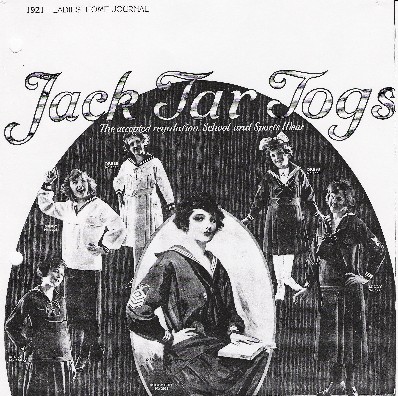
� Jack Tar suit:
� Man-of War suit: This style was particularly popular during the early 19th Century. It was more commonly worn with long trousers than many of the other styles. Usually worn with a wide-brimmed straw sailor hat.
� Reefer suit:
The sailor suit consisted of a middy blouse, long or short pants, skirts (for girls and small boys), and sailor hat.
The top had a deep square flat collar and "V"-shaped neck opening in front showing the vest or dicky.
The pants were either long or short.
Several different styles of hats could be worn, according to the style of suit chosen and the whims of the mother. Some of the most common in the 19th Century were broad brimmed sailor hats.
Sailor suits were generally blue or white, worn with matching stockings. The suits were made of serge fabric for winter & French flannel, linen or duck for summer wear.
Sailor suits were immensely popular in many countries, says the same site linked above.
The countries & their variations are described, & include Austria, Belgium, Canada, Estonia, France, Germany, Greece, Italy, the Netherlands, Poland, Russia, Switzerland, & Turkey, as well as England & the US.
The sailor suit must have been an important development in children�s clothing�it is included in the chronological timeline of boys clothing between the 1839 entry of Louis Daguerre & his development of the daguerreotype photograph & the 1846 entry of Elias Howe�s patent on a sewing machine!
Although there was a lot of information on sailor suits, it all came from only about 3 web pages, one of which was largely a copy of the Historical Boy�s Clothing site. A search of e-bay did not reveal much from the Victorian era. I also had more luck with a Yahoo search than a Goole search.
My earliest memory of seeing a sailor suit is in a vintage photograph of my father, in one of the family�s first formal pictures, not unlike the picture here.
In my continuing effort to get my students to think, I have a picture on my bulletin board that I posted to my web-site for week 10. The picture is an enrichment assignment, & comes from the book, The Way We Wore by Linda Martin (out of print). It is a reprint of an ad in a 1921 Ladies Home Journal . (My students must choose & do 6-7 enrichment paper assignments for their term grade in my class.) For this one, I ask them to figure out why the company who made the garments is called �Jack Tar Togs� Once one student figures out the answer, the picture is retired for the term & a new one takes its place.