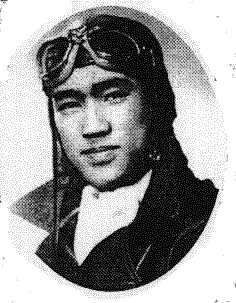
Mah was enjoying his life as a student of King Ed High School, and was a champion boxer who taught for the Provincial Recreation Centre. So he was less than impressed by his family’s sudden move to China after his father’s death in 1935. The village of Fei Gno was “out of this world.” he says. “There was no running water or electricity, nothing like that. There was hardly any modern infrastructure at all. Everybody had to haul their water from wells, and grow their own vegetables. I stayed into the next year. and then I asked my mother for the money for the boat fare. I think it was fifty bucks, or something like that. I was down in the steerage class, and I was the only kid there -everybody else was adults. It took us nearly two weeks to cross.
After finishing high school in 1938. Al Mah attended the California Flyers Aviation College in Los Angeles. his tuition paid by his brothers working at the Sunrise Grocery. In addition to training as a pilot. Mah learned one other skill that would serve him well in the years to come. ‘When I was in flying school. thi guy, Wang. a mechanical engineer he was almost a professional saxophone player. I really enjoyed the music of the time - Jan Garber and Guy Lombardo were my favourites -and I just loved the sax. So Wang taught me to play, and then when I was ready to leave he said. ‘take my sax with you’. I canied that saxophone everywhere I went.”
In 1941 Mah landed a job as a civilian pilot with No. 2 AOS (Air Observers School) Edmonton. At that time, these were run by Canadian Airways ~becoming Canadian Pacific the following year). In 1942 Mah transferred to the new No. 8 AOS Quebec City.
“Pan American phoned me in late 1942.” he says. “wanting me to go over and fly in China. I was told by the War Mobilization Board that I couldn’t leave because all staff pilots were frozen. Finally I got a letter from my sister in China, saying that they were in very desperate straits. I wrote a letter to Ottawa. and they finally let me go. Then I got into trouble with my supervisor. He said. ‘Jeez. you wrote to my boss instead to me. You should have just come through me.’ So I got the leave from the War Mobilization Board, joined Pan American Airways, and went over to China.”
In China a fighting man was known as a “tiger.” so the wartime pilots were called the “Flying Tigers” name also adopted by Chennault’s American Volunteer Group in China).
The Flying Tigers of the China National Aviation Corporation were charged with the treacherous mission of flying supplies over the ‘hump’ of the Himalayas. Japan held Burma and the entire Chinese coast, so it was the only way to supply the beleaguered Allied resistance. In C46s and DC-3s the pilots hauled silver, tin, wolframite and hog bristles out of China, and canied in gasoline, ammunition, gun powder. T.N.T.. and millions of dollars in Chinese currency printed in the United States. It was a miserable job. in high mountains, high winds. cloud, and Japanese fighters. “It was and it is the most dangerous air route in the world, Mah says. “We were really being pushed. because in addition to all of the natural hazards, the Japanese had a formidable military establishment in eastern China whose job it was to stop us.
Sometimes we’d fly around the clock. We’d be fatigued and so on, but because of our youth we were able to do it - to go without sleep. to wear an oxygen mask all the time, and sleep under mosquito nets and so on.”
His brush with the fighter at the Assam Valley airfield wasn’t Al Mah’s only encounter. Iced up so that his maximum altitude matched the 14,000 feet of the mountains, he was struggling home to the Assam Valley from Kunming. China. A clear pocket showed him that he was alongside Lijiang Mountain. 18.000 feet, and he turned into Japanese-held Burma and made for lower ground.
“I just had this feeling,” he remembers. “I made a turn and saw this big radial engine. I dove straight down into a valley and into some cloud, The Zero was still trying to catch us. I throttled right back. rpm right back, and Just sort of hovered until we came up. When we finally lost him - I guess they had to go back to Burma because they couldn’t stay up as long as we could, or something
- I saw some more planes coming toward us They turned out to be American P-51s coming out of the Assam Valley.
As a kicker to this story. when Mah returned to his airfield, friend Charlie Sundhy (who was later killed with all aboard as the pilot flying CNAC chief and CIA agent Quentin Roosevelt in 1949) wouldn’t believe the part about the Zero until some B24s came in with their tails shot up.
In all. Captain Al Mah flew 420 missions over the hump, yet perhaps his most daring exploit of the war came in February 1944. He flew by CNAC passenger plane to Guilin. then stuck out for Liuzhou. the first step on his first visit to Fei Gno since before the Japanese invasion of China.
NEXT ISSUE: When he reached his family in Fei Gno. Al Mah decided to extend his daring bid. by smuggling his 12-year-old sister back out of Japanese-held China.