.
Mah was finally granted a leave of absence from the CNAC. and turned to his friends for help. Moon Chin, who flew Jimmy Doolittle Out of China following the Tokyo Raid in 1942, and who remains a close friend of Mah’s today, helped him lay his plans. So did Freda (Wong) Chen. whose husband had been killed as a CNAC pilot, and who lived at Chin’s mansion with Chin’s family and Mah.
In February Mah flew to Guilin and ihen went on to Liuzhou by train and boat. Once there he made contact with a Chinese girl from San Fransisco named Jane. whose name he had been lzivcn before leaving India. She booked him passage to Wuzhou aboard a large junk. but insisted that he abandon his CNAC unilorm. Mah refused, thinking that the uniform might help intimidate bandits. whom he feared as much as he Japanese
On the junk Mah met an American-educated girl named Elsa who gave him the name of her uncle, a wine and rice merchant in Gongmun on the Pearl River. After a narrow escape from Chinese police collaborating with the Japanese in Wuzhou, Mah arrived by junk at Gongmun, 70 kilometres south of Guangzhou (Canton). The merchant arranged an overland journey to Fei Gno, with two guides costing $2,000 in Chinese currency per day. It was an eventful trip. They walked, once slipping Mah past a Japanese outpost inside a coffin. On the final day he was riding in a sedan chair. “By now.” he wrote in a memoir prepared in the late1970s, “though unknown to them, [the guides’ Taishanesel dialect was becoming slightly familiar to me and it was possible to grasp the gist of their conversation. As they carried me over a narrow footbridge spanning a tall canyon. they spoke of murdering me. Upon reaching the other side. I jumped out of the chair and pretended there was a gun under my jacket. Their voices subsided into a low quaver. (This may sound like banal corn, but it actually happened. It was doubtful they’d ever seen a class B western and they were scared out of their skins.) They began a steady trot and at times it was necessary to sprint in order to catch up to them.”
After an ecstatic reunion with his family in Fei Gno Mah paid the guides their arranged amount - though they tried for more - and turned over the balance of his CNAC payroll to his mother. “The economic situation is pathetic,” he wrote, “the trees
eaten bare of leaves There have been murders, a son having drowned his mother in a pool of human excrement in an outhouse. At least one tiny child has been cannibalized by its own family. Bandits prowl the village aisles and rooftops. But the populace remains industrious, effervescent. optimistic. My mother has sold nearly all the soft gold jewellery given me at birth -I’m neither angry nor disappointed. Toughs have taken away her rice but Japanese troops came and forced them to give it back. Yet they’re despised. They used to patrol the area with two or three troops and the peasants would slaughter them. Then they’d increase their numbers with no better results. Finally they stopped patrolling
.
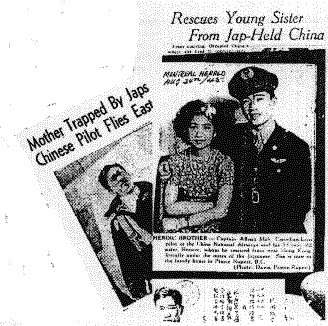
Judging that it was too risky to smuggle the entire family out of Fei Gno. Ma settled upon the idea of taking out his 12-year-old sister Bernice. It was a hazardous undertaking. Mah and his young charge made their way back out to Gongmun. sought the help of peasants. circumvented Japanese garrisons at night, and even rested in bordellos. From Gongmun to Wuzhou they went by junk. “Upriver the next day, we were strafed by one of several Zeros,’ he wrote. Both tugboat and junk promptly beached themselves in orange clay. Later’ searching among the casualties, I couldnt find my sister. The crew and passengers. chanting rhythmically, were already pushing the vessels afloat with scores of bamboo poles. When we saw a familiar configuration dashing frantically down toward us from the cave in the cliff.’
En-route from Liuzhou to Guilin an ancient train locomotive needed to be pushed by the passengers much of the way, and once in Guilin Bernice had to take shelter in a cave during an air raid. After much haggling, the pair were able to fly out to Zhongquing (Chungking) aboard a CNAC passenger plane shortly before Guilin fell to the Japanese. In Chungking Bernice camped at the Minister of Finance until he agreed to provide several thousand US dollars to send her back to America, while Mah arranged for a ‘small but regular Income’ to be sent to his mother “through circuitous channels prearranged by friends.” Friends also carried Bernice on to Calcutta
.
The sun seemed to beam with cordiality that autumn day. 1944.” Mah wrote. “At the Dover Park mansion in Calcutta. where I’d lived permanently with Moon Chin and his family, the Chins had the servants (all nine of them) plus five frisky puppies line up to bid Bernice farewell. Through the past months everyone in the household had been kind to her. They’d made silk dresses for her, sought friends her age, brought her shopping at the central market. As our command car pulled quietly past gardens of flowers, tall palms, then through the heavy iron gates, she burst into muffled sobs,”
Mah accompanied his sister from Calcutta to Bombay by train, where they were shuttled back and forth in a bureaucratic loop between the US Army and Navy before finally arranging passage on an overloaded ship heading back to the United States. “At the waterfront, to our surprise, the guards prohibited my accompanying Bernice on to the pier. I was spirited out of our taxi which shot through the gates which slammed in my face. Yipes? I’d forgotten to place a puppy tag on her as to destination. Prince Rupert. Canada. She had no passport - only a few questionable documents.” Mah cabled his friend Col. Joe Brooks in New York, who with the help of his father-in-law. New York Daily News publisher Captain Joe Patterson, searched for Mah’s lost sister. Bernice Mah. however, was not on the east coast, but was instead languishing in an immigration jail in San Pedro. California. Immigration officials eventually contacted her family, and Sister Violet travelled down to bring her home to Prince Rupert.
Mah, meanwhile, headed back for the Assam Valley in India. where he had been joined that spring by his brother Cedric