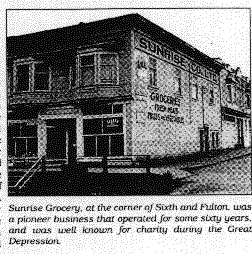
“I remember we used to be busy six days a week, everybody working, doing something. Even on Christmas and Boxing Day we would be busy. At Christmas my father would see people who were unemployed, more and more as the years went by. He’d rent a couple of Chinese restaurants. Lem and Sam Chin would cook turkeys, and all of the unemployed and destitute would have a Christmas dinner with all the trimmings.” In addition to this free. annual feast. Mah eased the burden of the Great Depression, offering credit to his customers - credit that was often unpaid and sometimes forgiven. Cedric Mah remembers that, as the Depression worsened, the Salvation Army would tell the hungry: “You go up and see that old man at the corner of Sixth and Fulton. You’ll get something to eat.’
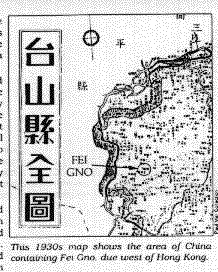
Despite his legendary generosity. Mah Bon Quens wealth, in every sense of the word as it was understood by the Chinese of imperial times, had mushroomed from his humble beginnings in Fel Gno. He had made three return visits to China, including one in 1925. He had built up the biggest business in Prince Rupert. He had eleven children - by his first wife. Gee (Edward), Earl. Lily and Alex, and by his second wife, Daisy, Violet. Albert, Cedric, Lucy, Phyllis and Bernice. He had prospered from his persistent hard work during his early years in Canada. and he constantly sought to expand on this “My father was a real close cohort to the cops and politicians in the city.” Albert Mah remembers. ‘There were always some deals going on. Once in the early years he baled this guy Murphy out of jail when he was arrested for starting a strike, and I can remember Murphy bringing cakes and things around for years after that. But my father was a real wheeler-dealer.’
The family of Mah Bon Quen were also noted for their fishing on Sundays, the one day that the grocery was closed. They went as a family to a bar on the Skeena popularly known as Sunrise Bar. Today it is still often known as China Bar, in a faded memory of the days when the Mah family made it a personal retreat.
Mah Bon Quen died in 1935. and it was said that his funeral - the procession swollen with needy people he had helped - was the largest in Prince Rupert up to that time. Then his second wife, and all of her children, were sent back to Fel Gno. taking Mah’s body to be placed with his ancestors. They arrived in August. It was the worst possible time to be entering China.
The Japanese had first turned their industrialized military strength against China in 1894, and had since then made steady advances. In 1931-’32 Japan had seized Manchuria and parts of north
China. The ruling Nationalists under Chiang Kaishek were too weak to stem the Japanese advance. Then in October 1935 the Chinese Communist Party, under the Comitern. broke out of a long siege and fled south through Guangdong province and then east, and instead of resisting the Japanese advance Chiang tried to exterminate the Communists. By October 1938 all of the eastern provinces were under the control of the Japanese, and puppet governments were established in Beijing and Nanjing. It was one of the most brutal invasions and occupations of the Second World War. typified by the horrendous Rape of Nanjing in 1938. And the family of Mah Bon Quen. trapped in Fei Gno in Guangdong province, was right in the middle of it.
NEXT ISSUE: Young Alberf Mah immediately left Fei Gno and returned to Prince Rupert As a member of the famed Flying Tigers. however he later crossed the Japanese lines in a daring hid to help his family in Fei Gno.