The Family of Mah Bon Quen - Part One
by Bruce Wishart, Editor-- Ebb n’ flow
The following is the first installment in a series detailing the history of the Prince Rupert family of Mah Bon Quen. In addition to the children and grandchildren of Mah, I would like to thank other members of the community who have helped me. including Paul Wong, Home Wong. Paul Mar. and Danny Mah. who rendered the characters for Fei Gno used in the masthead. In representing Chinese words I have been guided by the modern pinyin. except where common usage suggested otherwise. ~BW
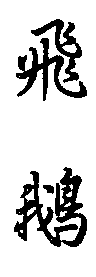
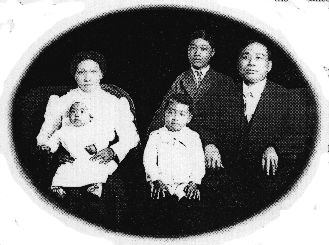
The village of Fei Gno (flying Goose) was small in the last days of the Qing Dynasty. Perhaps a few hundred people lived in houses made in the “ancient rammed earth” construction, and the Mah clan had lived there for some 500 years. The village, in the Pearl River Delta between Hong Kong and Guangzhou (Canton). in the county of Taishan in Guangdong province. lay in an area that was to be at the centre of a century of political unrest.
Mah Bon Quen was born in Fei Gno in 1871. during a turbulent century that saw increased western interference in China, which brought about the Opium Wars and the Taiping revolt. The political unrest, and the rural poverty. made him look to the West from a very young age. There was already an established tradition of seeking opportunities in North America, earning money to send back to relatives in China, and eventually, if possible. returning home.
Chinese immigration into Barkerville had begun with the Fraser River Gold Rush in 1858. and by 1860 there were already some 7,000 Chinese people in British Columbia. During the eras of gold rushes and railroad construction. large numbers of Chinese peasants poured in: and though they often worked under appalling conditions, the small wages they earned had a much higher value at home. Between 1881 and 1885 alone, more than 15.000 Chinese labourers arrived to help construct the Canadian Pacific Railway. This flood of immigration seemed alarming in the new country, and in 1885 a ‘head tax” was placed on incoming Chinese immigrants.
In 1890, at the age of 19 years, Mah Son Quen boarded a sailing ship for a passage to Canada that was of such long duration that it was necessary to grow vegetables aboard. lie went to Yahk. near Rossland. For his earliest years in Canada he remained in the Kootenay district, finding work logging and mining, clearing stumps. and working on the CPR He decided to move to the Fraser River bars. says son and family historian Cedric Mah. Everybody was working the bars there. China Bar. Boston Bar, all the way up to Lillooet. searching for gold. He started working there, and then all the people started streaming downstream Everybody threw down their shovels
and picks, heading downstream, heading for a place called the Klondike.
Mah didn’t have the money for a grubstake on the Trail of 98, so he stayed on the Fraser. Now, however, instead of just one hole to prospect, he was able to work many abandoned claims, and in this way accumulated enough money that he felt he could return to Fei Gno to make the next step in his life.
At the village he married, but while returning to Canada he was caught up in the so-called Boxer Rebellion. The Yi He Tuan (Society of Righteous Fists, or Boxers) laid siege to the foreign quarter of Beijing for 50 days before an expeditionary force sent by Japan and seven western powers arrived. The Empress-dowager fled at the same time, and the Forbidden City was occupied, which began a chain of events which led to the downfall of the last emperor of the Qing Dynasty in 1911. During this unrest foreigners flooded Out of China, which tied up all available shipping and left Mah stranded in Hong Kong. Not wanting to waste lost time, he used his Fraser River gold to hire a tutor and educate himself in bookkeeping,and mathematics. English.
In Canada my father went back up around the bars on the Fraser,” Cedric Mah says, but all the bars were worked out. He kept poking his way up the Fraser until he wound up in Barkerville. Of course Barkerville was way gone past Its heyday, and all he could do was get a job cutting wood for the big steam boilers feeding the hydraulic sluices.
‘One day two people came into Barkerville. Sam and Lem Chin. They talked to my father about how Prince Rupert was going to be a great city, how they were building the railroad there, and they asked my father to come along with them. So my father hooked up with them, and in the spring of 1909 they headed for Quesnel. They followed theCollins Overland Telegraph up to Fraser Lake. up the Bulkley River to Skeena Forts, then down to Hazelton. Just across from there in Kitwanga people were going down the river to trade furs for seafood, so they went with them and floated down there. Thats how they got to Rupert. Sam and Lem later opened Kwong Sang Hing, a Chinese restaurant on 7th Avenue that was famous there for its chow mein.
1909. but due to strong resistance to Oriental labour it was 1910 before they were allowed admittance to Prince Rupert. Once declared as a merchant in the city Mah immediately returned to China to purchase trade goods. He did not linger long in China, where revolutionary sentiments had reached a fever pitch that would a year later lead to Sun Yatsen becoming the first provisional president of the old empire. Back in Prince Rupert Mah established the King Tat import and export store on 7th Avenue West near his friends Samand Lem Chin, and on May 27. 1912 his son Earl Mah was born. Mah and his party might have reached the mouth of the Skeena in there. Earl Mah was the first Chinese child born in the young city of Prince Rupert
Local aviation history told
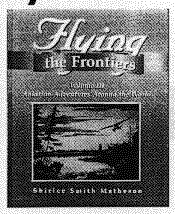
A new book published in Calgary contains much material that will be of interest to those who follow the history of aviation in Prince Rupert. Flying the Frontiers Volume III: Aviation Adventures Around the World. by Shirlee Smith Matheson. contains a collection of stones about the lives of Canadian pilots. Stories in the book range from that of astronauts Brian Ewenson and Chris Hadfleld. to Barry Davidson. whose wartime experiences inspired the movie The Great Escape. For Rupertites. however, it is the opening story in the book, detailing the flying career of Cedric Mah, which will be of most interest. was inspired to become a pilot while growing up in Prince Rupert in the early 1930s. and served as a Commonwealth Training Plan instructor before joining, the Flying Tigers in China. After the war he had numerous adventures as a bush pilot, including flying into Kemano during the construction era, and flying for North Coast Air Out of Prince Rupert.
Flying the Frontiers Volume III is available from Star of the West Books.
NEXT ISSUE; Mah Bon legendary Sunrise Grocery helped sustain the people of Prince during the Great Depression. His untimely death left members of his Prince Rupert family stranded in Fei Gno during the Japanese invasion of China.